Skip to content
 Quick Answer: Research shows that both resistance bands and free weights build equivalent muscle mass under matched mechanical tension. Free weights are superior for progressive overload and building maximum strength, whereas resistance bands provide linear variable resistance that is safer for joints and ideal for home workouts and mobility.
Bands Strength: Linear Variable Resistance (safer joint profile, constant tension, portable).
Free Weights Strength: Constant Gravity Load (easier tracking of progressive overload, superior peak load capacity).
- You travel frequently or have minimal space for heavy gym equipment.
- You are recovering from joint issues and need to reduce joint stress at the bottom of lifts.
- You want to improve target muscle isolation and explosive power (accommodating resistance).
- Your primary goal is building absolute strength or competing in powerlifting.
- You want to measure and track progressive overload down to the exact pound.
- You prefer a constant resistance profile throughout the entire range of motion.
What is a Resistance Band?
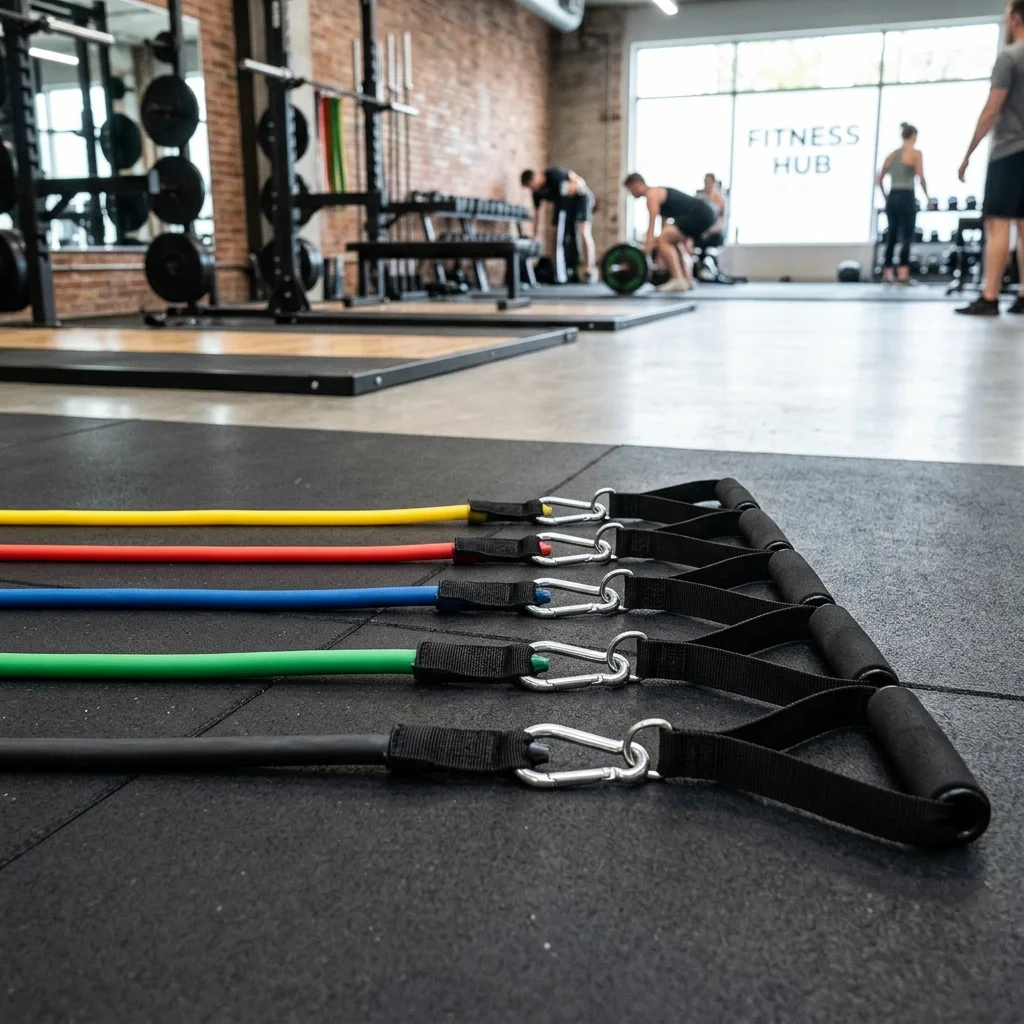
A resistance band is an elastic band made from latex rubber or fabric blends, used to apply resistive force to muscular contraction. Operating on the principle of linear variable resistance (LVR), bands exert increasing tension as they are stretched. They are available in various styles, including looped loop bands, tube bands with handles, and flat therapy bands.
Because resistance bands do not rely on gravity to generate loading, they can apply force from any direction or angle (e.g. horizontal forces for chest press or cable-style movements), making them highly versatile for isolating muscles, warming up joints, and rehabbing injuries.
The Physics: Variable Resistance vs. Constant Gravity
The fundamental difference between these two training tools lies in their resistance profiles:
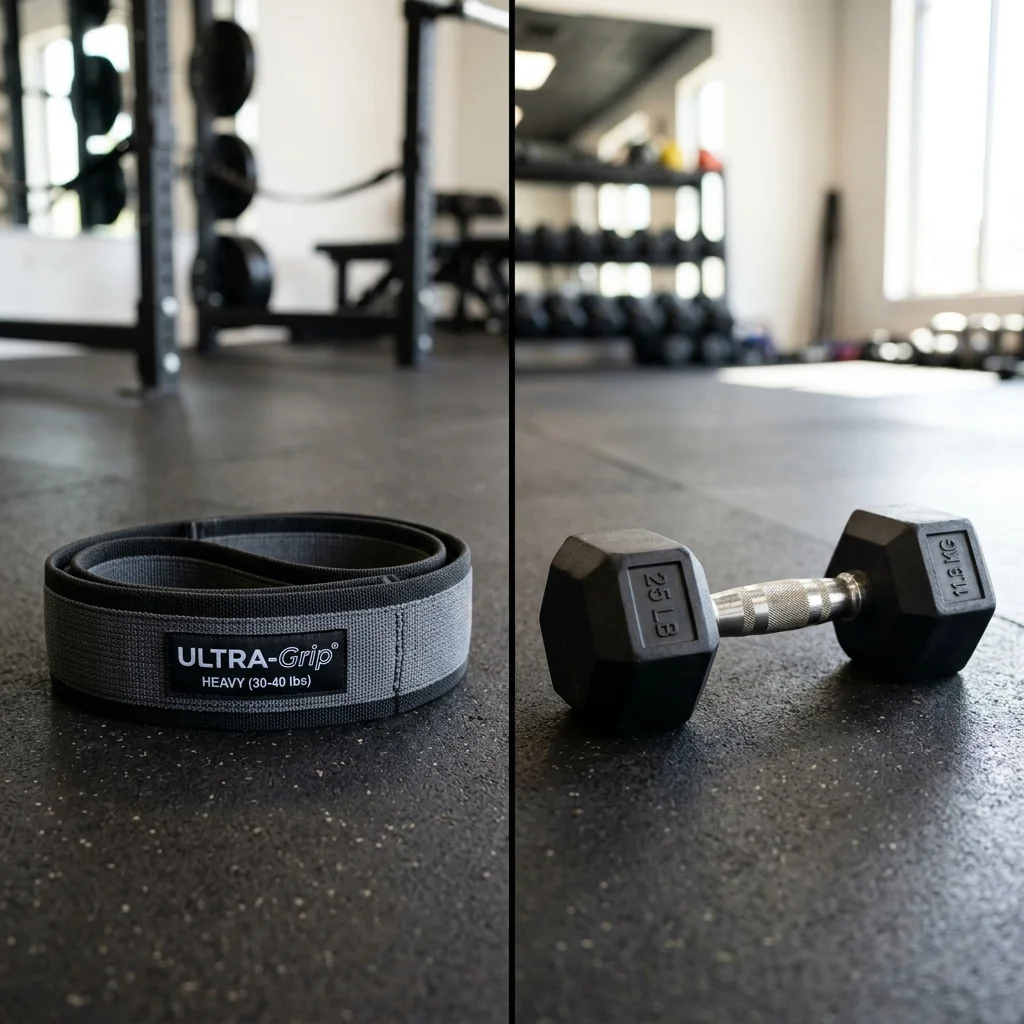
- Free Weights (Constant Gravity): A 25-pound dumbbell exerts exactly 25 pounds of downward force regardless of where it is in the range of motion. The relative difficulty shifts based on your joint angles (lever arms), leaving “sticking points” where the lift is hardest, and zones where the muscles experience zero tension.
- Resistance Bands (Linear Variable Resistance): Elastic bands generate resistance that increases as the band is stretched. The force is described by Hooke’s Law: \[F = -k \cdot x\] where \(F\) is the force exerted, \(k\) is the elasticity constant, and \(x\) is the stretch distance. As you approach the top of a lift (e.g., a chest press), the resistance increases. This aligns with your muscle’s strength curve, allowing for greater loading at your strongest position.
What is a Free Weight?
A free weight is any training implement that is not attached to a machine or cable system, including dumbbells, barbells, kettlebells, and weight plates. Free weights rely solely on gravitational acceleration (\(9.81 \text{ m/s}^2\)) acting on their mass to create mechanical resistance.
Free weights are the gold standard for traditional strength training. Because they require you to balance the load yourself, they recruit auxiliary stabilizer muscles and stimulate central nervous system adaptations, laying the foundation for compound strength movements (squats, deadlifts, presses).
The Science of Muscle Hypertrophy & Strength
Can resistance bands build the same muscle as iron weights? Yes. A meta-analysis published in the Journal of Human Kinetics compared muscle activation and growth outcomes and found no statistically significant difference in hypertrophy when training volume and mechanical tension are matched.
However, the methods of achieving progressive overload differ:
- Overloading Free Weights: Easy to quantify. If you benched 100 lbs last week and bench 105 lbs this week, you have applied progressive overload.
- Overloading Bands: Harder to track. You must stretch the band further, use a thicker band, or combine multiple bands. This variable nature can make precise training logs difficult to maintain.
Electromyography (EMG) Muscle Activation Research
Electromyography (EMG) studies measure the electrical activity generated by muscle fibers during contraction. When researchers compare EMG activation between bands and free weights, the results are surprising:
- Chest Press: Studies show that performing a chest press with resistance bands creates equivalent pectoralis major and anterior deltoid activation compared to a barbell bench press, provided the band is stretched to peak tension.
- Squat: Standard squats with bands generate similar quadriceps activation, but show slightly lower gluteus maximus and spinal erector activation compared to barbell back squats. This is because free weights require greater stabilization across the hips and spine to balance the load.
- Bicep Curls: EMG activation is highly similar. However, bands show peak activation at the top of the curl (peak contraction), whereas dumbbells show peak activation in the middle of the curl (when the forearm is parallel to the floor).
Time Under Tension (TUT) Mechanics
Time Under Tension (TUT) refers to the duration that a muscle is held under load during a set. The nature of the tension differs between these tools:
When lifting a dumbbell, there are positions in the range of motion where the load on the target muscle drops to zero (e.g., at the top of a bicep curl when the weight is resting on your joints, or at the top of a chest press when your elbows are locked out).
With resistance bands, there is constant tension. As long as the band is pre-stretched at the start of the movement, the target muscle must actively contract throughout the entire duration of the set, including the lockout. This continuous tension is highly effective for driving metabolic stress, a key pathway for muscle hypertrophy.

Joint Safety and Injury Prevention
Resistance bands are widely used in physical therapy because they match the natural leverage of your joints.
In exercises like the squat or chest press, the joints are in their most compromised, mechanically weak position at the bottom of the movement. Free weights apply maximum load in this deep stretch. Bands, conversely, exert the lowest amount of force at the bottom, increasing tension only as the joint moves into safer, stronger angles. This makes bands highly effective for people with osteoarthritis or tendonitis.
Common Mistakes to Avoid When Training With Bands
To get the most out of resistance bands, avoid these common training errors:
- Allowing Slack at the Start: If the band is loose or floppy at the bottom of a movement, you lose the first 25% of the range of motion. Always pre-stretch the band so it is under light tension at the start of the rep.
- Speeding Through the Eccentrics: Because the band pulls back naturally, it is easy to let it snap you back to the starting position. You must actively resist the band during the lowering (eccentric) phase. Control the return for a full 2 to 3 seconds to maximize hypertrophy.
- Using Poor Anchors: Anchoring a heavy band to a light table or a weak door frame is a serious safety hazard. Always use heavy-duty door anchors or wrap bands around structural gym uprights.
Direct Scientific Comparison
| Metric | Resistance Bands | Free Weights |
|---|---|---|
| hypertrophy Efficacy | Equivalent (when taken to failure) | Equivalent (when taken to failure) |
| Peak Power Output | High (accommodating resistance) | Moderate (deceleration at top of lift) |
| Joint Stress | Low (tension matches joint leverage) | High (peak load in stretched positions) |
| Portability | Excellent (under 2 lbs total weight) | Poor (bulky and heavy) |
| Progressive Overload Tracking | Complex (requires band tension metrics) | Simple (numeric increments in lbs/kg) |
Top Resistance Band Recommendation
 Amazon Image
 WHATAFIT Resistance Bands Set (11-Piece)
Verdict: An outstanding home gym solution. With 5 color-coded tube bands representing 10 to 50 lbs of resistance, cushioned handles, ankle straps, and a door anchor, this stackable system provides up to 150 lbs of variable tension.
Amazon prices, images, ratings, and availability can change. Verify before buying.
Top Free Weight Recommendation
 Amazon Image
 CAP Barbell Black Handle Hex Dumbbell (Single)
Verdict: The gold standard for home strength training. Featuring a hexagonal head design to prevent rolling and a solid cast-iron core encased in durable rubber with a premium black handle grip, these dumbbells are built to endure heavy drops.
Amazon prices, images, ratings, and availability can change. Verify before buying.
If you want the benefits of a full dumbbell set without the clutter, consider reading our detailed Bowflex SelectTech 552 review, which covers the premier adjustable dumbbell solution.
Scientific Video Demonstration
Watch this verified video breakdown explaining the mechanical differences and force profiles of bands versus traditional iron weights:
Frequently Asked Questions
Can you get ripped with just resistance bands?
Yes. Muscle growth is triggered by mechanical tension, metabolic stress, and muscle damage. Your muscles cannot tell the difference between the resistance generated by gravity pulling on an iron dumbbell and the tension created by stretching a rubber band. As long as you train close to muscle failure and apply progressive overload, you can build a highly defined, athletic physique using only bands. Incorporating quality supplementation (discussed in our creatine monohydrate vs HCL guide) can further assist results.
Do resistance bands burn fat?
Resistance bands burn calories during training and build metabolically active muscle tissue, which increases your resting metabolic rate. However, fat loss is ultimately determined by maintaining a caloric deficit. Resistance bands are a tool for preserving and building muscle while you burn fat.
How long do resistance bands last before snapping?
High-quality latex bands typically last 1 to 2 years under regular use. To prevent snapping, inspect them weekly for micro-tears, avoid wrapping them around sharp abrasive surfaces, and store them out of direct sunlight, which degrades the latex.
References & Scientific Sources
- Lopes, J. S., Machado, A. F., Micheletti, J. K., et al. (2019). Effects of training with elastic resistance versus conventional resistance on muscular strength: A systematic review and meta-analysis. Journal of Human Kinetics.
- Schoenfeld, B. J. (2010). The mechanisms of muscle hypertrophy and their application to resistance training. Journal of Strength and Conditioning Research.