Skip to content
Disclosure: FoodScan is our own free app, built by the GearUpToFit team. Some “better choice” cards inside it link to Amazon search results — those are affiliate links, labelled as affiliate links in the app, and we may earn a commission from qualifying purchases. This post has no paid placements.
See why.
Choose better.
B
C
D
E
⚡ The 10-second version
🔍 Five answers
🎯 Guess the grade
🔄 Better choices
❓ FAQ
First, a story about an orange juice.
Somewhere in the food database the whole world shares, a bottle of orange juice carries a grade E — the worst there is. The reason? Its record claims the juice contains 7.9 grams of salt per 100 ml. That’s not juice — that’s more than twice as salty as seawater, with pulp. It’s a typing slip, one wrong digit in a community database. Most apps would simply repeat the E and move on. FoodScan stops. It puts the grade on hold, tells you exactly why, and links to the record so it can be fixed. That little refusal is the whole idea behind this app: a grade you can’t question isn’t worth much.
⚡ The 10-second version
Point your phone at any food barcode. You get the product’s official Nutri-Score grade, why it earned that grade, a better choice from the same aisle, an allergen cross-check against the actual ingredient text, and a data guard that refuses to repeat a grade built on a contradictory record. And whatever any app tells you — always read the pack.
One scan. Five answers.
Here’s the deal: you shouldn’t need a nutrition degree to buy breakfast. One scan, one screen, five things worth knowing:
🏅
1 · The official grade
Nutri-Score A to E, calculated by Open Food Facts with the 2023 method. FoodScan doesn’t invent a score of its own — not now, not ever.
🔍
2 · The reasons, point by point
Which nutrients pulled the grade down, which held it up — with the actual grams. And if the points don’t add up to the published score, you don’t see a breakdown that doesn’t add up.
🔄
3 · A better choice, same aisle
Not a lecture — a swap. A strictly higher grade with the difference named: “−10.6 g sugars per 100 ml”. Products sold in your country come first.
⚠️
4 · An allergen cross-check
Allergen lists in databases are wrong more often than you’d think. FoodScan also reads the ingredient text itself, and flags what the list forgot.
🛡️
5 · A guard against bad data
Records contradict themselves. When one does, the grade goes on hold — like the orange juice above — instead of being repeated to you as fact.
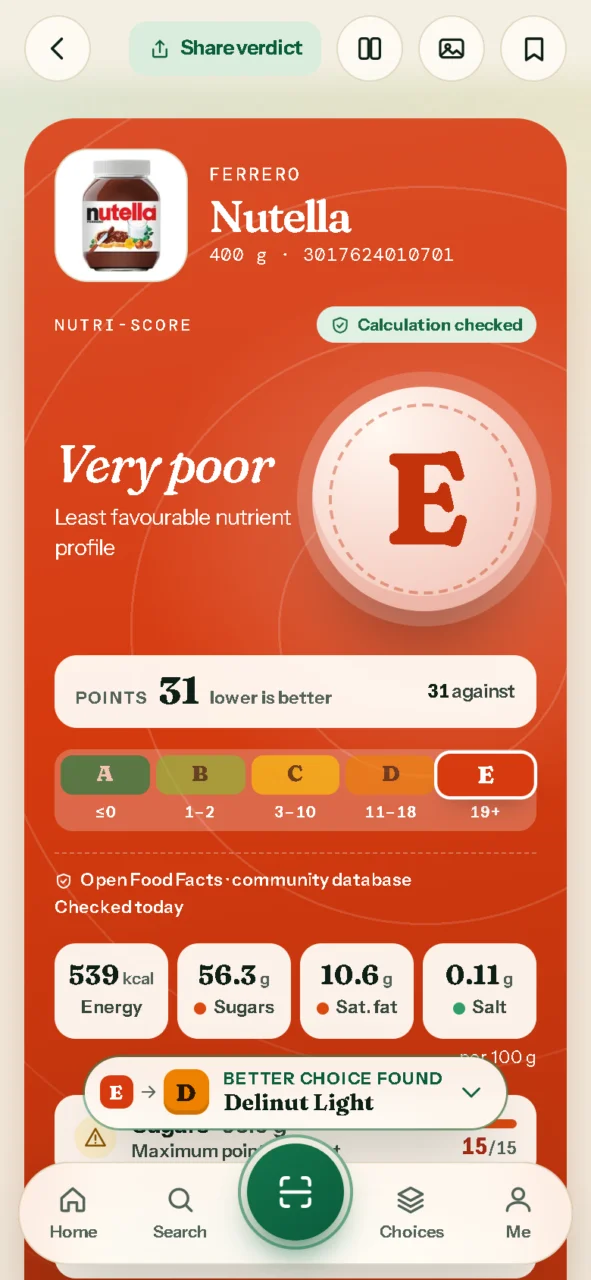
Yes, that’s a real scan. Nutella: grade E, 31 points against, sugars maxed out at 15/15. (We wrote a whole article about this jar — it earned it.) Open this product in FoodScan →
📖 What the letters actually mean
Nutri-Score adds points against a food (energy, sugars, saturated fat, salt) and points in its favour (fibre, protein, fruit, vegetables, legumes). Fewer points, better letter. For most solid foods:
Drinks are scored on a stricter scale of their own — that’s why Coca-Cola’s 12 points land on E. FoodScan always shows the points next to the letter, so nothing hides behind a colour.
🎯 Think you’d do better than a label? Guess the grade.
Three real products from the database. Call the grade in your head, then tap to check yourself. No prizes — just the mild shock everyone gets from the third one.
🥤
Coca-Cola Original
330 ml can. You know it’s sugary — but how bad, officially?
Reveal the grade
E
12 points — 10.6 g of sugar in every 100 ml, roughly 9 cubes in the can. The zero-sugar version jumps to a C or B. See the full scan →
🧀
A French soft cheese (Caprice des Dieux)
Soft, creamy, French. A treat — but a disaster? Or middle of the road?
Reveal the grade
D
14 points. The saturated fat (21 g per 100 g) maxes out its points — but the protein pulls some back. Not the villain, not the hero. See the full scan →
🫘
Baked beans in tomato sauce
Tinned, processed, in a sweet sauce. Surely this one’s a D at best… right?
Reveal the grade
A
Minus 3 points — the beans themselves (fibre, protein, legumes) overwhelm the sauce. And here’s the twist FoodScan shows honestly: it’s still NOVA 4, ultra-processed. A good grade and heavy processing can both be true. See the full scan →
And two more catches worth knowing
The juice was about bad data. These two are about incomplete data — which is quieter, and matters more.
01
The milk that wasn’t on the allergen list
In Nutella’s community record, the allergen list only says tree nuts. The ingredients say skimmed milk powder. FoodScan flags the milk and tells you to confirm on the jar. (The real jar highlights milk — the point is that the data every app relies on can be incomplete, and this one checks.)
02
The gluten hidden in Greek text
A Greek spaghetti had no allergens listed at all — but its Greek ingredient list names durum wheat semolina. That’s gluten — and FoodScan reads ingredient lists in seven languages, Greek included, so it flags what the allergen list missed.

Melissa spaghetti (barcode 5201193100019): grade A, 0 points — and a gluten catch in the fine print.
Better choices you can actually buy
“Eat better” is useless advice. “This one, not that one — here’s the difference in grams” is not. A better choice in FoodScan has to pass four tests: same kind of food, a strictly higher grade, a named improvement, and no clash with your allergies or diet. Products in your country come first. When we scanned these on 22 October 2026 as a shopper in the US:
On a phone? Swipe this table sideways →
| You scanned | Grade | FoodScan suggested | The difference |
|---|---|---|---|
| Coca-Cola Original | E | Zero-sugar colas C to B | −10.6 g sugar per 100 ml |
| FAGE Total 5% Greek yogurt | B | FAGE Total 2% A | −2.1 g saturated fat per 100 g |
| Nutella | E | Lower-sugar hazelnut spreads D | Up to −48 g sugar per 100 g |
Suggestions come from a sample of popular products in the same category, so they change with what’s in the database and where you shop. FoodScan re-checks each suggestion by its barcode before marking it “Checked just now”.

FAGE Total 5%: grade B — a single point. So close.

The better choice: the 2% version, grade A. (The Amazon button on cards like this is an affiliate link — labelled in the app, and disclosed at the top of this post.)
The wall of real scans
No mock-ups, no stock photos of phones. Every screen below came out of the app, from a real barcode. This is what you’ll actually see:

Coca-Cola: E, 12 points — all sugar.

The swap: zero-sugar colas, C and B.

The famous juice: grade on hold.

Why it’s on hold — in plain words.

Nutella’s swap: −48 g sugar per 100 g.

Already an A? It shows its peers, honestly.
More than a scanner
The scan is the hook. These are the parts that make it stick:
🗂️ Choice workspace
Save what you’re torn between, find better choices for the whole list, swap with one tap, compare up to four side by side.
🍽️ What you actually eat
Nobody eats “100 g”. Pick your real portion and see the sugar, saturated fat and salt in it, against EU daily reference intakes. Log it in one tap.
✅ Your rules
Tell it once what you avoid — allergens, or animal products entirely. Every scan is checked, and swaps that break your rules are hidden.
📴 Works offline in the shop
Supermarket signal is a myth. Foods you’ve seen before open without a connection, and it pins to your home screen like a real app.
🌍 English and Greek
The whole interface in English and Greek, one tap apart — and ingredient lists read in seven languages.
How to start (30 seconds)
1
Open food-scan.gearuptofit.com on your phone. That’s it — no store, no install.
2
Tap Scan and allow the camera. No barcode handy? Type the digits, or photograph one.
3
Read the grade and the reasons, then scroll to Better choice.
4
Optional: in Me, set the allergens you avoid and your diet, once.
5
Optional: pin it to your home screen — iPhone: Share → Add to Home Screen; Android: tap Install when offered.
Where the data comes from — and its limits
FoodScan reads Open Food Facts, a free, open database built by volunteers around the world. It covers millions of products, but it isn’t lab-tested, and some records are incomplete or out of date — you met one at the top of this page. That’s why FoodScan checks each record, labels what it calculated, and reminds you to always read the pack. If a product isn’t in the database, FoodScan shows you how to add it in about two minutes, and every shopper after you benefits.
FoodScan is a guide for comparing similar foods. It isn’t medical or dietary advice, and its allergen checks aren’t allergy clearance.
Questions, answered
Is FoodScan really free?
Yes. No subscription, no account, no ads. Some better-choice cards include a link to search for the product on Amazon, which is an affiliate link and is labelled as one.
Is the grade FoodScan’s own score?
No. It’s the Nutri-Score as published by Open Food Facts. When the source has no grade but the label has enough values, FoodScan can calculate one with the same method. It’s clearly marked “calculated”, with every assumption written out.
Do I need to install anything?
No. It runs in your phone’s browser. Adding it to your home screen is optional and makes it open like an app.
Does it work in my country?
Yes. Open Food Facts covers products worldwide, and FoodScan shows better choices sold in your country first.
What if my product isn’t found?
FoodScan says so plainly, links you to add it to Open Food Facts, and lets you calculate a grade from four numbers on the pack. That calculated grade isn’t saved or passed off as database data.
with your eyes open.
Product data © Open Food Facts contributors, under the Open Database Licence. Product photos in the screenshots come from Open Food Facts (CC BY-SA).