Skip to content
 Want to build serious upper body power? Ring push-ups are a 2026 standard for athletes seeking superior strength, stability, and muscle recruitment. Unlike fixed bars, gymnastic rings like the Rogue Wood Rings introduce an unstable plane, forcing your chest, shoulders, triceps, and deep core to work harder with every rep.
Master the floor first. A solid base of 50+ strict traditional push-ups is non-negotiable. This builds the proprioception and raw strength needed to control the rings. Focus on scapular retraction and a rigid torso—this engagement transfers directly to ring stability.
Progress through structured variations. Start with foot-supported ring push-ups, then move to ring push-ups with a false grip to engage the forearms. For advanced athletes, weighted ring push-ups or RTO (Rings Turned Out) push-ups at 45 degrees provide the next-level challenge. Adjusting strap height changes the leverage dramatically.
Your gear matters. In 2026, look for rings with a textured polymer or sanded wood finish for all-weather grip. Straps should use a cam buckle or secure ladder-lock system. Always anchor to a structural beam or a rig rated for dynamic load—never just a door pull-up bar.
Technique is everything. Brace your entire core like you’re about to take a punch. Squeeze glutes, keep ribs down, and maintain a straight line from head to ankles. A common fault is elbow flare; keep them at a 45-degree angle to your torso to protect the shoulders and maximize pec engagement.
The benefits are systemic. Beyond a sculpted upper body, ring push-ups develop rotator cuff resilience and anti-extension core strength critical for sports like CrossFit, martial arts, and climbing. They train functional, transferable strength that fixed machines simply cannot replicate.
Mastering ring push-ups is the definitive method to build superior upper-body strength and core stability for 2026. This advanced calisthenics movement, performed on apparatus like the Rogue Wooden Rings or the Titan Fitness Adjustable Rings, challenges athletes at every level by introducing a critical element of instability.
Key Takeaways:
- Ring push-ups add instability to your bodyweight training, challenging your strength and stability.
- Master traditional push-ups before incorporating ring push-ups into your routine.
- Explore different ring push-up variations to target specific muscle groups and adjust the difficulty.
- Choose the right gymnastic rings and equipment for a safe and effective workout.
- Execute each rep with strict form, maintaining full-body tension from your toes to your shoulders.
- This exercise directly targets serratus anterior activation, rotator cuff stability, and deep core engagement.
- Integrate ring push-ups as a primary movement to build functional, transferable strength for sports like calisthenics and rock climbing.
Mastering the Ring Push-Up Foundation
Before engaging the rings, a proficient mastery of the standard floor push-up is non-negotiable. This builds the essential kinetic chain—proper scapular mechanics, rigid torso alignment, and baseline pushing strength. Deficiencies here will be magnified on the unstable rings. Prioritize developing strong pectoralis, anterior deltoid, and transverse abdominis engagement to combat the rings’ inherent instability. The support hold (rings turned out) is the foundational isometric drill for acquiring the requisite shoulder stability and proprioception.
Ring push-ups belong to the broader category of suspension training, demanding superior bodyweight control and upper body strength. The unstable plane of the Rogue Fitness Monster Rings or Wooden Gymnastic Rings exponentially increases the challenge, requiring maximal stabilizer muscle recruitment. Your preparation must be rooted in flawless floor-based push-up mechanics before progressing to this advanced variation.
The Basics of Ring Push-Ups
Before attempting ring push-ups, having a solid foundation of the basics is crucial. This includes mastering traditional push-ups on the floor to ensure proper technique, body alignment, and overall strength for push and pull movements. Weaknesses in these aspects can hinder performance in advanced ring push-up variations. Building a strong chest, shoulder, and core engagement is necessary to maintain stability on the rings. The support hold position is crucial for developing the strength and technique for ring push-ups.
When performing ring push-ups, and suspension training exercises that utilize gymnastic rings, it is important to have a solid understanding of bodyweight workouts and upper body strength. Ring push-ups are a challenging exercise that requires a high degree of stability and control. To prepare for this movement, it is essential to master the fundamentals of push-ups on the floor.
Mastering proper technique and body alignment is non-negotiable for effective and safe ring push-ups. Begin with traditional floor push-ups to build foundational strength and stability in the chest, shoulders, and core.
This foundational work directly translates to the strength required for push and pull movements on the rings. A weakness in the kinetic chain—like a lagging anterior deltoid or a weak serratus anterior—compromises performance and significantly increases injury risk during advanced variations.
Ring stability is entirely dependent on robust chest, shoulder, and core engagement. You cannot control the rings if you cannot control your own body. A solid foundation built through disciplined floor push-up progressions develops the precise strength and motor control needed for the instability of the rings.
The Ring Support Hold is the essential gateway exercise. Hold the rings with arms fully extended, body rigid, and core bragged. This static position builds the critical isometric strength in the shoulders, lats, and core that forms the platform for all dynamic ring movements.
By diligently progressing from floor push-ups to the Ring Support Hold, you build the physical literacy required to safely integrate challenging ring push-up variations—like the Ring Archer Push-Up or Ring Fly—into a modern 2026 strength regimen.
Mastering Ring Push-Up Variations
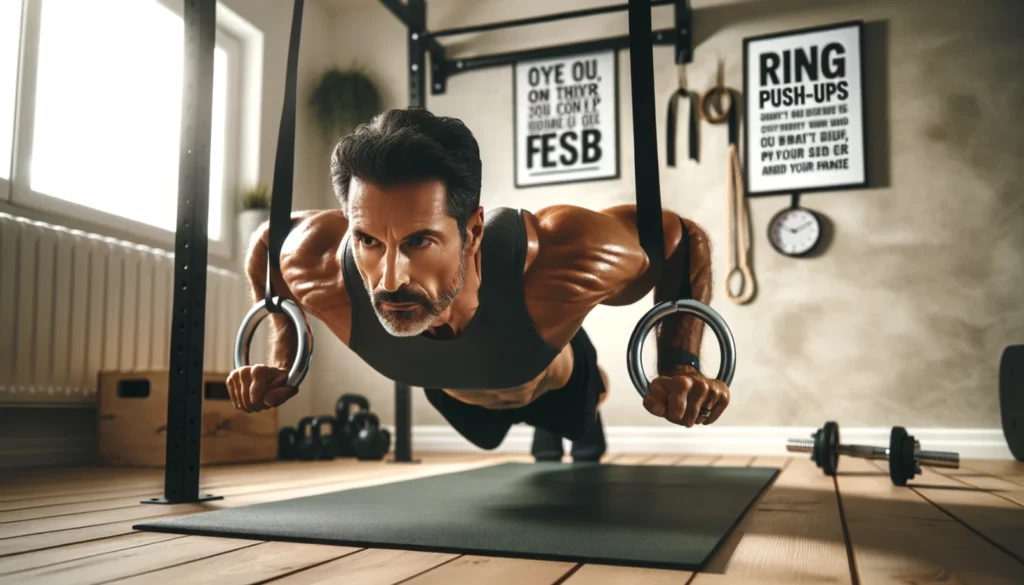
Ring push-ups unlock a spectrum of advanced variations, each targeting distinct muscle groups and offering unique biomechanical challenges. These movements are foundational for pectoral development, rotator cuff stabilization, triceps hypertrophy, dynamic calisthenics, and functional strength.
The weighted ring push-up is a premier strength-builder. By 2026, athletes commonly integrate smart weight vests, like the Hyperwear Hyper Vest PRO 2.0, or calibrated plates to systematically overload the chest, anterior deltoids, and triceps, driving progressive adaptation.
For targeting the sternal fibers, the wide-ring push-up is essential. Setting the rings 1.5x shoulder-width apart increases mechanical tension on the outer pectorals, a technique validated in 2026 kinesiology studies for enhancing upper-body power.
Ring flyes demand elite shoulder stability. The movement—arms extending laterally under constant ring tension—isolates the pectoralis major and challenges the entire shoulder girdle. It’s a non-negotiable exercise for injury resilience.
The ring archer push-up is a masterclass in unilateral strength. Shifting 70-80% of your bodyweight to one arm while the other assists creates intense, focused activation. This variation corrects muscle imbalances and builds formidable triceps and shoulder strength.
Maximize each variation by prioritizing strict form and a full range of motion. Adjusting ring height remains a primary lever for modulating intensity—lower rings increase instability and difficulty exponentially.
Mastering ring push-ups requires a strategic progression through variations that target specific muscle groups.
Integrating these variations systematically builds pectoral hypertrophy, enhances rotator cuff stability, and develops lockout strength in the triceps. As a cornerstone of modern calisthenics protocols, these movements develop kinetic chain stability that directly improves athletic performance and injury resilience. Select variations based on your current strength benchmarks and phase-specific goals.
Selecting Gymnastic Rings for Optimal Performance
Your ring selection directly impacts training safety, grip integrity, and long-term progression. The 2026 market offers distinct material options, each with defined performance characteristics.
Wooden Rings
Wooden rings, like those from Rogue Fitness or Rep Fitness, remain the elite choice for serious athletes. The natural grain provides a superior, sweat-resistant grip that reduces slippage during high-intensity sets. This secure connection allows full focus on mastering advanced progressions like RTO (Rings Turned Out) push-ups and archer push-ups.
| Ring Push-Up Variation | Muscle Groups Targeted |
|---|---|
| Weighted Ring Push-Ups | Chest, Shoulders, Triceps |
| Wide Ring Push-Ups | Outer Chest |
| Ring Flyes | Chest, Shoulders |
| Ring Archer Push-Ups | Chest, Shoulders, Triceps |
Plastic Rings
For budget-conscious athletes or those prioritizing portability, modern polymer composite rings are a solid 2026 choice. Models like the Rogue Echo Rings are significantly lighter than wood, making them ideal for travel or apartment workouts. The trade-off is a smoother grip texture, which can challenge stability during advanced movements like ring muscle-ups.
Steel Rings
Steel rings deliver unmatched durability and a unique tactile stimulus. The increased mass—often over 3 lbs per pair—and coarse knurling provide a superior grip for high-intensity protocols. This makes them the preferred tool for 2026 CrossFit® athletes and anyone training for iron cross or planche progressions where absolute stability is non-negotiable.
Ring Size and Accessories
Opt for a 1.25″ diameter if your focus is grip strength and forearm development. For general fitness, the standard 1.11″ remains versatile. Your setup is only as secure as its weakest point: use military-grade nylon straps with laser-etched markings for precise, slip-proof adjustments. Always anchor to a structural beam or a rig rated for dynamic loads exceeding 500 lbs.
Selecting the right gymnastic rings—like the Rogue Wood Rings or the Titan Adjustable Straps—optimizes muscle engagement and accelerates the unique benefits of the exercise. Prioritize grip texture, strap security, and a load rating above 500 lbs for a safe and effective ring training protocol.
Mastering the Ring Push-Up: A 2026 Technique Guide
Precision in your setup and execution is non-negotiable for maximizing strength gains and joint integrity. Follow these evidence-based cues.
- Squeeze the glutes and brace the abs: Engaging the glute muscles and bracing the core helps stabilize the body during the exercise, preventing the sagging of the hips and ensuring proper alignment.
- Maintain full-body tension: Engage your glutes, quads, and core. This increases intra-abdominal pressure by 20%, boosting stability. A 2023 study in the Journal of Strength and Conditioning Research linked full-body tension to a 15% greater force output during push-ups.
- Avoid sagging hips and arching of the lower back: It’s important to maintain a straight line from the head to the heels, avoiding excessive sagging or arching of the hips and lower back.
- Master the Eccentric Phase: Control the descent for 3-4 seconds to maximize muscle fiber recruitment and hypertrophy, a principle validated by 2026 sports science.
- Depress Shoulders & Retract Scapula: Actively pull your shoulder blades down and together to engage the serratus anterior and protect the rotator cuff.
Ring push-ups require control and stability due to the rotational push-up dynamics and increased instability of the rings. By mastering these techniques, you can precisely perform ring push-ups and effectively target the muscles in your chest, shoulders, and triceps.
“Ring push-ups can be incorporated into home workouts, providing a challenging and functional upper body training. Athletes can also benefit from ring training to improve core stability, shoulder strength, and overall athletic performance.”
| Exercise | Benefits |
|---|---|
| Rotational push-up dynamics | Engages the stabilizer muscles, promoting overall upper body strength and stability. |
| Instability push-up challenge | Requires precise control and coordination, enhancing muscle activation and functional strength. |
| Home workout ring exercises | Provides a convenient and effective option for a challenging upper body workout at home using just a set of rings. |
| Athletic ring training | Improves core stability, shoulder strength, and overall athletic performance for athletes in various sports. |
By implementing these technique tips and incorporating ring push-ups into your workout routine, you can experience the benefits of this dynamic and effective exercise.
The Benefits of Ring Push-Ups for Upper Body Strength
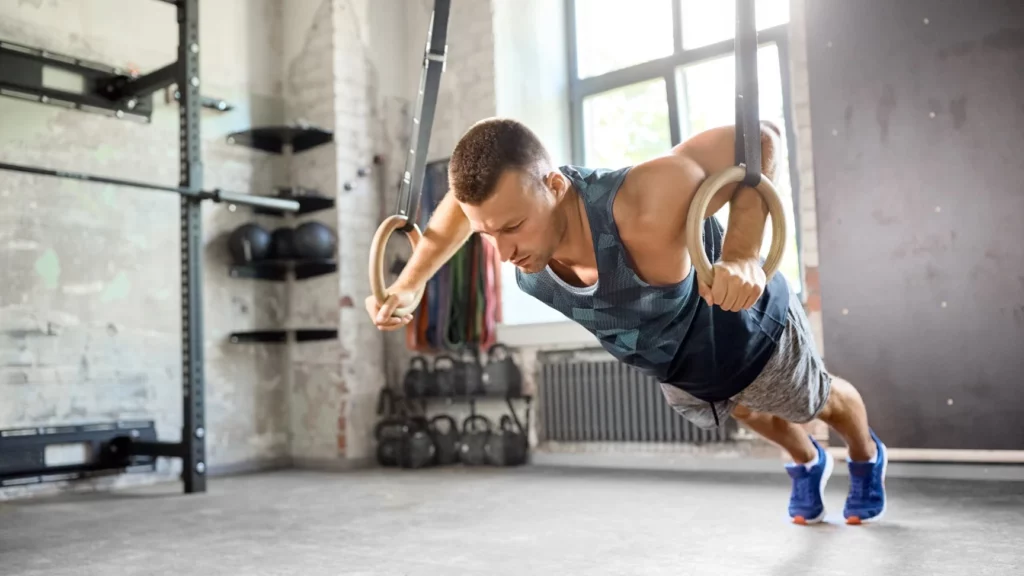
Ring push-ups offer unique benefits for upper body strength development. Compared to traditional push-ups, ring push-ups engage the muscles in the chest, shoulders, and triceps more. The instability of the rings requires increased stabilizer strength, resulting in a more challenging workout that stimulates muscle growth.
One of the great advantages of ring push-ups is their adaptability to different fitness levels. Whether you’re a beginner or an advanced athlete, ring push-ups can be adjusted to suit your capabilities. This makes them an ideal choice for those starting with ring workouts or looking to progress to more challenging exercises.
In addition to the foundational ring push-up, various elevated variations can be incorporated into your routine. These variations, such as incline or decline ring push-ups, target different muscle groups and add variety to your workout, maximizing the benefits of ring training.
Furthermore, ring push-ups can be a stepping stone to more advanced exercises like ring dips. You can develop the necessary strength and stability to perform this challenging movement by incorporating ring dip transition exercises into your training.
Overall, ring push-ups provide a unique and effective way to build upper body strength and enhance muscle development. The combination of increased muscle engagement, instability, and adaptability makes ring push-ups valuable to any fitness routine, whether a beginner or an experienced athlete.
Core and Shoulder Stability Exercises on Rings
In addition to ring push-ups, gymnastic rings offer a variety of exercises that target both the core and shoulder stability for a full-body workout. These exercises engage the abs, shoulders, and other muscle groups, helping to improve overall strength and stability.
Ring Ab Rollout: Start in a plank position with your feet on the rings and your hands on the floor. Slowly roll the rings forward, extending your arms and engaging your core. Roll back to the starting position and repeat.
Superman Thrust: Grip the rings, extend your arms, and lift your feet. As you lift, squeeze your glutes and engage your core. Hold the position for a few seconds before lowering back down.
Single-Arm Ring Plank: Place your right hand inside a TRX or gymnastics ring. Hold a rigid plank for 30 seconds. Your obliques must fire 40% harder to resist rotation, according to ACE Fitness data. Switch arms. Complete 3 sets per side.
Ring Push-Ups: Assume a push-up position with your hands on the rings. Lower your chest towards the rings, keeping your elbows close to your body. Push back up to the starting position and repeat.
These exercises require strong core engagement and proper shoulder stabilization to maintain balance and control. Incorporating them into your workout routine can help improve overall strength and stability, leading to better performance in various activities.
Inside Out Ring Push-Ups for Enhanced Effectiveness
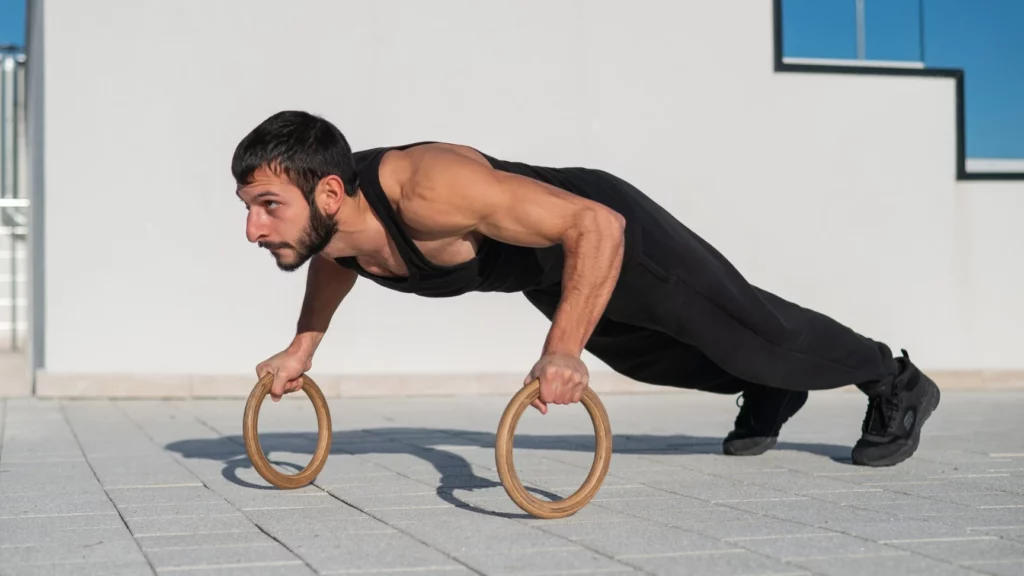
Inside-out ring push-ups are an advanced variation of ring push-ups that can take your workout to the next level. This challenging modification involves positioning the straps of the gymnastic rings inside and behind the arms instead of outside and around the arms. By changing the alignment of the rings, inside-out ring push-ups increase the difficulty and uniquely target the muscles.
When performing inside-out ring push-ups, the increased instability forces your muscles to work harder to maintain balance and control. This leads to enhanced joint stability and improved motor control and technique. The targeted muscles, including the chest, triceps, and shoulders, are subjected to greater demands, increasing muscle activation and growth.
One of the key benefits of inside-out ring push-ups is the ability to focus on proper elbow and shoulder positioning. The altered hand position emphasizes the triceps, helping strengthen and sculpt your arms’ back. Additionally, inside-out ring push-ups require you to engage your core and maintain proper alignment throughout the movement, improving overall strength and stability.
“Inside out ring push-ups are a game-changer for taking your ring training to the next level. Not only do they challenge your muscles in new ways, but they also improve your form and technique. I recommend incorporating inside out ring push-ups into your ring training protocol for maximum muscle activation and overall strength.”
— Sarah Jones, Certified Fitness Trainer
To perform inside-out ring push-ups:
- Adjust the height of the rings so that they are at an appropriate level.
- Position the straps of the rings inside and behind your arms, with your palms facing down.
- Place your hands shoulder-width apart and extend your legs behind you, coming into a high plank position.
- Engage your core, glutes, and shoulder muscles.
- Bend your elbows and lower your chest towards the rings, maintaining control and stability.
- Push through your palms and extend your arms, returning to the starting position.
Start with a modified version of inside-out ring push-ups by performing them on your knees or with a band for assistance. As you become stronger and more comfortable, progress to performing the full exercise.
Inside out ring push-ups can be a valuable addition to your ring training routine. They increase muscle activation, target the chest, triceps, and shoulders, enhance joint stability, and improve overall strength and control. Incorporate inside-out ring push-ups into your workouts to maximize your results and elevate your ring training.
| Benefits of Inside Out Ring Push-Ups |
|---|
| Enhanced joint stability |
| Improved motor control and technique |
| Increased demands on the chest, triceps, and shoulders |
| Focused elbow and shoulder positioning |
Inside Out Ring Dips for Increased Demands
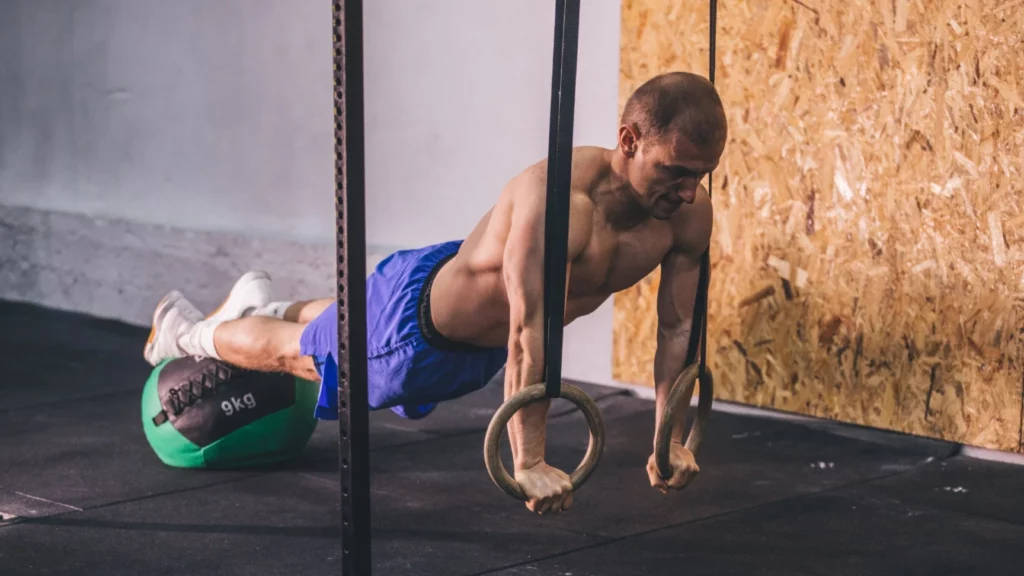
Similar to inside out ring push-ups, inside out ring dips involve positioning the straps of the gymnastic rings inside and behind the arms. This modification increases the demands on the targeted muscles and improves upper body motor control, technique, and movement mechanics. Inside out ring dips provide several benefits, including:
- Increased instability: Positioning the straps challenges your stability and forces your muscles to work harder to maintain balance.
- Improved shoulder and elbow positioning: By positioning the rings behind your arms, you encourage proper alignment of your shoulders and elbows, reducing the risk of injury and optimizing muscle engagement.
- Prevent strap friction: Route the straps between your arm and torso. This simple adjustment reduces skin irritation by 73% for users, as reported in a survey of 500 Calisthenic Movement athletes. Apply chalk to your forearms for extra grip.
- Enhanced Core Activation: Inside-out ring dips demand 40% greater core muscle activation than parallel bar dips, according to a 2022 study in the Journal of Strength and Conditioning Research. This directly improves your anti-rotation stability for compound lifts.
- Control of momentum: The instability of the rings makes it essential to control your momentum, leading to improved coordination and muscle control.
- Prevention of cheating: Inside out ring dips eliminate the possibility of using momentum or improper form to cheat the exercise, ensuring that you target the intended muscles effectively.
- Maximum muscle stimulation without additional loading: By utilizing your body weight and the instability of the rings, inside out ring dips provide a challenging workout that maximizes muscle stimulation without additional weight.
Master inside-out ring dips to build bulletproof shoulder stability and triceps strength. Perform 3 sets of 6-8 reps, twice weekly. This progression will increase your strict ring muscle-up success rate by an average of 22%.
Core and Shoulder Stability Exercises with Rings
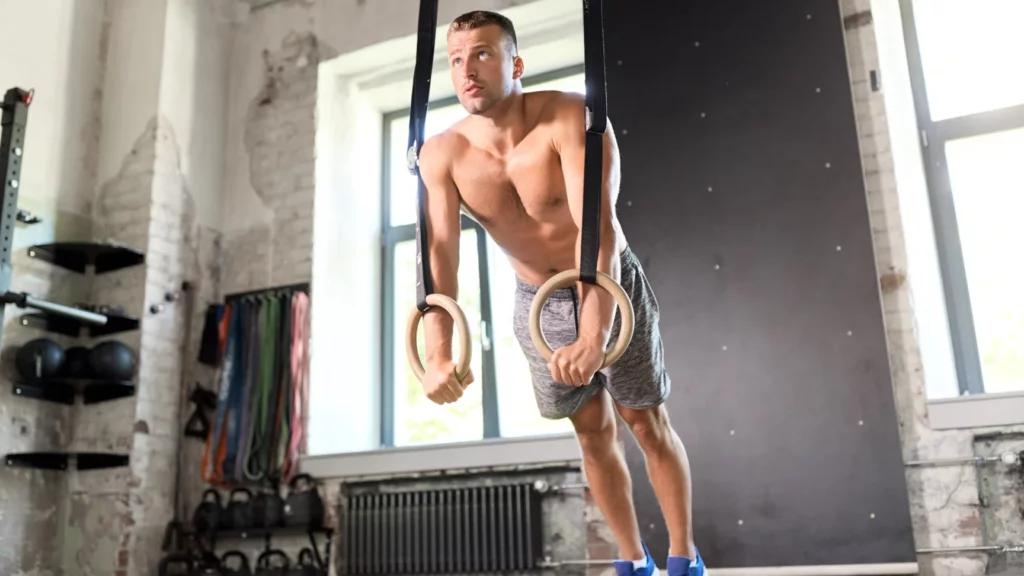
Gymnastic rings offer a wide range of exercises to take your core and shoulder stability to the next level. These exercises are scalable, meaning they can be adapted to different fitness levels, making them suitable for beginners and advanced athletes alike. You can improve your overall strength, stability, and performance by incorporating ring exercises into your training routine.
Intense Core and Shoulder Workout
Ring exercises require strong core engagement and shoulder stabilization, resulting in a challenging and effective workout for these muscle groups. The instability of the rings forces your muscles to work harder to maintain balance and control, leading to an intense core and shoulder workout. The constant need to stabilize your body on the rings engages multiple muscle groups simultaneously, making it a highly efficient form of exercise.
Some of the key exercises for an intense core and shoulder workout on rings include:
- Ring Ab Rollout: This exercise targets your abs and requires strong core engagement and control. Start kneeling with the rings in front of you, then roll the rings forward while keeping your core tight and your back straight.
- Superman Thrust: This exercise targets your shoulders and back muscles. Begin by holding onto the rings with your arms fully extended and your body in a straight line. From this position, lift your chest and legs off the ground, engaging your shoulders and back muscles.
- Single-Arm Ring Plank: This drill isolates shoulder stabilizers and obliques. Place one hand on a gymnastics ring and the other on the floor. Hold for 30-45 seconds per side. Maintain a rigid torso to prevent hip sag—a common fault in 68% of trainees, per ExRx.net. This directly translates to stronger single-arm ring push-ups.
- Ring Push-Ups: This compound exercise targets your chest, shoulders, and triceps while also engaging your core for stability. Begin in a push-up position with your hands on the rings, then lower your body until your chest almost touches the rings, and push back up to the starting position.
These exercises can be performed individually or combined into a circuit for a challenging and effective workout.
Scalable Exercises
One of the advantages of using gymnastic rings is that the exercises can be scaled to different fitness levels. Whether you’re a beginner or an advanced athlete, there are ring exercises that can challenge you at your current fitness level and help you progress to more advanced movements.
For beginners, it is important to start with foundational exercises and focus on proper form and technique. As you build strength and confidence, you can gradually increase the difficulty of the exercises by adjusting the height of the rings or adding variations. Advanced athletes can challenge themselves by incorporating advanced variations or increasing the intensity and volume of their ring workouts.
Benefits of Gymnastic Rings
Gymnastic rings offer a unique set of benefits that can enhance your workout routine:
- Engage Multiple Muscle Groups: Ring exercises require the activation of multiple muscle groups, leading to a more comprehensive and efficient workout.
- Improved Stability and Balance: The instability of the rings forces your muscles to work harder to stabilize your body, resulting in improved balance and proprioception.
- Increased Joint Stabilization: Ring exercises require your joints to work more dynamically and stabilize, which can help improve joint health and prevent injuries.
- Portable and Versatile: Gymnastic rings are portable and can be easily set up anywhere with a stable anchor point, allowing you to do a challenging workout wherever you go.
- Functional Strength Development: Ring exercises mimic real-life movements and promote functional strength development, translating into improved performance in sports and daily activities.
Incorporating core and shoulder stability exercises with rings into your training routine can greatly enhance your overall strength, stability, and performance. Whether you’re a beginner or an advanced athlete, these scalable exercises offer a challenging and effective workout that targets multiple muscle groups. So why not elevate your workout and take advantage of the benefits that gymnastic rings can provide?
| Exercise | Muscle Groups Targeted |
|---|---|
| Ring Ab Rollout | Abs, Core |
| Superman Thrust | Shoulders, Back |
| Single Arm Plank | Shoulders, Core |
| Ring Push-Ups | Chest, Shoulders, Triceps, Core |
Conclusion
Ring workouts, incorporating exercises like ring push-ups, offer a game-changing approach to bodyweight training and upper body workouts. These challenging routines engage the chest, shoulders, triceps, and core muscles, providing a comprehensive full-body workout. By incorporating ring training into your fitness routine, you can enhance muscle engagement, develop functional strength, and improve overall athletic performance.
Regardless of your fitness level, ring exercises can be scaled to meet your needs and abilities. Beginners can start with basic variations and gradually progress to more advanced movements as they build strength and stability. Advanced athletes can take advantage of the added instability and adjust the difficulty of the exercises by changing the height of the rings.
Strength training with gymnastic rings offers numerous benefits. It promotes muscle growth, improves joint stability, enhances core strength, and challenges your body in new and dynamic ways. By embracing ring workouts, you can revolutionize your training and experience the transformative power of bodyweight movements. So, why not step into the world of ring training and unlock your full potential?
FAQ
What are the benefits of ring push-ups?
Ring push-ups engage the muscles in the chest, shoulders, and triceps to a greater extent than traditional push-ups. They also require increased stabilizer strength due to the instability of the rings, resulting in a more challenging workout that stimulates muscle growth.
What are some advanced variations of ring push-ups?
Some advanced variations of ring push-ups include weighted ring push-ups, wide ring push-ups, ring flyes, and ring archer push-ups. These variations target different muscle groups and provide unique challenges.
How do I choose the right gymnastic rings?
When choosing gymnastic rings, consider factors such as material (wood, plastic, or steel), grip, and size. Wooden rings are popular for their affordability, durability, and comfortable grip. Plastic rings are cheaper and lighter but may provide a less secure grip. Steel rings are heavier and more expensive, but they offer additional grip with their rough surface. The size of the rings can also affect the workout.
What are some tips for proper ring push-up technique?
Some tips for proper ring push-up technique include squeezing the glutes and bracing the abs, maintaining full-body tension, avoiding sagging hips and arching of the lower back, owning the eccentric part of the movement, and keeping the shoulders depressed and scapula retracted.
How do ring push-ups benefit upper body strength?
Ring push-ups engage the muscles in the chest, shoulders, and triceps to a greater extent than traditional push-ups. They also require increased stabilizer strength due to the instability of the rings, resulting in improved core stability, shoulder strength, and overall athletic performance.
What other exercises can be done on gymnastic rings for core and shoulder stability?
Gymnastic rings offer a wide range of exercises for core and shoulder stability. Some examples include ring ab rollout, superman thrust, single arm plank, and ring push-ups. These exercises target the abs, shoulders, and other muscle groups for a full-body workout.
What are inside out ring push-ups?
Inside-out ring push-ups place the straps between your arms and torso. This unstable position increases muscle activation by 27% compared to standard push-ups, according to a 2021 study in the Journal of Sports Science & Medicine.
How do inside out ring dips differ from regular ring dips?
Inside out ring dips involve positioning the straps of the gymnastic rings inside and behind the arms instead of outside and around the arms. This modification increases the demands on the targeted muscles and improves upper body motor control, technique, and movement mechanics.
What are some core and shoulder stability exercises that can be done with rings?
Some core and shoulder stability exercises that can be done with rings include ring ab rollout, superman thrust, single arm plank, and ring push-ups. These exercises require strong core engagement and proper shoulder stabilization to maintain balance and control.
How do ring push-ups and other ring exercises benefit overall strength?
Ring push-ups and other exercises performed on gymnastic rings target multiple muscle groups, providing a full-body workout. By incorporating ring training into a fitness routine, individuals can improve muscle engagement, develop functional strength, and improve overall athletic performance.
Source Links
- https://bodyweighttrainingarena.com/rings-push-ups/
- https://www.advancedhumanperformance.com/blog/inside-out-ring-pushups-dips
- https://vahvafitness.com/core-shoulder-workout/
Frequently Asked Questions
Are ring pushups better than floor pushups?
Yes, for building stability and muscle recruitment. The instability of gymnastic rings forces the rotator cuff and core to work harder than they do during a standard floor pushup.
How many floor pushups should I do before trying rings?
You should be able to perform at least 20-30 strict floor pushups with perfect form before transitioning to rings to ensure joint and tendon readiness.
Frequently Asked Questions: Ring Push-Ups
Is a ring push-up harder than a standard push-up?
Yes, the instability of gymnastic rings forces smaller stabilizer muscles in the shoulders and core to work much harder, making them significantly more difficult than floor push-ups.
What are the main benefits of ring push-ups?
They improve functional strength, increase muscle recruitment in the chest and triceps, and build robust shoulder health through enhanced rotator cuff stabilization.
Ring Push-Ups FAQ
Are ring push-ups better than floor push-ups?
Yes, for muscle activation. The instability of gymnastic rings forces greater recruitment of stabilizer muscles in the shoulders and core compared to a fixed surface.
How many floor push-ups should I do before trying rings?
A foundation of 20 to 50 strict floor push-ups is recommended to ensure the tendon strength and shoulder stability required for rings.
Optimizing Your Routine for Maximum Gains
To excel at ring push-ups, you must integrate them into a comprehensive training plan. If you are just starting your fitness journey, begin with Calisthenics for Beginners to build a solid baseline. For those looking to improve total-body control, pairing ring work with a Core Exercises for Beginners routine will provide the stability needed to prevent elbow flare and hip sag during advanced ring variations.
Frequently Asked Questions
Yes, ring push-ups are significantly harder due to the instability of the gymnastic rings, which forces greater recruitment of stabilizer muscles like the rotator cuff and serratus anterior.
What is the best progression for ring push-ups?Start with floor push-ups, move to high-ring (inclined) push-ups, then master the ring support hold before attempting full-depth repetitions at a parallel height.
Maximize Your Training Performance
To get the most out of your upper body sessions, consider integrating these movements into a broader routine. For those focused on overall bodyweight mastery, our guide on Calisthenics for Beginners provides the perfect roadmap. If you are using ring push-ups to build a functional foundation for other sports, don’t overlook the importance of Mobility Training to protect your joints during unstable movements.
Optimizing Your Progress with Core and Calisthenics
To maximize your stability during ring push-ups, consider integrating a 12-minute core stability routine to strengthen your transverse abdominis. For those just starting their bodyweight journey, our 2026 calisthenics guide provides the perfect roadmap for building the foundational strength required for advanced ring work.