Skip to content
E
Here’s the maths.
Let’s be honest about the jar in the cupboard. Nobody buys Nutella thinking it’s a health food — but the marketing works hard to make it feel like a breakfast: the hazelnuts on the label, the glass of milk, the happy-toast energy. So we scanned it, and let the official maths say what it says.
If you already suspect the answer, you’re right. But the size of it surprised even us — and the portion table further down might genuinely change how you spread it.
⚡ Short answer
No — Nutella is a treat, not a health food. Its official Nutri-Score is E, the lowest grade. That doesn’t mean you can never eat it. It means the portion matters far more than the marketing suggests — and below you’ll see exactly why, number by number.
Nutella’s nutrition, per 100 g
| Per 100 g | Amount |
|---|---|
| Energy | 539 kcal |
| Sugars | 56.3 g |
| Fat | 30.9 g |
| of which saturated | 10.6 g |
| Carbohydrate | 57.5 g |
| Protein | 6.3 g |
| Salt | 0.11 g |
Source: Open Food Facts record for Nutella (400 g, barcode 3017624010701), checked 22 October 2026. Recipes differ slightly by country — check the jar sold where you live.
How much sugar is in a serving?
Nobody eats 100 g at once, so here’s what a real serving means:
One US serving (2 tbsp, 37 g) = 20.8 g of sugar
That’s about 5 sugar cubes (one cube ≈ 4 g):
…about three-quarters of a woman’s full-day added-sugar limit (American Heart Association: 25 g/day for women, 36 g for men), before breakfast has even started:
20.8 g of sugar — nearly all of it added — against the AHA’s 25 g daily limit for women, in one serving of spread. The WHO advises keeping free sugars under 10% of daily energy, ideally under 5% (about 25 g).
On a phone? Swipe this table sideways →
| Serving | Sugar | Calories | Sat. fat |
|---|---|---|---|
| 1 teaspoon (≈5 g) | 2.8 g | 27 kcal | 0.5 g |
| European portion (15 g) | 8.4 g · ≈2 cubes | 81 kcal | 1.6 g |
| 1 tablespoon (≈18.5 g) | 10.4 g | 100 kcal | 2.0 g |
| US serving on the jar (2 tbsp, 37 g) | 20.8 g · ≈5 cubes | 199 kcal | 3.9 g |
Be honest — how do you actually spread it?
The jar’s serving sizes are fiction for most of us. Pick the one that’s really you, and tap:
🥄 The teaspoon graze
A polite scrape, about 5 g. The saint’s serving.
What it costs
2.8 g sugar · 27 kcal. Honestly? Fine. If this is really you, enjoy it and close the article.
🍞 The honest spread
A real, visible layer — the European portion, 15 g.
What it costs
8.4 g sugar · about 2 cubes · 81 kcal. A third of a woman’s daily added-sugar limit — manageable, if the rest of breakfast behaves.
🔪 The knife-load
Thick enough to hold the knife’s shape — the US serving, 37 g.
What it costs
20.8 g sugar · about 5 cubes · 199 kcal. That’s about three-quarters of a woman’s full-day added-sugar limit before 9 a.m. This is the serving this article is really about.
Why Nutella gets a Nutri-Score E
This is the official Nutri-Score, explained on a real product. The grades follow the official 2023 Nutri-Score method published by Santé publique France. Nutri-Score adds “points against” for energy, sugars, saturated fat and salt, and “points in favour” for fibre, protein, and fruit, vegetables and legumes. Fewer points is better. Nutella’s 31 points, visualised:
31 points against, 0 in favour. Salt adds 0. 19 or more points = grade E.
On a phone? Swipe this table sideways →
| Component | Per 100 g | Points |
|---|---|---|
| Energy | 2,228 kJ | 6 of 10 against |
| Sugars | 56.3 g | 15 of 15 — the maximum |
| Saturated fat | 10.6 g | 10 of 10 — the maximum |
| Salt | 0.11 g | 0 of 20 |
| Fibre; fruit, vegetables and legumes | — | 0 in favour |
| Total | 31 points → grade E |
Two things decide the grade: sugar and saturated fat are both at the maximum. Even the hazelnuts (13%) don’t help much. Protein isn’t counted in its favour at all, because under the Nutri-Score rules a food with 11 or more points against can’t earn protein points.
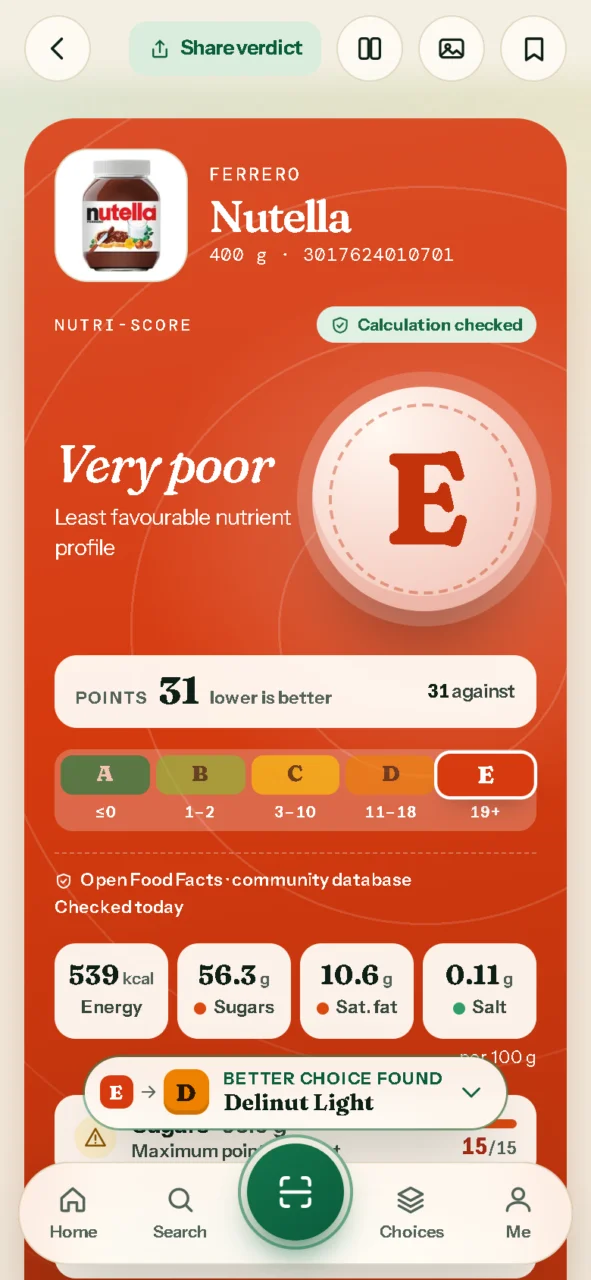
The scan itself, in FoodScan: 31 points against, none in favour.
What’s actually in the jar
Ingredients, in order of weight — biggest first:
2 · Palm oil
3 · Hazelnuts 13%
4 · Skimmed milk powder 8.7%
5 · Fat-reduced cocoa 7.4%
6 · Lecithins (soya)
7 · Vanillin
- Sugar comes first, so it’s the main ingredient — over half the jar.
- Palm oil comes second, and it’s the main source of the saturated fat.
- There’s only 13% hazelnuts, despite the name “hazelnut spread”.
- It contains milk and soy, so it’s not vegan or dairy-free. Interestingly, the community database record listed only tree nuts as allergens. FoodScan reads the ingredient text, flags the milk, and reminds you to confirm on the jar. Always read the pack if you have an allergy.
So, is Nutella bad for you?
A little Nutella as an occasional treat is fine for most people. It’s a problem when it becomes a daily breakfast habit, especially in the US-size serving: 20 g of sugar before the day has started, mostly from the spread itself. If you love it, three simple changes help:
🥄 Measure a teaspoon
Not a knife-load. One teaspoon is under 3 g of sugar.
🍞 Spread it on something better
Thin, on wholegrain toast or a rice cake with Greek yogurt — fibre and protein blunt the sugar hit.
🎉 Keep it a treat
Weekend food, not the default breakfast.
Lower-sugar alternatives
When we scanned Nutella in FoodScan (22 October 2026, US shopper), it suggested hazelnut and chocolate spreads in the same category with a better grade (D) and up to 48 g less sugar per 100 g. They’re listed by what’s sold in your country, so your results may differ.

FoodScan’s closest match: a grade D spread with 48 g less sugar and 2.8 g less saturated fat per 100 g.
- “Light” or “no sugar” spreads often use sweeteners to keep the taste. If you’d rather avoid them, turn on Artificial sweeteners under Me → Optional ingredient preferences in FoodScan, and it will tell you.
- A 100% nut butter (hazelnut, almond or peanut) with a little cocoa stirred in gives you the flavour with almost no added sugar. It’s still calorie-dense, so the portion still counts.
👉 See Nutella’s better choices in FoodScan
Just demote it — from breakfast staple to weekend treat, and measure the spoon.
Questions, answered
How much sugar is in a tablespoon of Nutella?
About 10 g, roughly two and a half sugar cubes, in a tablespoon of about 18.5 g.
Is Nutella good for weight loss?
It’s not a good everyday choice. It’s high in calories (about 100 kcal per tablespoon) and sugar, and low in fibre and protein, so it isn’t very filling.
Is Nutella vegan?
No. It contains skimmed milk powder.
Does Nutella contain palm oil?
Yes. Palm oil is its second ingredient.
Is Nutella better than jam?
Both are mostly sugar. Nutella has more calories and saturated fat per spoon; jam has no fat. Compare the two jars you actually buy with FoodScan’s Compare two products button.
Nutrition data © Open Food Facts contributors (ODbL). This article is general information, not medical or dietary advice. If you have a health condition or allergy, follow your doctor’s or dietitian’s guidance and always read the pack. Sugar guidance figures are from the American Heart Association and the World Health Organization’s sugars guideline.