Skip to content
 2026 running shoe guide
Ball-of-foot pain (metatarsalgia) requires shoes with thick forefoot cushioning, a wide toe box, and rocker geometry. This guide compares the best cushioned, rocker-sole, and wide-toe-box running shoes for runners with forefoot pain, with real Amazon links and product images.
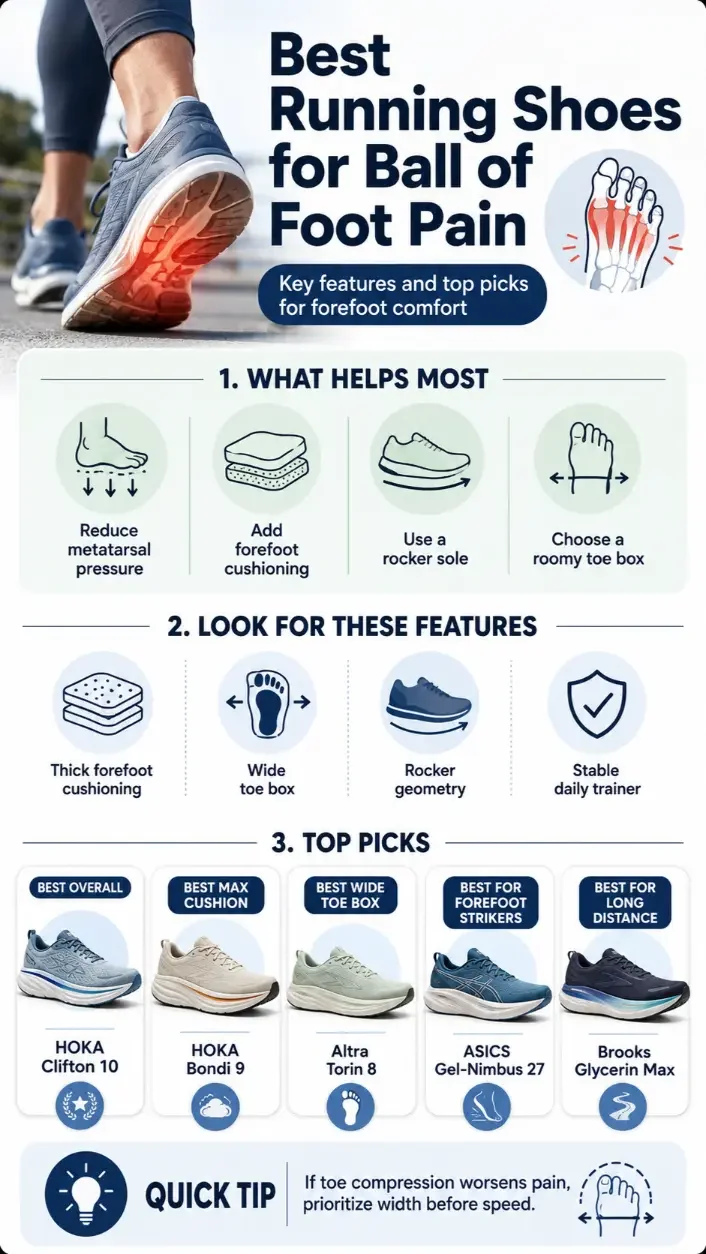
Infographic: Key features to look for in running shoes for ball of foot.
Best picks at a glance
Start here. For most runners with ball-of-foot pain, the safest choice is a cushioned shoe with a rocker sole and a roomy toe box.
The Clifton 10 is the best all-around shoe for runners with ball-of-foot pain.
The Bondi 9 is the most cushioned road shoe in HOKA lineup, offering maximum forefoot protection for runners with metatarsalgia.
The Altra Torin 8 has a foot-shaped toe box that is wider than any traditional running shoe, making it the best choice for runners whose ball-of-foot pain is worsened by toe compression.
For runners who land on the forefoot and experience ball-of-foot pain, the Gel-Nimbus 27 places PureGel directly under the impact zone.
Quick comparison
| Best for | Shoe | Why it works | Skip it if | Amazon |
|---|---|---|---|---|
| Best overall | HOKA Clifton 10 | The Clifton 10 is the best all-around shoe for runners with ball-of-foot pain. | EVA compresses faster than premium foam | Check Amazon |
| Best max cushion | HOKA Bondi 9 | The Bondi 9 is the most cushioned road shoe in HOKA lineup, offering maximum forefoot protection for runners with metatarsalgia. | Bulky appearance | Check Amazon |
| Best wide toe box | Altra Torin 8 | The Altra Torin 8 has a foot-shaped toe box that is wider than any traditional running shoe, making it the best choice for runners whose ball-of-foot pain is worsened by toe compression. | Zero drop requires transition period | Check Amazon |
| Best for forefoot strikers | ASICS Gel-Nimbus 27 | For runners who land on the forefoot and experience ball-of-foot pain, the Gel-Nimbus 27 places PureGel directly under the impact zone. | Premium pricing | Check Amazon |
| Best for long-distance | Brooks Glycerin Max | The Glycerin Max is the best long-distance shoe for runners with ball-of-foot pain. | Expensive retail price | Check Amazon |
| Best rocker alternative | Saucony Triumph 23 | The Triumph 23 uses PWRRUN PB foam with a center-of-pressure design that shifts weight forward, reducing the concentrated load on the metatarsal heads. | May feel too soft for tempo | Check Amazon |
| Best for daily training | Brooks Ghost Max 3 | The Ghost Max 3 is a versatile daily trainer with enough cushioning for metatarsalgia without the bulk of max-stack shoes. | Less cushioning than max-stack | Check Amazon |
Detailed shoe reviews
Each shoe is evaluated for its ability to reduce metatarsal pressure, provide forefoot cushioning, and accommodate runners with ball-of-foot pain.
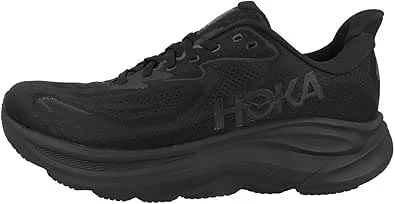
HOKA Clifton 10
The Clifton 10 is the best all-around shoe for runners with ball-of-foot pain. The MetaRocker geometry rolls the foot forward, reducing the pressure on the metatarsal heads during push-off. Generous EVA cushioning absorbs forefoot impact, and the relatively low 5 mm drop shifts load away from the forefoot.
Buy it if
- MetaRocker reduces metatarsal pressure
- Generous forefoot cushioning
- Lower drop shifts load from forefoot
- Lightweight for its cushioning
Skip it if
- EVA compresses faster than premium foam
- 5 mm drop may not suit heel strikers
- Not for severe overpronation
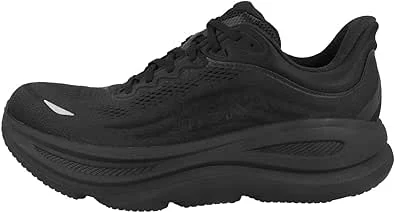
HOKA Bondi 9
The Bondi 9 is the most cushioned road shoe in HOKA lineup, offering maximum forefoot protection for runners with metatarsalgia. The massive EVA stack absorbs the impact that aggravates ball-of-foot pain, while the MetaRocker reduces the bending force on the metatarsals during toe-off. Ideal for long runs where forefoot pain typically worsens.
Buy it if
- Maximum forefoot cushioning
- MetaRocker reduces metatarsal bending
- Broad base distributes pressure
- Great for long runs and walking
Skip it if
- Bulky appearance
- Heavier than daily trainers
- Too soft for faster efforts
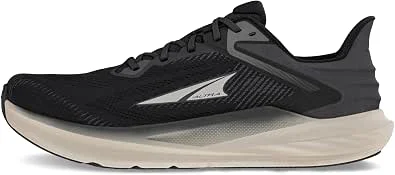
Altra Torin 8
The Altra Torin 8 has a foot-shaped toe box that is wider than any traditional running shoe, making it the best choice for runners whose ball-of-foot pain is worsened by toe compression. The zero-drop platform promotes a midfoot strike that reduces forefoot loading, and the EGO MAX midsole provides responsive cushioning without the mushy feel.
Buy it if
- Foot-shaped toe box prevents compression
- Zero drop reduces forefoot loading
- Responsive EGO MAX cushioning
- Promotes natural foot splay
Skip it if
- Zero drop requires transition period
- May not suit heel strikers
- Less cushioning than max-stack options
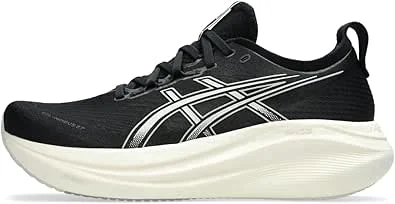
ASICS Gel-Nimbus 27
For runners who land on the forefoot and experience ball-of-foot pain, the Gel-Nimbus 27 places PureGel directly under the impact zone. FF Blast Plus Sky foam provides the softest ASICS ride, and the full-length gel unit absorbs the concentrated forefoot loading that causes metatarsalgia in forefoot strikers.
Buy it if
- PureGel absorbs forefoot impact
- Softest ASICS foam for comfort
- Full-length gel protection
- Excellent for forefoot strikers
Skip it if
- Premium pricing
- May feel too soft for speed
- Heavier than daily trainers
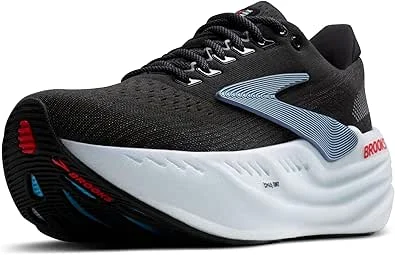
Brooks Glycerin Max
The Glycerin Max is the best long-distance shoe for runners with ball-of-foot pain. The nitrogen-infused DNA Tuned cushioning maintains its shock absorption over high mileage, and the smooth heel-to-toe rocker reduces the forefoot bending that aggravates metatarsalgia on long runs. The broad platform also distributes pressure evenly.
Buy it if
- Cushioning maintains protection over miles
- Rocker reduces forefoot bending
- Broad platform distributes pressure
- Excellent for marathon training
Skip it if
- Expensive retail price
- Tall stack may feel unstable
- Not ideal for speed work
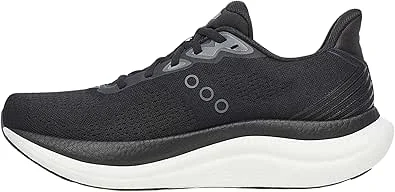
Saucony Triumph 23
The Triumph 23 uses PWRRUN PB foam with a center-of-pressure design that shifts weight forward, reducing the concentrated load on the metatarsal heads. The 8 mm drop and springy foam make it a good rocker alternative for runners who find HOKA MetaRocker too aggressive but still want forefoot pressure relief.
Buy it if
- Forward-shifted pressure reduces metatarsal load
- Springy PWRRUN PB foam
- Less aggressive rocker than HOKA
- Durable for high mileage
Skip it if
- May feel too soft for tempo
- Premium pricing
- Less rocker than HOKA options
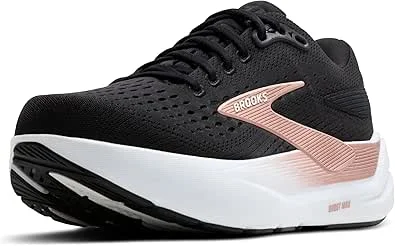
Brooks Ghost Max 3
The Ghost Max 3 is a versatile daily trainer with enough cushioning for metatarsalgia without the bulk of max-stack shoes. DNA Loft v3 foam absorbs forefoot impact, the wide base distributes pressure, and the subtle rocker smooths toe-off. The best all-round daily shoe for runners managing ball-of-foot pain on regular mileage.
Buy it if
- Versatile for daily and tempo
- Wide base distributes forefoot pressure
- Subtle rocker smooths toe-off
- Good balance of cushion and responsiveness
Skip it if
- Less cushioning than max-stack
- May not suit severe metatarsalgia
- Not enough for max cushion needs
Who this guide is for
This guide is for runners who experience pain in the ball of the foot — the padded area behind the toes — during or after running. You will benefit most if you:
- Feel a burning, aching, or sharp pain in the forefoot during runs
- Have been diagnosed with metatarsalgia, capsulitis, or Morton’s neuroma
- Notice the pain worsens with higher mileage or harder surfaces
- Feel like you are “running on pebbles” or have a bruised sensation
- Have high arches, a long second toe, or wear narrow-toed shoes
Who should skip this: If you have sudden severe pain, visible swelling, numbness between toes, or cannot bear weight, see a podiatrist immediately. This guide is for managing chronic forefoot pain, not acute injuries.
What is metatarsalgia and what causes ball-of-foot pain?
Metatarsalgia is a general term for pain and inflammation in the ball of the foot, specifically around the metatarsal heads — the joints where your toes connect to the long bones of your foot. The Mayo Clinic describes it as a common overuse injury in runners, characterized by a burning or aching pain that worsens with standing, running, or wearing thin-soled shoes.
Common causes include:
- Repetitive impact: Running transfers forces of 2-3 times body weight through the forefoot on each step. Over time, this inflames the metatarsal heads.
- Improper footwear: Shoes with thin forefoot cushioning, narrow toe boxes, or high heels shift pressure onto the metatarsals.
- Foot structure: High arches, a long second toe (Morton’s toe), or a prominent metatarsal head concentrate pressure on specific points.
- Forefoot striking: Landing on the ball of the foot instead of the heel increases forefoot loading significantly.
- Tight calf muscles: Limited ankle dorsiflexion shifts weight forward onto the metatarsals.
According to the Cleveland Clinic, proper footwear with adequate forefoot cushioning and a wide toe box is one of the most effective non-surgical treatments for metatarsalgia.
What to look for in running shoes for ball-of-foot pain
- Forefoot cushioning: The most important feature. Look for shoes with thick, soft foam under the metatarsal heads. Max-cushion shoes (30+ mm stack) absorb the impact that aggravates metatarsalgia.
- Rocker geometry: A curved sole (MetaRocker, heel-to-toe rocker) rolls the foot forward, reducing the bending force on the metatarsals during push-off. This is the single most effective shoe feature for forefoot pain.
- Wide toe box: A shoe that allows the toes to splay naturally distributes pressure across the entire forefoot instead of concentrating it on one or two metatarsal heads.
- Lower heel-to-toe drop: A lower drop (0-6 mm) shifts weight toward the midfoot and heel, reducing forefoot loading. However, transitioning to a lower drop should be gradual.
- Gel or air cushioning in the forefoot: Some shoes (like ASICS with PureGel) place cushioning specifically in the forefoot impact zone, providing targeted relief.
- Arch support (if needed): For runners with high arches, proper arch support prevents the foot from collapsing and shifting pressure onto the metatarsals.
Shoes to avoid if you have ball-of-foot pain
- Narrow toe box shoes: Shoes that squeeze the toes together concentrate pressure on the central metatarsals. This includes many racing and performance shoes.
- Racing flats and spikes: Minimal cushioning and firm plates transmit impact directly to the metatarsal heads.
- Carbon-plated super shoes: The stiff carbon plate can increase forefoot bending forces in some runners, aggravating metatarsalgia.
- Worn-out trainers: Compressed forefoot cushioning provides almost no protection. Replace shoes at 350-500 miles.
- High-drop shoes (12+ mm): While not universally harmful, very high drops can shift weight forward onto the forefoot in some runners.
Common mistakes runners make with ball-of-foot pain
- Toughing it out: Metatarsalgia worsens with continued impact. Running through the pain can turn a 2-week issue into a 2-month recovery.
- Only changing shoes: While shoes are critical, tight calves, weak foot intrinsic muscles, and training errors also contribute. Stretch calves daily and strengthen the foot with towel scrunches and marble picks.
- Ignoring toe box width: A cushioned shoe with a narrow toe box still concentrates pressure. Always prioritize width alongside cushioning.
- Adding too much cushion too fast: If you switch from a 10 mm drop to a 0 mm drop shoe, the Achilles and calf take on more load. Transition gradually over 2-3 weeks.
- Not using metatarsal pads: Over-the-counter metatarsal pads or orthotics can provide targeted relief that shoes alone cannot, especially for runners with structural foot issues.
Frequently asked questions
What are the best running shoes for ball of foot pain?
The best running shoes for ball-of-foot pain have thick forefoot cushioning, a wide toe box, and rocker geometry. Top picks include the HOKA Clifton 10 (best overall), HOKA Bondi 9 (best max cushion), and Altra Torin 8 (best wide toe box). Look for shoes that reduce metatarsal pressure during push-off.
Can running shoes help with metatarsalgia?
Yes. Running shoes with adequate forefoot cushioning, rocker geometry, and a wide toe box can significantly reduce metatarsalgia pain. The rocker sole reduces bending forces on the metatarsals, while cushioning absorbs impact. The Cleveland Clinic identifies proper footwear as one of the most effective non-surgical treatments.
Should I use metatarsal pads in my running shoes?
Metatarsal pads can provide targeted relief by lifting and separating the metatarsal heads, redistributing pressure away from the painful area. They are especially helpful for runners with structural issues like high arches or a long second toe. Over-the-counter pads work for many runners, but custom orthotics from a podiatrist offer the most precise support.
Is it OK to run with ball-of-foot pain?
If the pain is mild and improves with rest, you can often continue running at reduced volume and intensity. Reduce mileage by 30-50%, avoid hard surfaces, and ice after runs. If the pain is sharp, worsens during the run, or persists after running, stop and see a podiatrist. Continuing to run through significant forefoot pain can lead to stress fractures.
What heel-to-toe drop is best for ball-of-foot pain?
A lower heel-to-toe drop (0-6 mm) can reduce forefoot loading by shifting weight toward the midfoot. However, transitioning to a lower drop should be gradual to avoid Achilles strain. The HOKA Clifton 10 (5 mm) and Altra Torin 8 (0 mm) are popular choices. If you currently run in a 10-12 mm drop shoe, transition to 6 mm first before going lower.
- Mayo Clinic. “Metatarsalgia.” mayoclinic.org
- Cleveland Clinic. “Metatarsalgia.” clevelandclinic.org
- NIH/PMC. “Forefoot loading during running.” PubMed
- American College of Foot and Ankle Surgeons. “Metatarsalgia.” acfas.org
Related reading
This article is educational, not medical advice. Consult a podiatrist for persistent forefoot pain. As an Amazon Associate, GearUpToFit earns from qualifying purchases.
Managing Metatarsalgia While Running
Relieving ball-of-foot pain requires a combination of high-stack cushioning, rocker geometry to reduce toe-off pressure, and a wide toe box for natural foot splay. While choosing the right footwear is critical, incorporating mobility training can help improve joint function and reduce strain. If your pain is severe, a structured return to running guide can help you safely rebuild mileage without re-aggravating the injury.
Recovery and Support for Foot Health
Selecting the right footwear is only one part of managing metatarsalgia. For runners returning to the sport after a period of rest, following a structured return to running after injury guide is essential to avoid re-aggravating the ball of your foot. Additionally, incorporating mobility training drills can improve your range of motion, reducing the strain on your forefoot during the toe-off phase of your stride.
Why Foot Health Matters for Runners
Selecting the right footwear is only one part of managing forefoot pain. Often, metatarsalgia is linked to underlying biomechanical issues. For instance, incorporating core exercises for beginners can improve overall running stability, while ensuring a proper return to running after injury protocol is essential if you are recovering from a stress fracture or severe inflammation.
Why Foot Mechanics Matter for Metatarsalgia
Reducing ball-of-foot pain isn’t just about footwear; it’s about how your body moves. Strengthening your foundation with a core stability routine can improve your running form and reduce compensatory strain on your forefoot. Additionally, if you are returning to activity after a flare-up, following a structured return to running guide is essential to prevent re-injury.