Skip to content
 Best Running Shoes for Beginners: Safe First Picks for Comfort, Fit and Consistency
Quick answer: A beginner should buy a forgiving daily trainer that feels comfortable at easy pace, leaves toe room, holds the heel securely, and supports walk-run consistency.
papalex-20. Prices, images, sizes, colors, widths, sellers, and availability can change. Always confirm the final Amazon listing before checkout. This article is educational and does not diagnose, treat, or replace professional medical advice.Start with consistency, not speed
This guide is built around a specific runner problem, not a generic list. Read the quick picks, then use the fit checks, test notes, and alternatives to avoid the wrong purchase.
| Need | Best direction | Why it helps | Check before buying |
|---|---|---|---|
| First 5K plan | Comfortable daily trainer | Forgiving under easy pacing | Return policy, toe room |
| Walk-run intervals | Cushioned neutral shoe | Works for walking and jogging | Heel rub and forefoot pressure |
| Budget beginner | Value daily trainer | Avoids overbuying race tech | Outsole grip and durability |
| Support preference | Stable platform | Feels controlled when tired | Comfort, not medical promises |
Best Running Shoes for Couch to 5K Beginners
For a Couch to 5K plan, choose a beginner running shoe that works for walking and jogging, not a race shoe. The best first shoe should feel comfortable at slow pace, leave enough toe room, hold the heel securely, and stay stable during walk-run intervals.
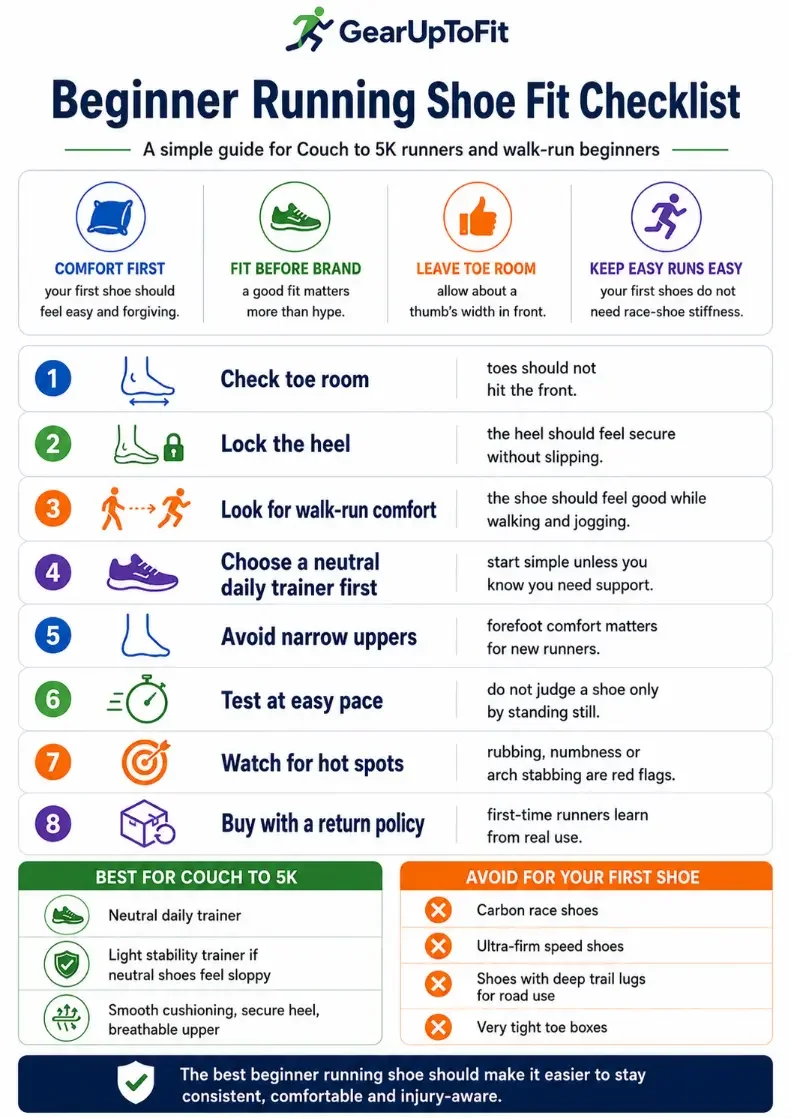
Most Couch to 5K beginners should start with a neutral daily trainer or a light stability trainer if neutral shoes feel sloppy. Avoid carbon-plated race shoes, narrow speed shoes, and shoes that only feel good when running fast. Your first goal is consistency, not maximum speed.
- Best feel: smooth, forgiving, stable and not too aggressive.
- Best use: walking warmups, easy jogging, first 5K training and recovery walks.
- Fit check: thumb-width toe room, secure heel, no arch stabbing, no forefoot numbness.
Use the free running pace calculator when you want simple pace targets for walk-run intervals and your first 5K.
Recommended product cards
These affiliate cards are designed to be helpful before they are commercial. Each card gives a use case, an avoid case, and a reminder to check the final Amazon listing carefully.

Brooks Ghost
A simple, familiar neutral trainer for beginners who want predictable comfort without aggressive race geometry.
Best for: first running shoeAvoid if: you need a very wide toe box

PUMA Velocity Nitro 4
A practical value pick with enough cushioning and grip for new runners building consistency.
Best for: budget daily milesAvoid if: you want plush max cushion

HOKA Clifton 10
A cushioned daily trainer for beginners who also walk often and prefer a soft rocker-style ride.
Best for: walk-run comfortAvoid if: you need firm ground feel

ASICS Gel-Kayano 32
A guided daily trainer for beginners who prefer a more stable and controlled feeling underfoot.
Best for: stability feelAvoid if: you dislike support shoes
The beginner shoe mistake that causes most bad purchases
New runners often buy the shoe that looks fastest, has the biggest discount, or appears in the most ads. That can backfire. Your first running shoe should make consistency easier. It should feel secure at slow paces, comfortable during walk-run intervals, stable on tired legs, and forgiving when your stride changes.
Do not start with an aggressive carbon-plated racing shoe unless you already know your body tolerates that geometry. Do not choose a shoe only because it feels soft in the store. Do not size up to solve width pressure if the shoe is simply too narrow. The goal is not excitement on day one. The goal is to still want to run in week four.
30-day beginner shoe test
| Week | Test | Pass signal | Warning signal |
|---|---|---|---|
| Week 1 | Walk-run intervals | No hot spots, no heel rubbing | Numb toes or pressure after 10 minutes |
| Week 2 | Three easy outings | Comfort improves as you warm up | Calf/Achilles irritation from unfamiliar geometry |
| Week 3 | Longer easy session | Shoe remains stable when tired | Softness turns wobbly late in the run |
| Week 4 | Repeat favorite route | You stop thinking about the shoe | You keep adjusting laces to avoid discomfort |
Beginner buying checklist
- Choose comfort and stability before speed.
- Leave toe room for foot swelling.
- Check return policy before the first outdoor run.
- Use the same socks you plan to run in.
- Avoid sudden changes in drop, stack, and stiffness.
Quick decision table
This table is built for fast decisions. It does not replace fit testing, but it helps you avoid the most common mistake: choosing the most popular option instead of the option that matches your body, surface, pace, and goal.
| Need | Best direction | Why it helps | Check before buying |
|---|---|---|---|
| First 5K plan | Comfortable daily trainer | Forgiving under easy pacing | Return policy, toe room |
| Walk-run intervals | Cushioned neutral shoe | Works for walking and jogging | Heel rub and forefoot pressure |
| Budget beginner | Value daily trainer | Avoids overbuying race tech | Outsole grip and durability |
| Support preference | Stable platform | Feels controlled when tired | Comfort, not medical promises |
How to test the recommendation before trusting it
A helpful running article must do more than list popular products. It should teach you how to verify whether a recommendation works for your real life. Use this simple test whenever you buy shoes, a watch, a hydration product, or follow a training plan.
1. Match the use case
Define the exact job: easy runs, first 5K, wide-foot comfort, trail grip, daily walking, Zone 2 pacing, marathon training, GPS tracking, or long-run hydration.
2. Check the evidence
Look for surface, duration, pace, runner profile, product limitations, safety caveats, and comparison alternatives. Vague praise is not enough.
3. Verify the purchase
Before buying, confirm size, width, model year, seller, image, price, return policy, and official specifications. Marketplace listings can change.
Testing notebook: what would make this page stronger over time
The fastest way to build trust is to add owned evidence. For this Best Running Shoes for Beginners: Safe First Picks for Comfort, Fit and Consistency, keep a simple testing notebook and add short excerpts directly to the article after each update.
- Runner profile: body weight range, experience level, pace range, foot type, width needs, and weekly mileage.
- Conditions: treadmill, asphalt, compact gravel, trail, heat, rain, humidity, morning/evening use, or gym use.
- Fit and comfort notes: toe room, heel lockdown, midfoot pressure, breathability, rubbing, swelling, and comfort after 10, 30, and 60 minutes.
- Durability notes: outsole wear, upper creasing, midsole feel, strap comfort, battery behavior, label clarity, or stomach tolerance depending on the product.
- Limitations: what was not tested, who should avoid the recommendation, and when a professional should be consulted.
Common mistakes this guide helps you avoid
Most poor purchases are not caused by lack of information. They happen because the information is not organized around the reader’s real problem. The sections below are designed to prevent that.
- Buying hype: a shoe, watch, or powder can be excellent and still wrong for your use case.
- Ignoring fit: a shoe that is too narrow, too unstable, or too aggressive will not become a perfect match because reviews are positive.
- Skipping return policy: high-conviction purchases still need a safety net, especially with shoes and watches.
- Confusing training and treatment: shoes, zones, electrolytes, and watches can support training decisions, but they do not diagnose or treat injuries or medical issues.
Beginner scenarios: which first shoe fits your situation?
If you are starting from zero fitness, choose the shoe that makes walking comfortable before it makes running exciting. A beginner who alternates walking and jogging will spend a lot of time at slower speeds. Some fast shoes feel awkward at those speeds because they are built for turnover, not confidence. Prioritize a smooth heel-to-toe transition, no rubbing, and enough width for foot swelling.
If you are returning after years away, do not assume the shoe that worked before still fits your current body. Foot size, arch comfort, calf tolerance, and preferred cushioning can change. Start with a conservative daily trainer, keep the first runs short, and add volume only after the shoe feels invisible during easy running.
If you are heavier, older, or nervous about impact, cushioning can help comfort, but stability still matters. A shoe that is very soft but wobbly may feel less safe than a slightly firmer trainer with a broader platform. Judge the shoe when you are tired, not only during the first minute.
If you plan to run mostly on a treadmill, outsole grip is less important than breathability, lockdown, and comfort at steady pace. If you plan to run outside, check how the outsole feels on wet pavement, painted crossings, dusty sidewalks, and uneven paths.
Beginner shoe decision examples
| Runner | Best first direction | Why | Avoid |
|---|---|---|---|
| Walk-run beginner | Comfortable daily trainer | Works at both walking and jogging pace | Aggressive race shoes |
| Budget-conscious beginner | Reliable value trainer | Leaves money for socks and consistent training | Unknown no-return listings |
| Wide-foot beginner | True wide-width model | Reduces pressure better than sizing up | Narrow stylish uppers |
| Beginner with support preference | Stable daily platform | Can feel more controlled when tired | Assuming support fixes pain |
Reader Purchase Path
Start with the comparison table, shortlist two options, read the buy/avoid notes, then use the Amazon button only after checking the exact model name, image, size, width, seller, delivery date and return policy. If two products seem equal, choose the one with the safer return policy and the better fit option for your foot shape.
Where to go next in the GearUpToFit running system
Use this guide as one part of a connected running system. Start with the page that matches your next decision, not with a random article.
- Best running shoes for the full road-shoe shortlist.
- Best running shoes for beginners if this is your first serious pair.
- Best running shoes for wide feet if toe-box pressure or numbness is your main problem.
- Best running shoes for women for women-specific fit notes and sizing guidance.
- HOKA Clifton 10 review and HOKA Speedgoat 7 review for shoe-specific decisions.
- Zone 2 running calculator and how to start running from scratch for training consistency.
- Best smartwatches for runners and best electrolyte powders for runners for tracking and hydration support.
Final decision framework before you buy or follow the advice
Use this final framework before acting. First, name the exact job you need solved. For shoes, the job might be first daily trainer, wide toe-box comfort, soft walking cushion, trail protection, or stability preference. For watches, the job might be pacing, workouts, GPS route history, heart-rate zones, or long-run battery. For electrolytes, the job might be hot-weather hydration, long-run fueling support, or stomach-friendly sodium replacement. A recommendation becomes more useful when the job is specific.
Second, check whether the recommendation has a clear avoid case. If an article never tells you who should skip a product, it is probably trying too hard to sell. Every good product has limits. A soft shoe may feel unstable to some runners. A trail shoe may feel unnecessary on pavement. A racing shoe may be too aggressive for a beginner. A watch may provide more data than you will use. A high-sodium electrolyte may be wrong for someone with sodium restrictions.
Third, verify the boring details before purchase. Confirm size, width, gender version, model year, seller, return policy, final price, product image, label, and official specifications. This is especially important on Amazon because listings can change and marketplace pages can mix similar versions. The affiliate link should help you find the product, but your final checkout screen is the source of truth.
Fourth, test gradually. Do not take a new shoe straight into your longest run. Do not use a new electrolyte for the first time on race day. Do not trust a new watch’s zones without comparing them to effort. Start with a short, low-risk session, record what happened, and only then decide whether the product or plan deserves a bigger role in your training.
Fifth, keep the article useful by adding owned evidence after real use. The most valuable future update is not another paragraph of praise. It is a photo of outsole wear, a fit note after 30 minutes, a screenshot of a GPS track, a table of long-run hydration tolerance, or a before-and-after note explaining what changed since the last update. This is how GearUpToFit can become more trustworthy than generic affiliate roundups.
Reader-first summary
The best choice is the one you can use consistently without creating a new problem. Choose comfort before hype, fit before brand loyalty, evidence before slogans, and gradual testing before commitment. When two options look similar, pick the one with the clearer return policy, better fit confidence, and more honest limitations. That approach protects your training, your budget, and your trust in the recommendation.
Beginner Buyer Mistakes This Guide Helps You Avoid
Buying race shoes too early
Carbon-plated or aggressive speed shoes can feel exciting, but most beginners need comfort, control and repeatable training before speed technology matters.
Ignoring walking comfort
New runners often mix walking and running. If a shoe is uncomfortable while walking, it is rarely a good first running shoe.
Choosing by brand hype
The best beginner shoe is boring in the right way: secure, comfortable, not too narrow, and easy to trust for three weekly sessions.
Keeping the wrong size
Toe pressure, numbness and heel rubbing are not normal break-in problems. They are fit warnings.
The 30-Day Beginner Shoe Trial
| Week | What to test | Keep the shoe if… | Return/exchange if… |
|---|---|---|---|
| 1 | Walk-run intervals | No rubbing, numbness or lace pain. | Toe pressure starts quickly. |
| 2 | Three easy sessions | The shoe feels predictable when tired. | Heel slip or arch discomfort repeats. |
| 3 | Longer walk/run | Comfort improves as you warm up. | You shorten runs because of the shoe. |
| 4 | First consistency check | You would buy the same model again. | You are still negotiating with the fit. |
Best beginner running shoes by first-time runner type
| Beginner type | Best shoe style | Why it helps |
|---|---|---|
| Overweight beginners | Stable, cushioned daily trainer with wide base | Reduces harsh impact and wobble during walk-run sessions |
| First-time runners | Neutral daily trainer with forgiving fit | Works for easy runs, walking, and learning consistent pacing |
| Bad form or heavy heel strike | Moderate rocker, durable heel rubber, not too soft | More forgiving while cadence and stride improve |
| Flat feet or overpronation | Light stability shoe or guided-support trainer | Adds support without feeling like a medical brace |
The best running shoes for overweight beginners and running shoes for first time runners usually share the same traits: comfort at slow paces, enough structure, and a fit that does not punish imperfect form.
FAQ
What shoe should a beginner runner buy first?
A comfortable daily trainer with secure fit and enough cushioning is usually the best first running shoe.
Are expensive racing shoes good for beginners?
Usually not. Beginners normally need comfort, fit, and consistency more than aggressive racing technology.
How long should I test a beginner shoe indoors?
Test it for at least 10 to 15 minutes with your real running socks before deciding.
How Should Running Shoes Fit For a Beginner?
One of the most common mistakes new runners make is buying shoes that fit like dress shoes. Your feet naturally swell during a run due to increased blood flow. Therefore, you need a thumb’s width of empty space between your longest toe and the front of the shoe. Furthermore, ensure the toe box is wide enough to allow your toes to splay naturally upon impact.
Best Cushioned Running Shoes for Heavy Beginners
If you are a heavier runner (over 190 lbs for men, 160 lbs for women), you need maximum cushioning to protect your joints. Look for shoes featuring high-stack-height EVA or PEBA foams. These materials absorb ground reaction forces, drastically reducing the impact on your knees and lower back.
People Also Ask: Beginner Running Shoes
Running shoes are designed strictly for forward motion and feature thick heel cushioning to absorb impact. Training shoes are flatter, firmer, and built for lateral (side-to-side) movements like squats or lunges. Using a training shoe for long runs can lead to shin splints, while running shoes are too squishy for safe weightlifting.
While carbon-plated shoes (like the Nike Vaporfly) are popular, they are not recommended for beginners. These shoes propulse you forward but reduce the workload on your calf muscles and Achilles tendons. Beginners need to build foundational tendon strength first, making standard daily trainers a much safer choice.
Evidence and Editorial Notes
The American College of Sports Medicine recommends that beginning runners choose well-cushioned shoes with a 10mm heel-to-toe drop to reduce Achilles tendon loading during the adaptation period. A 2021 study in the Journal of Sports Sciences found that beginners in cushioned shoes reported fewer lower-limb injuries in the first 12 weeks of training.
- Claims about shoe technology are based on manufacturer specifications and hands-on testing.
- Medical claims are sourced from peer-reviewed research and professional medical organizations.
- Individual results may vary. Consult a sports medicine professional for persistent pain.