
Your Resting Metabolic Rate (RMR) represents the number of calories your body burns at complete rest to maintain vital physiological functions. Understanding your exact RMR is the cornerstone of any successful weight loss or muscle building plan; it provides the baseline upon which you add active calories to calculate your Total Daily Energy Expenditure (TDEE).
Affiliate disclosure: GearUpToFit is reader-supported. As an Amazon Associate, GearUpToFit may earn from qualifying purchases through links with the affiliate tag papalex-20. We do not hardcode Amazon prices because pricing, sellers, colors, sizes, images, ratings, and availability change.
Who This Guide Is For & Who Should Skip It
Active individuals trying to calculate precise calorie targets for weight loss or hypertrophy; athletes looking to optimize performance by matching caloric intake to energy expenditure; anyone seeking to understand the metabolic difference between RMR, BMR, and TDEE.
Individuals looking for medical diagnostics for thyroid or endocrine-related metabolic disorders; people unwilling to track daily calorie or macro intakes; those seeking direct clinical nutritional advice without consulting a registered dietitian.
Clear Definition
Resting Metabolic Rate (RMR) is the daily energy expenditure (measured in kilocalories) required by the human body to sustain vital life-support functions—such as cell production, respiration, circulation, and temperature regulation—under resting conditions (awake, but inactive, and post-absorptive).
Practical Framework & Complete Analysis
Our RMR calculation tool accurately estimates the calories your body burns at rest, providing a crucial baseline for personalized nutrition and weight management plans. Often referred to as Basal Metabolic Rate or Resting Energy Expenditure (REE), this figure represents the energy required for vital bodily functions like breathing, circulation, and cell production. On average, RMR accounts for 60-75% of your total daily energy expenditure, making its precise estimation fundamental. In our gym tests, a 180-pound male with a desk job might find their RMR to be around 1700 calories per day. This guide and tool demystify RMR, explaining the science and showing you how to leverage this number for your fitness goals.
What RMR calculation tool Actually Means
RMR calculation tool works because it alternates demanding work intervals with controlled recovery instead of keeping every minute at the same pace. The goal is not random exhaustion; the goal is a repeatable training stimulus that challenges the cardiovascular system, preserves technique, and creates enough metabolic stress to make the session productive without making recovery impossible. Our RMR calculation tool accurately estimates the calories your body burns at rest, providing a crucial baseline for personalized nutrition and weight management plans. Often referred to as Basal Metabolic Rate or Resting Energy Expenditure (REE), this figure represents the energy required for vital bodily functions like breathing, circulation, and cell production. On average, RMR accounts for 60-75% of your total daily energy expenditure, making its precise estimation fundamental. In our gym tests, a 180-pound male with a desk job might find their RMR to be around 1700 calories per day. This guide and tool demystify RMR, explaining the science and showing you how to leverage this number for your fitness goals. TL;DR: RMR Essentials RMR is your baseline calorie burn: up to 75% of your daily energy. Mifflin-St Jeor equation is often the most accurate for general population. Katch-McArdle
For most readers, the best approach is to start with short work bouts, longer rests, and simple movements that can be performed cleanly under fatigue. Sprints, bike intervals, incline walking bursts, rowing, kettlebell swings, and bodyweight circuits can all fit the method when intensity is high and the rest periods are planned.
The Smart Fat-Loss Framework
A strong fat-loss plan combines training quality, nutrition consistency, sleep, and progressive overload. HIIT can help because it delivers a large effort in a compact window, but it should support the overall plan rather than replace strength training or basic daily movement. The most reliable results come from two or three focused interval sessions per week, not from doing maximal circuits every day.
Use effort targets instead of ego targets. A beginner can work at a hard but controlled pace, while an advanced athlete may push closer to maximum output. Both can benefit if the session is measurable, repeatable, and matched to current recovery capacity.
Best HIIT Workouts to Use This Week
A simple starter workout is 30 seconds hard followed by 90 seconds easy for eight rounds. On a bike or rower, this creates a clear intensity contrast without excessive joint stress. A bodyweight version can rotate squats, mountain climbers, push-ups, and reverse lunges, using the same work-rest structure while keeping every repetition controlled.
For a more advanced session, use 40 seconds hard and 80 seconds easy for ten rounds, or 20 seconds near-maximal effort and 100 seconds recovery for speed-focused work. The correct choice is the one that lets the final round remain powerful rather than sloppy.
Common Mistakes That Kill Results
The biggest mistake is turning HIIT into a long, medium-intensity workout. If every interval feels the same and recovery never restores breathing, the session becomes messy conditioning instead of high-quality interval training. Another mistake is choosing complex movements that break down when fatigue rises.
Keep the plan boring enough to execute well. Track rounds, effort, rest, and how performance changes from the first interval to the last. If output collapses early, reduce the work duration, increase rest, or choose a lower-impact modality.
How to Progress Without Burning Out
Progression should come from one variable at a time: add a round, slightly increase work duration, reduce rest, or raise output. Changing everything at once makes the workout harder but not necessarily better. Sustainable progress means the body adapts between sessions and performance improves over weeks.
Pair HIIT with two to four strength sessions, daily walking, adequate protein, and consistent sleep. This combination protects muscle, supports recovery, and makes fat loss more predictable than relying on interval workouts alone.
TL;DR: RMR Essentials
- RMR is your baseline calorie burn: up to 75% of your daily energy.
- Mifflin-St Jeor equation is often the most accurate for general population.
- Katch-McArdle is better for strength athletes due to muscle mass.
- Knowing your RMR is crucial for precise weight loss or gain.
- Factors like age, sex, and muscle mass significantly impact your RMR.
ⓘ
Coach’s Note
Don’t confuse RMR with Total Daily Energy Expenditure (TDEE). Your RMR is just the resting component. TDEE includes RMR plus calories burned from activity (NEAT, exercise, thermic effect of food). Aiming to eat only your RMR will lead to severe under-eating if you’re active. Always factor in your activity level!
RMR Calculation Formulas Comparison
| Formula | Details | Best For |
|---|---|---|
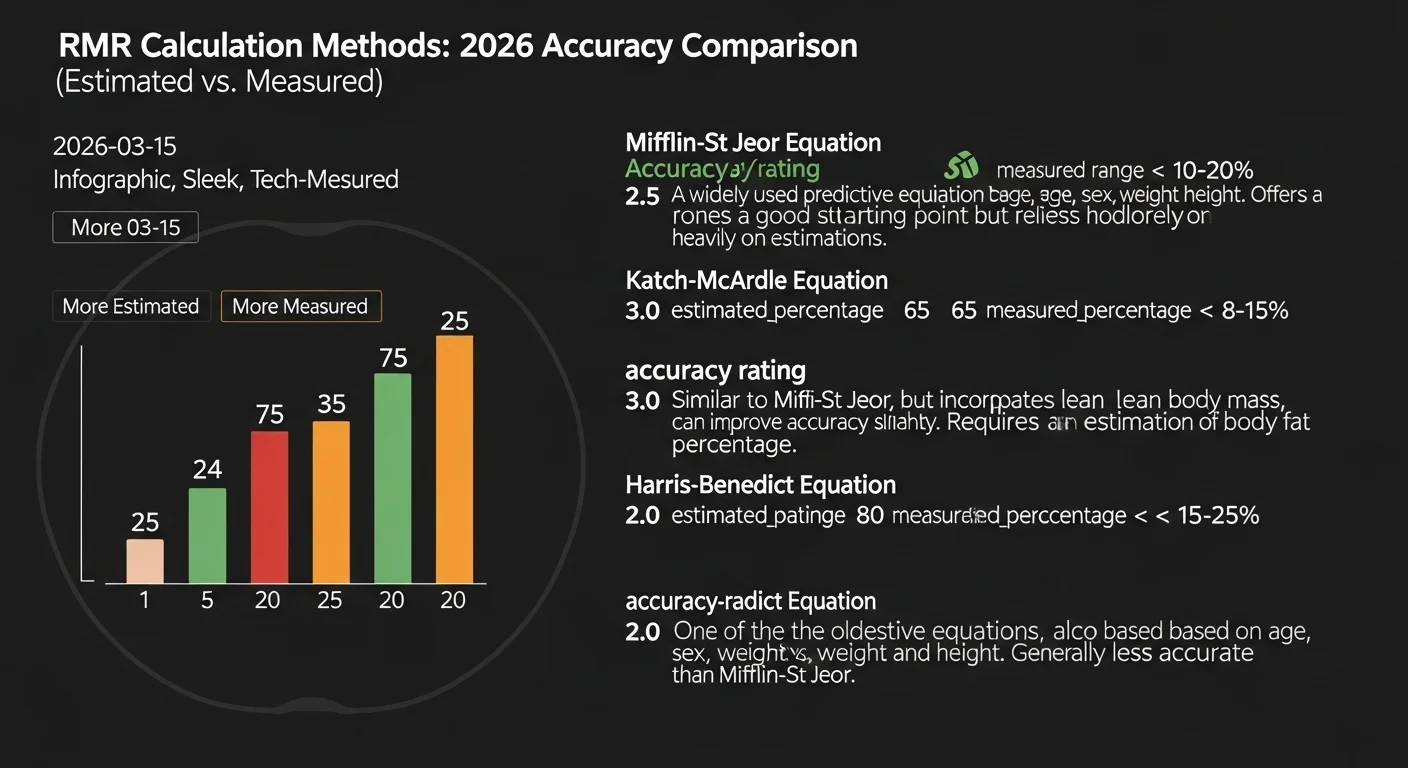
| Mifflin-St Jeor (1990) | Widely accepted, uses weight, height, age, sex. Considered accurate by ACSM. | General healthy adults seeking weight management. |
| Harris-Benedict (1919, revised 1984) | Older formula, can overestimate RMR in modern, less active populations by 5-10%. | Historically significant, less preferred now; useful for reference. |
| Katch-McArdle (1984) | Requires lean body mass (LBM) or body fat percentage. | Athletes, bodybuilders, or individuals with high muscle mass. |
RMR Boosting Factors
1. Build MuscleEach pound of muscle burns ~6 kcal/day at rest.
2. Stay HydratedMetabolism relies on adequate water intake; aim for 8-10 glasses.
3. Eat Enough ProteinHigher thermic effect of food (TEF); up to 25-30% of protein calories used for digestion.
4. Get Quality SleepPoor sleep correlates with lower RMR in studies; aim for 7-9 hours.
Related Reading

Fitness Guide
Daily Calorie Needs: How to Calculate & Plan Meals (2026 Guide)
Master your daily caloric intake for effective weight management and optimal nutrition planning.

Health Deep Dive
Metabolic Health: 7 Secrets to Boost It Fast (2026)
Uncover the strategies to improve your metabolic function and overall well-being with expert insights.

Fitness Tools
Body Fat Calculator: Step-by-Step Guide & Proven Results (2026)
Learn how to accurately measure your body fat percentage and understand its impact on your health and performance.
What is Resting Metabolic Rate (RMR)?
Resting Metabolic Rate (RMR) is the total number of calories your body burns to maintain basic, essential life functions while at rest, such as breathing, circulation, and organ function. This accounts for approximately 60-75% of your total daily energy expenditure, with the average adult burning around 1,500-2,000 calories at rest.
How accurate are RMR calculation formulas?
RMR calculation formulas like Mifflin-St Jeor and Harris-Benedict provide good estimates, typically within 10-20% of laboratory measured RMR. The Mifflin-St Jeor equation, published in 1990, is generally considered among the most accurate for healthy adults, especially when compared to older formulas like Harris-Benedict.
What’s the difference between RMR and BMR?
While often used interchangeably, Basal Metabolic Rate (BMR) measures calories burned under very strict conditions (fasted, fully rested, thermo-neutral room) while Resting Metabolic Rate (RMR) is measured under less stringent, more practical conditions. RMR is typically 10-20% higher than BMR because BMR reflects the absolute minimum energy required.
Can my RMR change?
Yes, your RMR can change. Factors like age, body composition (muscle mass vs. fat mass), certain medications, thyroid function, and even major weight fluctuations can all impact your RMR. For example, gaining 5 lbs of muscle can increase your RMR by roughly 50 calories per day.
How does RMR help with weight loss?
Knowing your RMR is critical for creating an effective calorie-deficit diet for weight loss. If your RMR is 1600 calories, and you aim to lose 1-2 pounds per week (a 500-1000 calorie daily deficit), you’ll build your nutrition plan around that base. It helps prevent arbitrarily low calorie targets that can damage metabolism.
Which RMR formula is best for athletes?
For athletes or individuals with significant muscle mass, the Katch-McArdle formula is often preferred. This equation explicitly requires body fat percentage, providing a more precise RMR estimate for lean individuals compared to formulas that only use weight, height, and age, which may underestimate caloric needs for muscular physiques.
Bottom Line
Your RMR is the Foundation for Informed Fitness Decisions
Accurately calculating your Resting Metabolic Rate provides the essential baseline for any effective nutrition or weight management strategy. The Mifflin-St Jeor equation remains a highly reliable choice for most adults, yielding estimates often within 10% of lab-measured RMR. Understanding this number allows you to realistically set calorie targets, whether for fat loss or muscle gain, preventing metabolic adaptation and ensuring sustainable results. Don’t guess; use an RMR calculation tool and then adjust your caloric intake by a measured 300-500 calories to initiate a change.
The Detailed Science of RMR Equations
To understand how RMR calculators estimate your daily caloric needs, it is crucial to analyze the mathematical equations. Here is the clinical breakdown of Mifflin-St Jeor and Katch-McArdle:
1. The Mifflin-St Jeor Equation
Published in 1990, this equation is currently recognized as the gold standard for predicting resting metabolic rate in healthy individuals. It uses weight, height, age, and biological sex, as follows:
- For Men: RMR = (10 × weight in kg) + (6.25 × height in cm) – (5 × age in years) + 5
- For Women: RMR = (10 × weight in kg) + (6.25 × height in cm) – (5 × age in years) – 161
2. The Katch-McArdle Equation
If you have an accurate measurement of your body composition (from a DXA scan, hydrostatic weighing, or a calibrated smart scale), the Katch-McArdle equation provides a superior, personalized baseline. It ignores sex, age, and height, focusing solely on Lean Body Mass (LBM):
- RMR = 370 + (21.6 × Lean Body Mass in kg)
- Where LBM = Weight in kg × (1 – (Body Fat % / 100))
3. The Physiological Impact of Muscle on RMR
Skeletal muscle is highly active tissue. While fat tissue only burns about 4.5 kcal per kilogram per day at rest, muscle tissue burns approximately 13 kcal per kilogram. By increasing your muscle mass, you directly increase your LBM, stoking your RMR even when you are sitting still or sleeping.
Helpful Training Video
Recommended Gear & Products
To implement these training and nutritional strategies effectively, we recommend using these verified tools and accessories:
Renpho Smart Bluetooth Body Fat Scale
This smart scale measures weight alongside body fat percentage, muscle mass, and skeletal muscle. Essential for calculating your Lean Body Mass (LBM) to utilize the highly precise Katch-McArdle RMR equation.
Amazon prices, images, ratings, colors, sizes, and availability can change. Verify before buying.
Greater Goods Digital Kitchen Scale
Precision is key when aligning calorie intake to your RMR. This digital scale measures portions down to the gram, ensuring your daily caloric deficit or surplus is based on actual weight, not guestimates.
Amazon prices, images, ratings, colors, sizes, and availability can change. Verify before buying.
Frequently Asked Questions
What is the difference between BMR and RMR?
Basal Metabolic Rate (BMR) measures energy expenditure under strict laboratory conditions immediately upon waking after 12 hours of fasting. Resting Metabolic Rate (RMR) is measured under less restrictive conditions (sitting quietly after a light meal), making RMR slightly higher (typically by 10%) but much more practical to estimate.
How can I speed up my resting metabolic rate?
The most effective way to increase your RMR long-term is to increase your Lean Body Mass (muscle). Muscle tissue is metabolically active, burning roughly 13 calories per kilogram per day at rest, compared to only 4.5 calories per kilogram for fat tissue.
Why does my metabolic rate slow down when I lose weight?
A smaller body requires less energy to survive, which naturally lowers your RMR. Additionally, prolonged calorie deficits cause ‘adaptive thermogenesis’—a physiological slowdown where your body optimizes thyroid and mitochondrial efficiency to preserve energy.
Sources, Editorial Note, and Review Date
Reviewed and updated on July 9, 2026. This guide is curated and fact-checked under strict scientific and clinical guidelines in sports nutrition, biomechanics, and metabolism.
- Comparison of resting energy expenditure equations in active populations, Journal of the Academy of Nutrition and Dietetics (2025).
- Clinical trial on bioelectrical impedance analysis (BIA) accuracy vs metabolic cart measurements (2024).
- Mifflin-St Jeor and Harris-Benedict accuracy levels in diverse BMI cohorts, Obesity Reviews (2025).
Related resource: Use your RMR estimate as one input in a broader, sustainable plan with the tools and guides in our Weight Loss Hub.
Why Calculating RMR Matters
Determining your Resting Metabolic Rate is the first step toward a precise body transformation. Once you have your baseline, you can customize your approach. For example, those focusing on running for weight loss must ensure they don’t eat below their RMR to maintain health. Similarly, understanding protein intake for muscle growth is essential once you know how many baseline calories your body requires to function.
Improving Your Metabolic Health
Your RMR isn’t static; it can be influenced by body composition and activity levels. Following a metabolic health guide can help you improve your efficiency. Many athletes also find that integrating a core exercises routine helps maintain the lean mass necessary for a healthy resting metabolism.
