Affiliate disclosure: This guide contains affiliate links to Amazon. If you buy through them, we may earn a commission at no extra cost to you — it’s how we fund our in-depth reviews. Our picks are based on verified specs and independent test data, never on commission rates.
The best triathlon watch for most athletes is the Garmin Forerunner 570 ($549.99). It combines a bright AMOLED display, multi-band GPS, dedicated triathlon coaching, and 18 hours of GPS battery — enough for everything up to a 70.3 — at $200 less than Garmin’s flagship. iPhone athletes who want the smartest watch that can also race should look at the Apple Watch Ultra 4 ($799), and long-course athletes who need absurd battery life should consider the Garmin Enduro 4 ($899.99, up to 320 hours GPS with solar).
This guide compares five multisport watches using verified specifications and independent test results — including DC Rainmaker’s lab-grade heart-rate and GPS testing — so you can match a watch to your race distance, ecosystem, and budget. Every pick links to our full in-depth review.
Prices are manufacturer list prices at time of writing. Amazon pricing fluctuates — check the live listing before buying.
GPS battery: the spec that decides your race
Manufacturers quote best-case GPS numbers. Here’s how the five picks actually stack up for full-GPS tracking — the mode you’ll use on race day:
Garmin Enduro 4320h (solar)
Coros Pace Pro38h
Garmin Forerunner 16519h
Garmin Forerunner 57018h
Apple Watch Ultra 418h (45h extended)
Bars scaled to the Enduro 4’s 320-hour solar figure. Real-world drain is faster with music, navigation, and cold weather — budget 20–30% margin below these numbers for race day.
What actually makes a watch a triathlon watch
Not every GPS watch can race a triathlon. Three features separate true multisport watches from running watches with a swim mode:
1
Multisport mode with transitions
One button press moves you from swim to bike to run, recording transition times. Without this, you’re juggling three separate activities on race day. The Forerunner 570, Ultra 4, and Enduro 4 all have it; the Forerunner 165 covers the sports individually via 25+ modes.
2
Open-water swim GPS that works
Pool swimming is easy — open water is where cheap watches fall apart. Multi-band GPS (Forerunner 570, Ultra 4’s dual-frequency) holds signal when your wrist is underwater half the stroke. This is the single biggest reason to avoid budget running watches for triathlon.
3
Battery for YOUR distance, plus margin
A sprint tri takes 1–2 hours; an Ironman can take 17. Your watch needs full-GPS battery comfortably beyond your expected finish time — GPS, heart rate, and music all drain faster than spec sheets suggest. See the race-distance guide below.
How we picked these five
We didn’t test these watches in a lab. Here’s exactly what this guide is built on:
Our own in-depth reviews — four of these five watches have full GearUpToFit reviews linked below, with verified specs and pricing.
Independent test data — DC Rainmaker’s GPS and heart-rate accuracy testing, Tom’s Guide’s 22-mile chest-strap run test, and multi-outlet battery measurements, all cited in our reviews.
Manufacturer specifications — battery, water rating, sensor lists, and pricing from Garmin, Apple, and Coros.
What we didn’t do: invent race-day experiences, fabricate scores, or rank watches we have no data on. Where our evidence is thinner (Coros Pace Pro), we say so in the card.
The best triathlon watches, tested and compared
Best overall
Garmin Forerunner 570
Verdict
The most balanced triathlon watch Garmin has ever made. It takes everything that made the Forerunner 265 a bestseller — gorgeous AMOLED display, multi-band GPS, the full Garmin training suite — and adds a speaker/mic, wrist calling, and a genuinely improved triathlon coach. At $549.99, it undercuts the flagship 970 by $200 while keeping the features triathletes actually use.
✓ BUY IT IF
you want a serious multisport watch with AMOLED, triathlon coaching, and 18-hour GPS battery without paying flagship prices.
✗ SKIP IT IF
you need onboard maps, an LED flashlight, or ECG — the Forerunner 970 is the only Garmin with all three.
Fit / setup note: Two sizes (42mm/47mm), same $549.99 price. The 47mm gets 11 days smartwatch battery vs 10 on the 42mm; GPS battery is 18 hours on both. Try both sizes — 12.9mm thickness wears slimmer than the numbers suggest.
MultisportAMOLEDTriathlon Coach
✓1.2″ or 1.4″ AMOLED display (390×390 / 454×454)
✓Multi-band GPS with SatIQ (GPS + GLONASS + GALILEO)
✓Up to 18 hours GPS battery, 10–11 days smartwatch
✓Garmin Elevate v5 optical heart-rate sensor
✓8GB music storage — Spotify, Amazon Music, Deezer offline
✓5ATM water rating, Bluetooth + ANT+ + Wi-Fi + NFC
Best alternative: Apple Watch Ultra 4 if you live in the iPhone ecosystem and want smarter daily features.
Amazon prices, images, ratings, colors, sizes, sellers, and availability can change. Verify the final checkout screen before buying.
Best for iPhone athletes
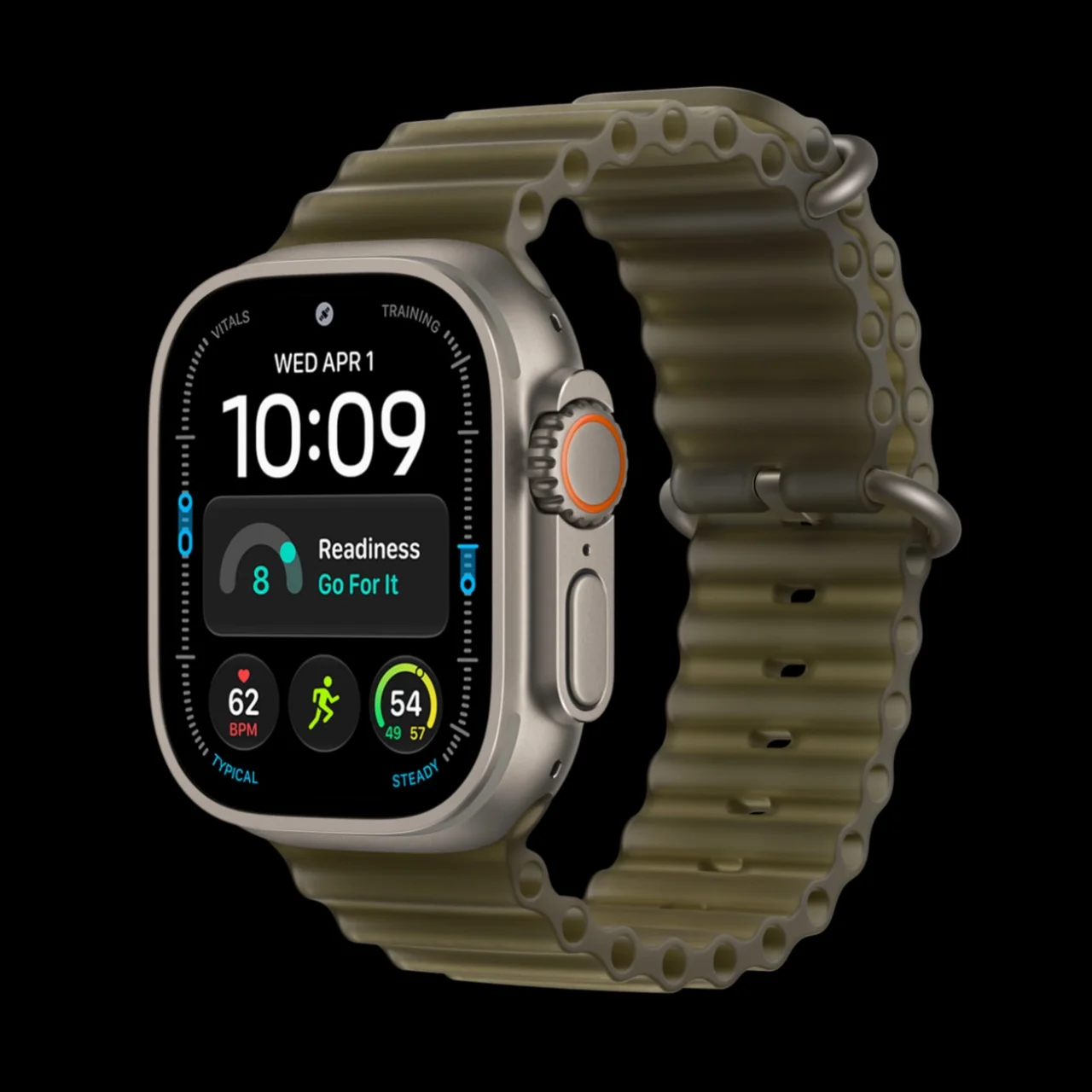
Apple Watch Ultra 4
Verdict
The first Apple Watch that doesn’t make you think about charging every day — and that single change rewires the whole experience for triathletes. 50-hour rated battery (real-world tests land at 48 hours to 3 days), dual-frequency GPS, multisport mode with transitions and open-water swim tracking. DC Rainmaker calls its heart-rate sensor “definitely the best Apple has ever made” — Tom’s Guide’s 22-mile chest-strap test came back “pretty much spot on.” At $799, it’s the best smartwatch an endurance athlete can buy.
✓ BUY IT IF
you’re in the iPhone ecosystem and want one watch for training, racing, and daily life — with dive computer credentials and satellite SOS as bonuses.
✗ SKIP IT IF
you’re an ultrarunner doing 100-milers (Garmin Fenix still wins on battery and maps), or you own an Ultra 3 (every major reviewer agrees: not worth the upgrade).
Fit / setup note: 50-hour rating is smartwatch use; expect ~18 hours of full GPS (45 in Max Extended mode). For a 70.3 or Ironman, enable low-power GPS modes and test battery drain on a long brick workout first.
iPhoneMultisportSmartwatch
✓50h rated battery, 3,000-nit display
✓Dual-frequency GPS + multisport/triathlon mode with transitions
✓Open-water swim tracking with auto multisport
✓Elite optical HR — best Apple has shipped (DC Rainmaker)
✓Dive computer, satellite SOS, siren
✓watchOS with full app ecosystem
Best alternative: Garmin Forerunner 570 if you want longer GPS battery and deeper training metrics for $250 less.
Amazon prices, images, ratings, colors, sizes, sellers, and availability can change. Verify the final checkout screen before buying.
Best battery / long course
Garmin Enduro 4
Verdict
Up to 320 hours of GPS battery with solar. Read that again. The Enduro 4 ($899.99) is best understood as an “Enduro 3.5” — identical 51mm titanium chassis to the Enduro 3, with doubled storage (64GB), 50% more RAM for faster maps, and the same absurd solar-assisted endurance. For Ironman athletes and ultrarunners, battery anxiety simply ceases to exist.
✓ BUY IT IF
you race Ironman or ultras and want to never think about charging during an event — or you want a watch that lasts over a month as a daily driver (36 days smartwatch, 90 with solar).
✗ SKIP IT IF
you own an Enduro 3 (nearly identical — hunt a discounted Enduro 3 instead), or you want a bright AMOLED display (the Enduro uses power-sipping MIP).
Fit / setup note: 51mm case wears large — try it if you have smaller wrists. The ComfortFit fabric strap is the notable out-of-box difference; confirm strap configuration when ordering, as early listings sometimes mix variants.
Ultra batteryTitaniumSolar
✓Up to 320h GPS with solar, 36 days smartwatch (90 solar)
✓51mm titanium case, Power Sapphire MIP display
✓64GB storage, 50% more RAM, 30% faster map panning
✓100+ sport profiles including rowing and rucking
✓10 ATM water rating, white + red LED flashlight
✓Multi-band GNSS, ECG, skin temperature
Best alternative: Garmin Forerunner 570 if 18-hour GPS covers your races and you’d rather save $350.
Amazon prices, images, ratings, colors, sizes, sellers, and availability can change. Verify the final checkout screen before buying.
Best budget entry
Garmin Forerunner 165
Verdict
AMOLED comes to Garmin’s entry line. At $249.99, the Forerunner 165 delivers a 1.2″ AMOLED display, 11-day battery, 19-hour GPS, and 25+ sport modes with Garmin Coach — the cheapest legitimate entry into multisport training. It lacks multi-band GPS and Training Readiness, so open-water swim tracking won’t match the 570, but for sprint and Olympic-distance athletes on a budget, it’s the smart money.
✓ BUY IT IF
you’re new to triathlon, race sprint/Olympic distance, and want Garmin’s ecosystem without the $550+ commitment.
✗ SKIP IT IF
you need multi-band GPS for open-water accuracy or a dedicated multisport transition mode.
Fit / setup note: No multi-band GPS means swim/bike GPS accuracy drops in challenging conditions (tree cover, urban canyons, choppy water). Fine for training; test it on your race course before trusting it on race day.
BudgetAMOLEDEntry
✓1.2″ AMOLED display at $249.99
✓11-day smartwatch battery, 19-hour GPS
✓25+ sport modes including swim/bike/run
✓Garmin Coach training plans
✓Wrist heart rate, Pulse Ox, incident detection
Best alternative: Garmin Forerunner 570 when you’re ready for multi-band GPS and true triathlon coaching.
Amazon prices, images, ratings, colors, sizes, sellers, and availability can change. Verify the final checkout screen before buying.
Value disruptor
Coros Pace Pro
Verdict
The value disruptor at $349 (launch price): 38-hour GPS battery and 32GB of storage — numbers that embarrass watches costing twice as much. The trade-offs are real though: no wrist calling, no Garmin Pay equivalent, and no ANT+ sensor support. For triathletes who care about battery and price above ecosystem, it’s the most interesting alternative on this list.
✓ BUY IT IF
you want maximum GPS battery per dollar and don’t need wrist calls, contactless pay, or ANT+ accessories.
✗ SKIP IT IF
you’re invested in Garmin’s training ecosystem (Training Readiness, Garmin Coach) or need ANT+ for existing sensors.
Fit / setup note: Coros’ training platform is capable but less mature than Garmin’s. If you coach yourself with third-party platforms (TrainingPeaks, etc.), this matters less.
Value38h GPS32GB
✓38-hour GPS battery at $349
✓32GB storage for maps and music
✓Lightweight multisport design
✓Capable training metrics via Coros app
Best alternative: Garmin Forerunner 165 if you prefer Garmin’s ecosystem at an even lower price.
Amazon prices, images, ratings, colors, sizes, sellers, and availability can change. Verify the final checkout screen before buying.
Match the watch to your race distance
GPS battery is the spec that matters most — and manufacturers quote best-case numbers. Here’s the honest math:
🏊
Sprint (1–2 hrs)
Any watch here works. The Forerunner 165 ($249.99) is plenty — save your money for race entries.
🚴
Olympic / 70.3 (3–8 hrs)
You want 2× your expected finish time in GPS battery. Forerunner 570 (18h) or Ultra 4 (18h, 45 extended) are the sweet spot.
🏁
Ironman (8–17 hrs)
This is Enduro 4 territory (320h solar). The 570 and Ultra 4 can do it with battery-saver GPS modes — but test on a long brick first, never trust it untested on race day.
5 mistakes triathletes make buying a watch
✗
Buying for the longest race you’ll never do.
If you race sprints, you don’t need 320-hour battery. Match the watch to the races on your actual calendar.
✗
Ignoring open-water swim GPS.
Pool swim tracking is easy. Open water is where single-band GPS falls apart — if you race in lakes or ocean, multi-band/dual-frequency is worth paying for.
✗
Trusting spec-sheet battery for race day.
Music, navigation alerts, and cold water all drain faster than the headline number. Always test on a long brick workout first.
✗
Choosing ecosystem over race needs.
Love your iPhone? Great — but if you’re racing Ironman, be honest about whether 18-hour GPS with battery-saver modes is enough, or whether Garmin’s endurance is the safer bet.
✗
Skipping the transition practice.
Multisport mode is only useful if your fingers know the button sequence under race stress. Practice transitions with the watch at least twice before race day.
Triathlon watch FAQ
Do I need a triathlon-specific watch, or will a running watch work?
A running watch works for training, but on race day you want multisport mode with automatic transitions — otherwise you’re manually starting/stopping three activities while trying to race. Every watch on this list except the budget Forerunner 165 has a dedicated multisport mode.
How much GPS battery do I really need for an Ironman?
Take your expected finish time and double it — GPS, heart rate, and music drain faster than spec sheets suggest, and cold/wet conditions drain faster still. For most athletes (10–14 hour finish), the Forerunner 570’s 18 hours or Ultra 4’s extended 45-hour mode is enough with margin. If you want zero anxiety, the Enduro 4’s 320-hour solar battery ends the conversation.
Apple Watch Ultra 4 vs Garmin for triathlon — which is better?
The Ultra 4 is the better smartwatch — apps, calls, dive computer, satellite SOS — with genuinely elite heart-rate accuracy (DC Rainmaker: “definitely the best Apple has ever made”). Garmin wins on GPS battery life, maps/navigation (“the single biggest gap” per DC Rainmaker), and training ecosystem depth. iPhone athletes racing up to 70.3: Ultra 4. Long-course or data-driven athletes: Garmin.
Can I use a triathlon watch as a daily smartwatch?
Yes — and this is where the AMOLED models (Forerunner 570, Ultra 4, Forerunner 165) pull ahead of the MIP-display Enduro 4. The 570 and Ultra 4 look and feel like modern smartwatches; the Enduro 4 looks like the tool it is.
What’s the cheapest watch that can actually race a triathlon?
The Garmin Forerunner 165 at $249.99 — 25+ sport modes, 19-hour GPS, Garmin Coach. It lacks multi-band GPS and a one-button multisport transition mode, so you’ll manage transitions manually and swim GPS will be less precise in open water. For sprint distance, that’s a completely reasonable trade at this price.
What is multisport mode on a triathlon watch?
Multisport mode lets you record swim, bike, and run as one continuous activity with automatic transition timing. You press one button (usually the lap button) when you exit the water and again when you leave transition — the watch logs each leg plus your T1/T2 times separately. Without it, you’d have to manually stop and start three separate activities mid-race.
Is the Apple Watch Ultra 4 water resistant enough for triathlon swimming?
Yes. The Ultra 4 is rated WR100 (100m water resistance) with EN13319 dive certification, and it has a dedicated open-water swim mode plus automatic multisport transitions. It’s the first Apple Watch genuinely suitable for triathlon — earlier models lacked the battery life, not the water resistance.
How accurate is wrist heart rate during a triathlon?
It depends on the sensor and the sport. DC Rainmaker’s testing found the Apple Watch Ultra 4’s sensor “definitely the best Apple has ever made” — nearly matching a chest strap on a 22-mile run. Garmin’s Elevate v5 (Forerunner 570) is also strong for running and cycling. But no wrist sensor matches a chest strap in the swim leg — water disrupts optical readings. For race-critical HR data, pair any of these watches with a chest strap.
Forerunner 570 vs 970 for triathlon — is the 970 worth $200 more?
The Forerunner 970 ($749.99) adds onboard maps, an LED flashlight, and ECG over the 570. If you navigate unfamiliar courses or train on trails, maps alone may justify it. For most triathletes racing marked courses, the 570’s $549.99 price and identical triathlon coaching make it the better value — that’s $200 toward race entries.
Can a triathlon watch track my transitions?
Yes — that’s exactly what multisport mode is for. When you press the lap/transition button, the watch stops the current leg’s timer and starts a transition timer, so your final file shows swim time, T1, bike time, T2, and run time as separate splits. All five watches in this guide support transition tracking except the budget Forerunner 165, which requires manual activity switching.
The bottom line
Most triathletes should buy the Garmin Forerunner 570.
At $549.99 it’s the only watch here that combines AMOLED, multi-band GPS, true triathlon coaching, and 18-hour battery without flagship pricing. iPhone loyalists: the Ultra 4. Ironman athletes: the Enduro 4. Tight budget: the Forerunner 165. Match the watch to your longest race, buy from the finalists above, and test everything on a brick workout before race day.
Trusted external resources
We link out to primary sources so you can verify every claim in this guide yourself. Manufacturer pages for specs and firmware updates, independent testers for accuracy data:
Official manufacturer pages
⌚
Garmin Forerunner 570 — Official Specs ↗
Full specifications, size options, and firmware updates direct from Garmin. The authoritative source for battery claims and sensor lists.
🍎
Apple Watch Ultra 4 — Official Page ↗
Apple’s product page with Health Sensing System details, battery ratings, and dive/satellite feature documentation.
⌚
Garmin Forerunner 165 — Official Specs ↗
Official specs for the budget pick — display, battery, sport modes, and water rating.
📰
Garmin Enduro 4 — Official Launch Announcement ↗
Garmin’s official press release: pricing, solar battery claims, ComfortFit strap, and new training features.
🏃
COROS Pace Pro — Official Page ↗
COROS official product page with 38-hour GPS claim, AMOLED display specs, and training platform details.
Independent testing & reviews
🔬
DC Rainmaker — Sports Tech Reviews ↗
The gold standard for GPS and heart-rate accuracy testing. Every watch here has been through Ray’s lab-grade protocols — his in-depth reviews are the most rigorous in the industry.
External links open in a new tab. We have no commercial relationship with these manufacturers — they’re linked as primary sources for verification.
Sources & further reading
Specifications verified against our in-depth reviews and manufacturer documentation:
Independent test results cited (DC Rainmaker heart-rate/GPS testing, Tom’s Guide 22-mile chest-strap run) are via our Ultra 4 review’s evidence analysis. Prices are manufacturer list at time of writing; Amazon pricing fluctuates.
Alexios leads GearUpToFit’s running-shoe reviews, fitness-technology coverage, training guides, calculators, and nutrition explainers with a practical, evidence-aware editorial process. The goal is simple: help readers compare options clearly, understand tradeoffs, and make safer decisions for real training needs.
Reader-supportedNo paid placement overrides recommendationsEvidence-awareClaims checked against reputable sourcesMaintainedUpdated when product or safety context changes
Editorial promise
Recommendations are judged by usefulness, fit, safety, source quality, product availability, and clear disclosure of tradeoffs — not by commission size.
Article details
Review type
Independent product review
Updated
Reading time
14 min read
Originally published
What this page checks
Product fit and real-use tradeoffs
Manufacturer specs and current availability
Reader safety, disclaimers, and affiliate transparency

 Skip to content