Skip to content
 This Apple Watch Ultra 4 review is an evidence-based buying analysis for runners, triathletes, and outdoor athletes. We reviewed Apple’s technical documentation, DC Rainmaker’s full in-depth testing, Tom’s Guide’s 22-mile chest-strap run test, multiple independent battery tests, and the available launch-issue reports — then organized it all around one question: should you spend $799 on this watch?
- The Ultra 4 is Apple’s best endurance watch by a wide margin — 50-hour rated battery (real-world tests land at 48 hours to 3 days), dual-frequency GPS, and the new Health Sensing System shared with the Series 12.
- Don’t upgrade from the Ultra 3. The consensus across every major reviewer: same design, same display, same $799 — the gains are the new sensors, Readiness score, and ~20% more battery. Ultra 1 and Ultra 2 owners, this is your upgrade.
- Heart-rate accuracy is genuinely elite. DC Rainmaker calls it “definitely the best Apple has ever made”; Tom’s Guide’s 22-mile run against a chest strap came back “pretty much spot on.”
- It’s still not a Garmin for ultrarunners. 18 hours of full GPS (45 in Max Extended mode) vs. 54+ on a Fenix — and Apple’s maps/navigation remain, in DC Rainmaker’s words, “the single biggest gap” vs. endurance rivals.
- Launch bugs were real but mostly fixed. Random restarts were patched in watchOS 27.0.1 (Sept 23); slow Readiness scores may still be ironing out.
Watch: DC Rainmaker’s in-depth video review
Before the written deep-dive, watch the most rigorous test this watch will ever get. DC Rainmaker’s full Apple Watch Ultra 4 review covers multi-hour GPS battery drain tests, heart-rate accuracy against chest straps across intervals and trail runs, and the Readiness score’s teething problems — the perfect companion to this written Apple Watch Ultra 4 review.
Video: DC Rainmaker’s full in-depth review — battery drain tests, GPS and heart-rate accuracy, and his verdict on who should upgrade.
Quick verdict
The Apple Watch Ultra 4 is the first Apple Watch that doesn’t make you think about charging every day — and that single change rewires the whole experience. Two-day real-world battery, the best optical heart-rate sensor Apple has ever shipped, dual-frequency GPS, dive computer credentials, and satellite SOS, all for the same $799 as the Ultra 3.
But let’s be precise about what it is and isn’t. It isn’t a redesign — put it next to an Ultra 3 and you’ll squint. It isn’t a reason for Ultra 3 owners to upgrade — every major reviewer agrees on that. And it isn’t a Garmin Fenix killer — for 100-mile races and multi-day adventures, Garmin and Coros still win on battery and maps.
What it is: the best smartwatch an endurance athlete can buy, and the obvious upgrade for anyone on an Ultra 1 or Ultra 2. If you run, ride, swim, hike, or dive — and you live in the iPhone ecosystem — this is Apple’s very best. Our rating of the evidence: 9/10 for the target athlete, 6/10 as an upgrade from the Ultra 3.
Our scores
Numbers are opinions; these are ours, after weighing every independent test against Apple’s claims:
Apple Watch Ultra 4 at a glance
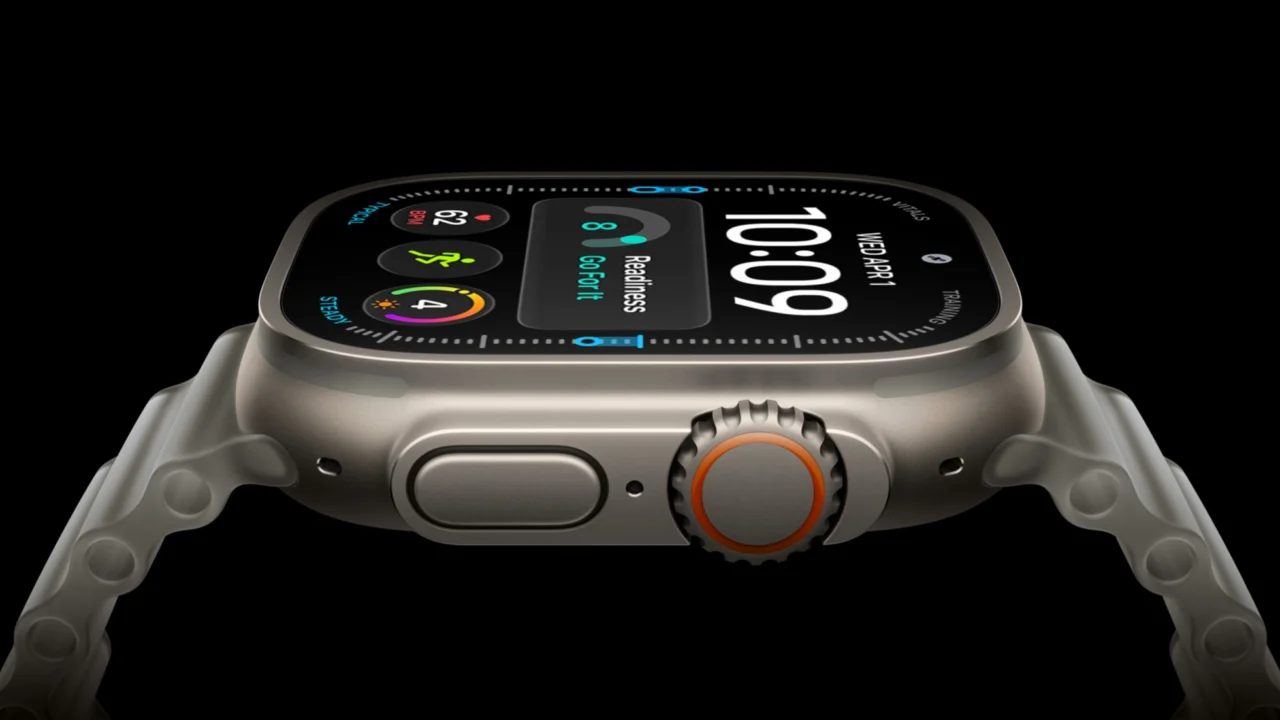
Photo: Apple
Key specifications
| Specification | Details |
|---|---|
| Case | 49mm, grade-5 titanium (natural or black), 49 × 44 × 12mm |
| Weight | 63.0g (natural) / 63.1g (black) |
| Display | Always-On Retina LTPO3 OLED, 422×514, 3,000 nits peak, 1 nit min, sapphire |
| Chip | S11 SiP, 4-core Neural Engine, W3 wireless |
| Storage | 64GB |
| Battery (rated) | 50h normal · 84h Low Power · 18h workout · 25h Extended · 45h Max Extended |
| Charging | 15 min → 18h use; 0–80% in ~45 min |
| GPS | Precision dual-frequency L1+L5 (GPS, Galileo, QZSS, BeiDou; GLONASS removed) |
| Water | WR100 (ISO 22810), EN13319 dive-rated to 40m, IP6X dust |
| Health | ECG, blood oxygen, wrist temp, sleep apnea notifications, hypertension notifications, Readiness score, sleep score |
| Safety | Satellite SOS/Messages/Find My (2 yrs incl.), 86dB siren, crash/fall detection |
| Connectivity | 5G RedCap + LTE cellular (standard), Wi-Fi 4, Bluetooth 5.3, UWB gen 2, NFC |
| Durability | MIL-STD 810H, −20°C to 55°C on-wrist operating range |
| OS / Phone | watchOS 27; requires iPhone 11+ with iOS 27 |
| Price | From $799 — unchanged from Ultra 3 |
Sources: Apple Newsroom (Sept 9, 2026), Apple’s tech specs via MacObserver, the5krunner specs database.
What’s new vs the Ultra 3
The Ultra 4 is an internals upgrade wearing last year’s body. Here’s the complete delta:
| Feature | Ultra 4 | Ultra 3 |
|---|---|---|
| Chip | S11 | S10 |
| Normal battery | 50h | 42h |
| Low Power Mode | 84h | 72h |
| GPS workout battery | 18h | 14h |
| Extended / Max Extended workout | 25h / 45h | 20h / 35h |
| Health sensors | New Health Sensing System | Previous generation |
| Readiness score / Recovery HRV | Yes | No |
| Audio Intelligence | Yes (needs S11) | No |
| Single-tap gesture | Yes | No |
| 15-min charge | 18h of use | 12h of use |
| GNSS constellations | L1+L5 (GLONASS removed) | L1+L5 incl. GLONASS |
| Case / display / water / dive | Unchanged | — |
| Weight | 63.0g | 61.6g |
| Price | $799 | $799 (discontinued) |
The honest summary: bigger battery, new sensors, new software. Everything you touch and see is the same. That’s why MacRumors’ buyer’s guide says “for the vast majority of Ultra 3 owners, the Ultra 4 is not worth upgrading to” — and why DC Rainmaker frames it as “a solid upgrade for earlier Ultra owners, especially the Ultra 1.”
Design, display, and comfort

Photo: Apple
Apple didn’t redesign the Ultra 4. Same 49mm grade-5 titanium case, same flat sapphire crystal, same orange Action button, same 3,000-nit display. Gizmodo calls the design “stale”; TechRadar says “visually similar.” They’re right — and for a tool watch, that’s arguably a feature: every Ultra band ever made still fits, the case is proven to MIL-STD 810H, and you already know exactly how it wears.
What changed is small but real: it’s 1.4g heavier (63.0g), the titanium is now 100% recycled and 3D-printed, and there are new band colors — burgundy Alpine Loop, translucent kelp Ocean Band, new Trail Loop shades. The display remains the best on any smartwatch: 3,000 nits readable in direct desert sun, 1-nit minimum with Night Mode for 3am ultra aid stations.
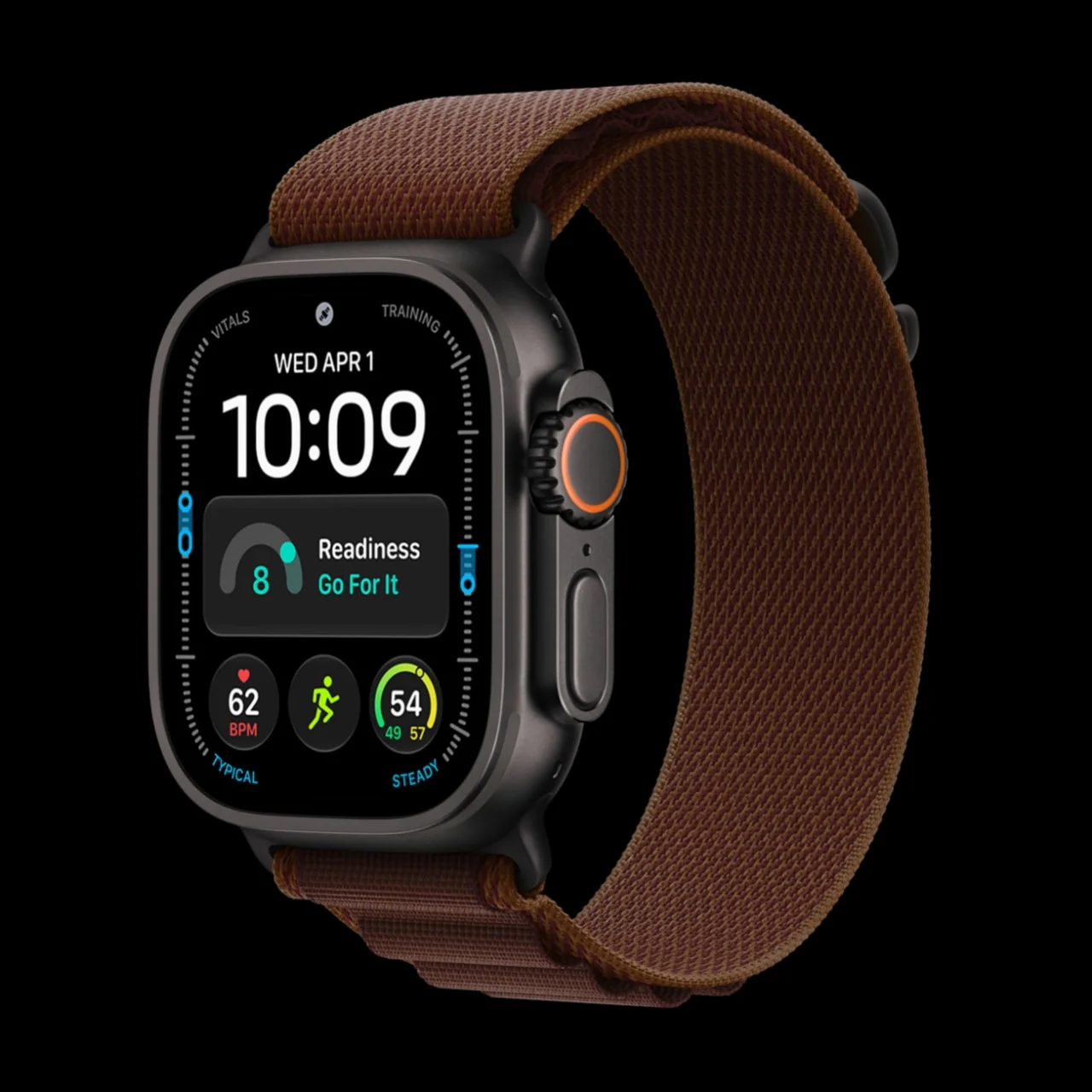
Photo: Apple
Comfort note for runners: 63g is noticeable next to a 32g aluminum Series 12, but the weight sits flat and balanced — trail runners in early reviews report forgetting it within a mile. If you’re coming from a Garmin Fenix (similar weight class), it’ll feel like home.
Battery life: the two-day barrier finally falls
This is the Ultra 4’s headline, and the numbers hold up. Apple rates it at 50 hours normal use (up from 42), 84 hours in Low Power Mode, 18 hours of full GPS+HR workout tracking, and two extended workout modes: 25 hours (Extended) and 45 hours (Max Extended) — the latter, Apple says, is “typically enough to finish a 100-mile race.”
Independent tests confirm the rating is honest:
- DC Rainmaker: 2 full days with heavy daily workouts; GPS drain tests extrapolated to ~18.5 hours — matching Apple’s 18h claim almost exactly. “Squeaking by and holding up.”
- 9to5Mac: 48 hours real-world — 100% Sunday 8pm to Tuesday 8pm, including 90 minutes of workouts, 3 hours off-iPhone, and 2 nights of sleep tracking. “Lives up to Apple’s battery life claims.”
- Tom’s Guide: “up to 48 hours per charge.”
- Mashable: “roughly three days between charges” in lighter use.
- Gizmodo: charged every 2–3 days over weeks of testing.
Charging got faster too: 15 minutes buys 18 hours of use (up from 12), and 0–80% takes ~45 minutes. The practical effect: charge while you shower and you may never think about battery again — the psychological shift from “daily charger” to “occasional top-up” is the Ultra 4’s biggest quality-of-life upgrade.
A note on rumors: some aggregator sites cited “74 hours” from PCMag. We couldn’t verify a primary PCMag source for that figure, so we don’t cite it. The verified range is 48 hours to ~3 days depending on use.
Ultra 4 battery estimator
Apple’s 50-hour rating assumes a specific mix. Drag the sliders to match your training week — the estimate uses DC Rainmaker’s measured ~5.4%/hour GPS drain rate.
Can it finish your race?
Here’s the question every endurance athlete actually asks. Drag the slider to your expected finish time — we’ll tell you exactly which battery mode covers it, and whether you should be looking at Garmin instead. Nobody else has built this for the Ultra 4.
GPS accuracy: dual-frequency, honestly assessed
The Ultra 4 keeps precision dual-frequency GPS (L1+L5) — the Series 12 is single-frequency only. Apple claims “the most accurate on-device GPS in a sports watch,” based on its own urban-canyon route tests. Independent verdict from DC Rainmaker: “nearly identical to previous” Ultra generations and “largely perfectly fine across the board” — interval loops and trail runs all tested good.
One real change: Apple removed GLONASS from the Ultra 4’s constellation list (GPS, Galileo, QZSS, BeiDou remain). Apple told DC Rainmaker it has no accuracy impact, and his testing agrees. In his side-by-side work, dual- vs single-frequency is “mostly a wash” — the Series 12 occasionally shows slight offsets only a nitpicker would catch.
The honest limit: GPS accuracy was never the Ultra’s problem — maps and navigation are. DC Rainmaker calls Apple’s mapping/routing/navigation “probably now the single biggest gap for the company when it comes to competing with most other endurance sports watches.” If your adventures need offline topo maps and turn-by-turn trail routing, Garmin still owns that category.
Heart-rate accuracy: the best sensor Apple has ever made
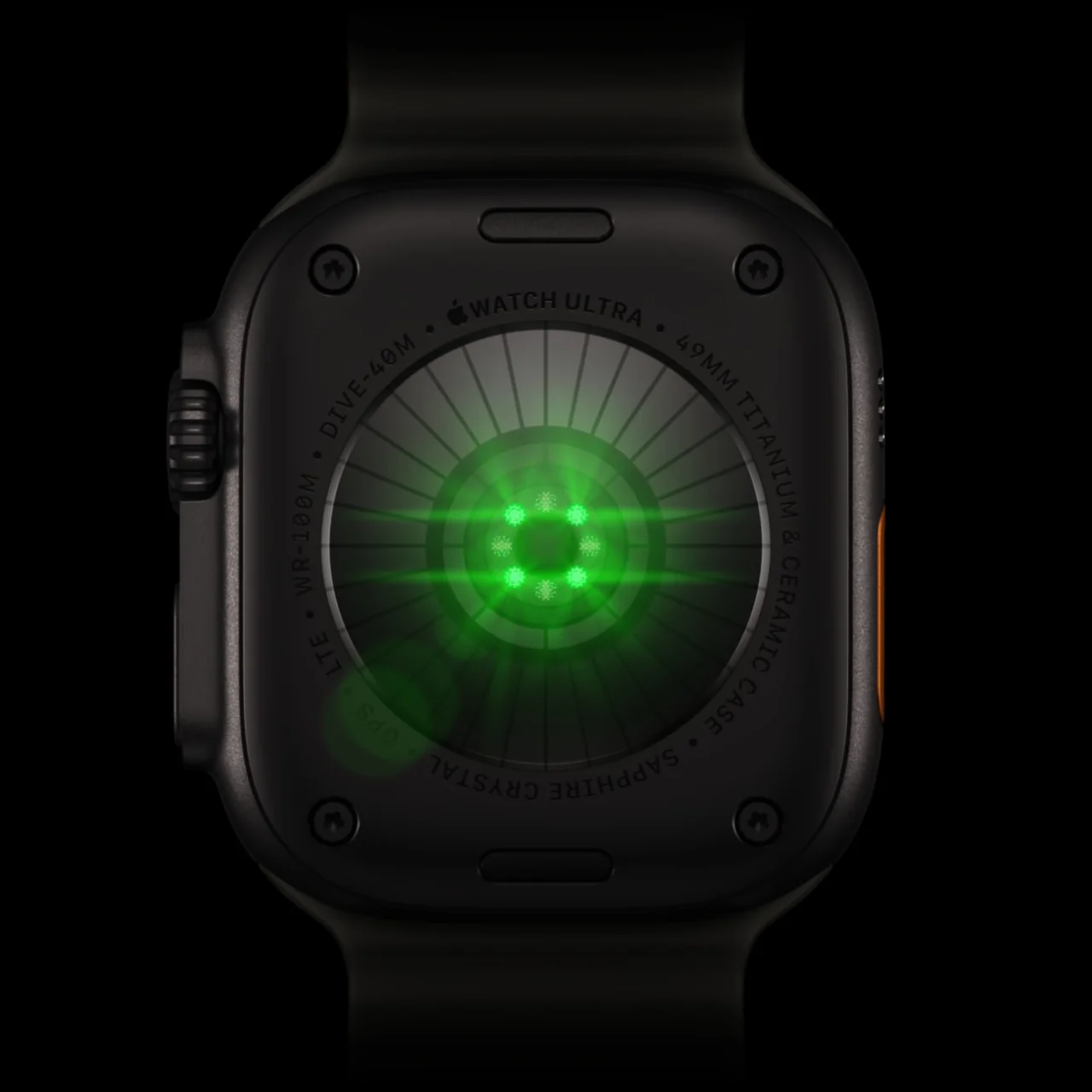
Photo: Apple
The Ultra 4 carries the identical Health Sensing System as the Series 12 — DC Rainmaker’s comparison states it explicitly. Background heart rate every 5 seconds (60× more frequent than before), HRV sampling up to 24× more often, a redesigned optical array with more LEDs and photodiodes.
Layer 1 — Apple’s study. Apple tested 1,000+ diverse participants against a Polar H10 chest strap and found the Ultra 4 (and Series 12) more accurate than the Garmin Forerunner 970, Pixel Watch 4, Huawei Watch 5, Galaxy Watch 8, Whoop 5.0, and Oura Ring 5 in the vast majority of 159 comparisons. Caveats from analyst the5krunner: Apple sponsored, designed, and ran the study; tattooed participants were excluded; and it validates heart-rate in beats per minute — not HRV accuracy, which needs millisecond beat-to-beat precision and is what Readiness actually runs on.
Layer 2 — independent testers. DC Rainmaker, across trail runs, Peloton intervals, rowing, 10×400m and 8×600m track intervals, and multi-hour road rides: “very, very good” throughout, with occasional 11–14 second dropouts and spikes visible only when zoomed in. His verdict: “The optical HR sensor is definitely the best Apple has ever made.” Tom’s Guide ran 22 miles against a chest strap: “pretty much spot on” — and calls the new HR monitor “the reason I think this is the best Apple Watch Ultra yet.” The Quantified Scientist’s early Ultra 4 lab test covers HR, step counting, and GPS (full figures pending); his Series 12 numbers on the same sensor system were ~1.0 cycling, 0.98 running, 0.97 lifting vs. Polar H10.
Layer 3 — the technical nuance. Same as Series 12: during workouts the sensor updates on average every 5 seconds — it can sample every second or gap up to ~20 seconds depending on signal confidence, and low-confidence points are skipped rather than plotted. The on-watch HR display refreshes only every 5 seconds, so as DC Rainmaker notes, “any fast-moving intervals will be wrong 80% of the time on the display.” For intervals where seconds matter, pair a Bluetooth chest strap.
Bottom line on HR: for zone training, tempo work, and trend tracking, the Ultra 4’s wrist HR is now genuinely trustworthy — roughly on par with the best optical sensors in the industry, per DC Rainmaker (“better than most sensors out there”). The remaining gap vs. chest straps is display latency and brief dropouts, not average accuracy.
Readiness score: genuinely useful, still ironing out bugs
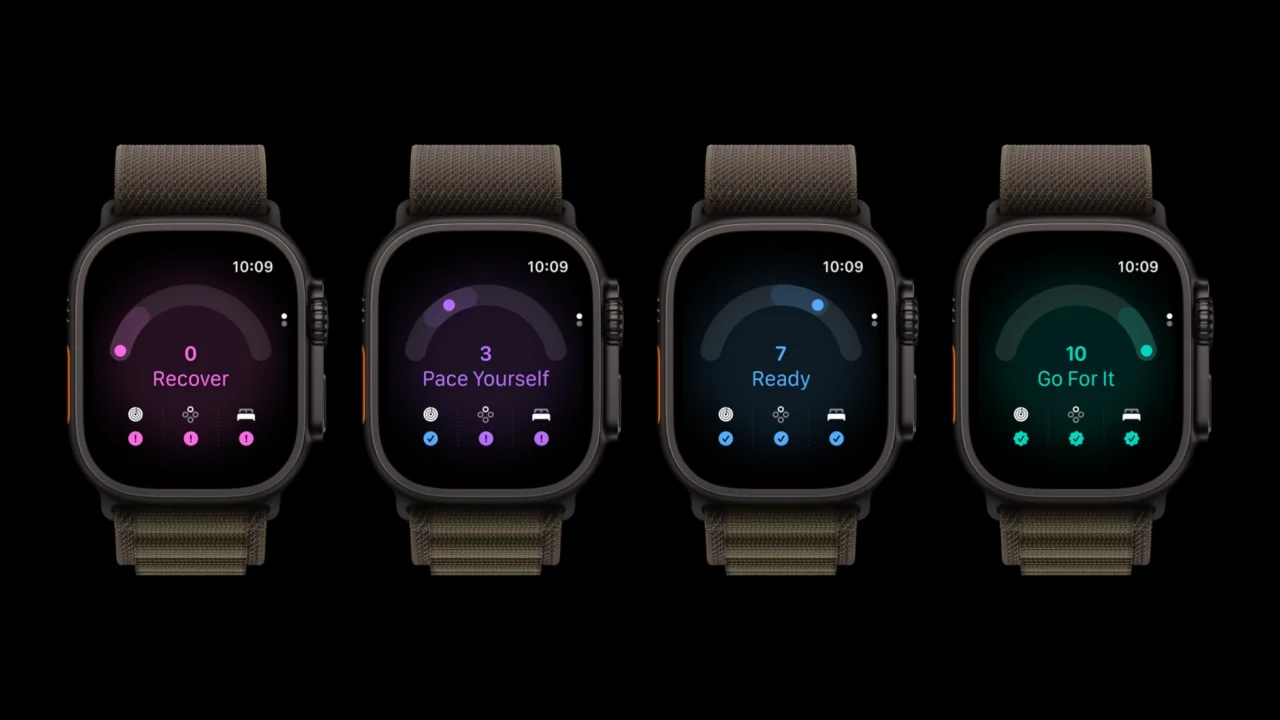
Photo: Apple
The Readiness score (0–10, with Recover / Pace Yourself / Ready / Go For It guidance) blends recent activity, training load, vitals, and sleep score, updating through the day. DC Rainmaker praises the dynamic all-day score as “critical, and a piece that both Whoop & Google/Fitbit are missing” — close to Garmin’s approach, though “Garmin’s tends to be a bit more responsive.”
The honest part: launch was bumpy. DC Rainmaker’s watches took up to 4 hours to display a score, with “teething bugs around disappearing readiness values.” Apple told him they’re working on it. If your score is missing entirely, Apple’s support doc lists four checks: Health Details filled in, Activity set up, overnight vitals enabled, and 7+ nights of sleep tracked on the watch. Give it a full week before judging it — and remember the HRV-accuracy caveat from the heart-rate section: Readiness is “promising” rather than “proven” until independent HRV validation lands.
Health features: the full clinic on your wrist
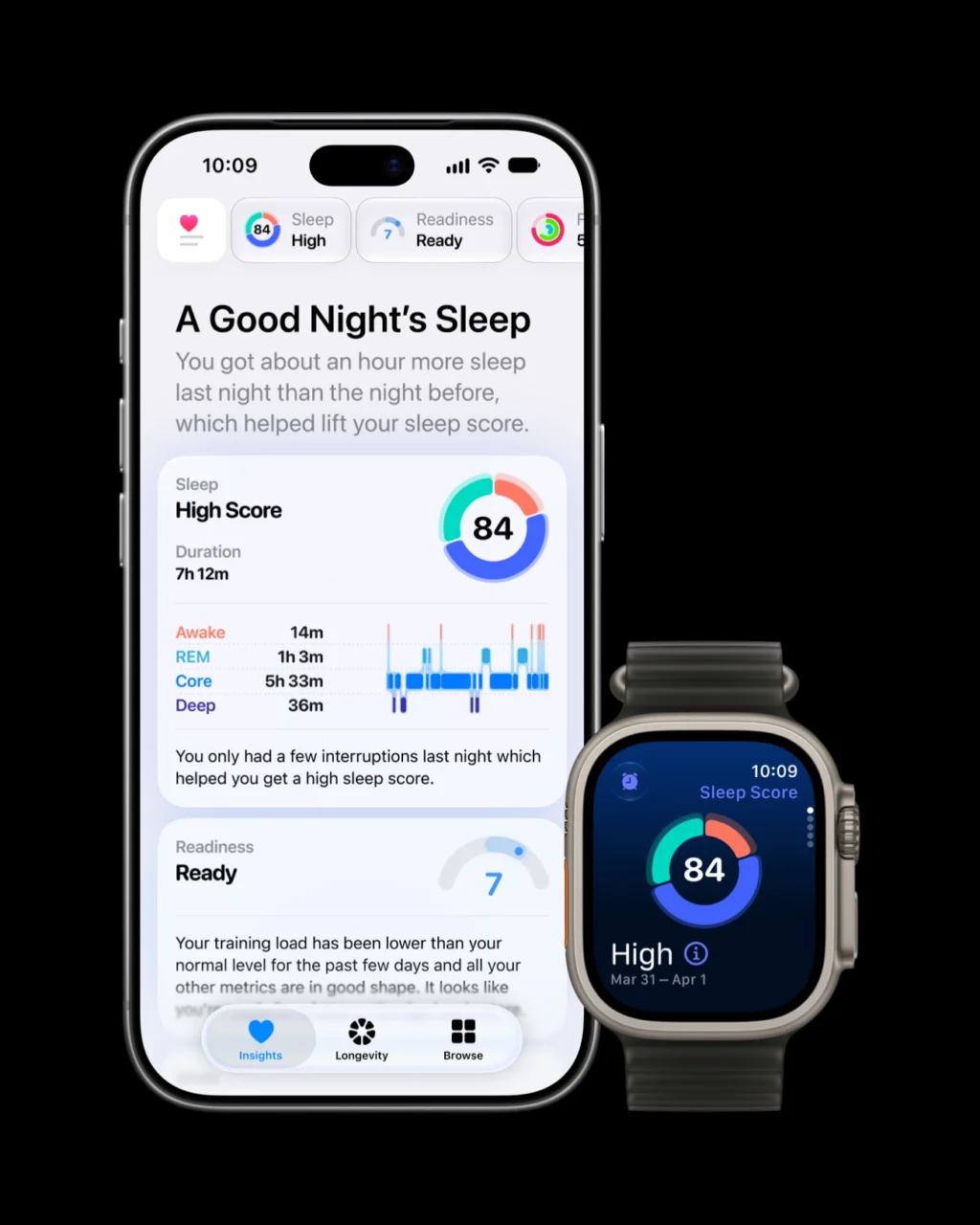
Photo: Apple
The Ultra 4 inherits the complete Series 12 health stack: ECG app, blood oxygen sensing, wrist temperature, sleep apnea notifications, sleep score, and hypertension notifications (trend-based alerts over weeks — not live blood-pressure readings, and unavailable in 33 countries/regions including Canada, India, Australia, and Japan pending regulatory clearance).
What the Ultra adds for health tracking is continuity: with 2–3 day battery, sleep tracking stops being a charging-logistics problem. Overnight vitals, Recovery HRV, and respiratory rate finally get the unbroken multi-night baselines they need to be meaningful. The redesigned Health app (Insights tab, Longevity tab with Health Age) arrives later in 2026 — reviewers note it’s not fully there at launch.
The framing that matters: these are pattern alerts, not diagnoses. The ECG is FDA-cleared for AFib screening; everything else is a conversation starter with your clinician, not a replacement for one.
Adventure toolkit: dive, satellite, siren
This is where the Ultra 4 justifies its existence over the Series 12:
- Dive computer: EN13319 certified to 40m with ±1m depth accuracy, water temperature sensor, Depth app. Genuine recreational scuba credentials — the Series 12 is rated to just 6m.
- Satellite: Emergency SOS, Messages, and Find My via satellite, with 2 years included. (Find My and Messages need a carrier plan; Emergency SOS doesn’t.)
- 86dB siren: audible over long distances if you’re injured on a trail.
- 100m water resistance (WR100, ISO 22810), IP6X dust, MIL-STD 810H, −20°C to 55°C on-wrist operating range.
- Precision Start and the customizable Action button for instant workout/marker/dive functions.
None of this matters for road running. All of it matters the first time you’re 10 miles from the trailhead with no cell signal.
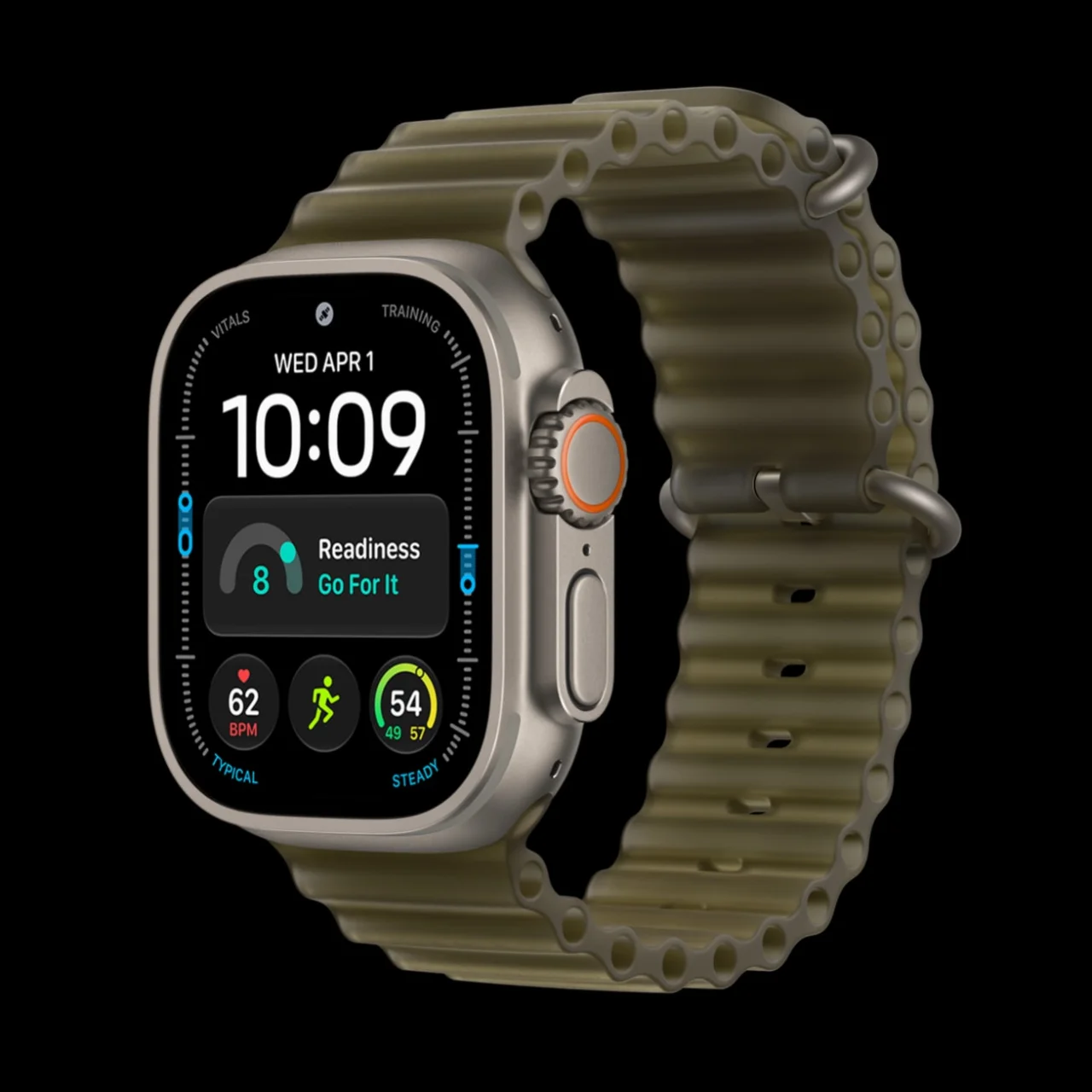
Photo: Apple
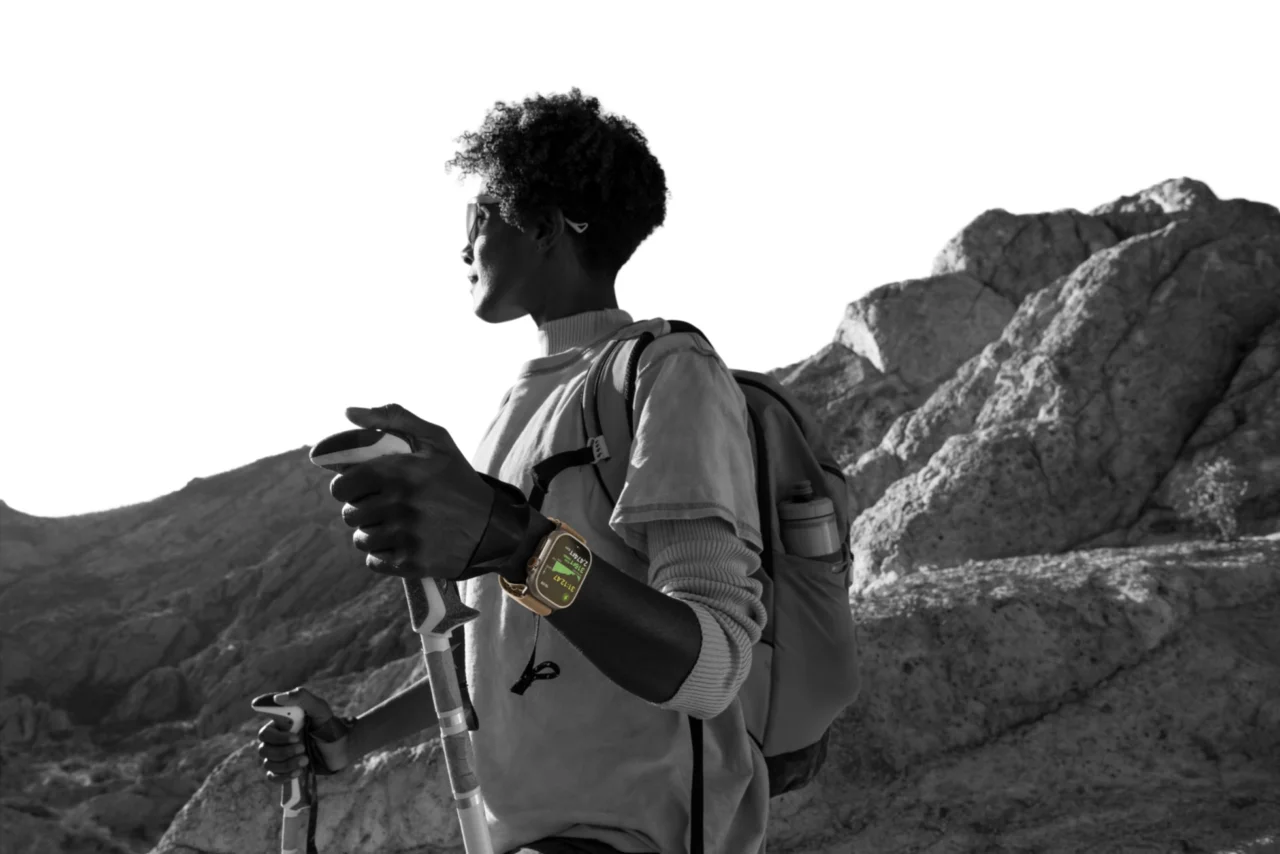
Photo: Apple
For runners and triathletes: the complete picture
Everything in our Apple Watch Series 12 review about running features applies here — Pacer, Race Route, automatic track detection, custom workouts, wrist-based running power, cadence, stride length, heart-rate zones, training load — plus the Ultra-only advantages:
- 18 hours of full GPS+HR covers any marathon and most 50Ks; 25h Extended and 45h Max Extended modes stretch to 100-milers (with reduced metrics and alerts off).
- Dual-frequency GPS for cleaner tracks in cities and canyons.
- 7 data fields per workout screen (vs 6 on Series 12).
- Multisport/triathlon mode with transitions, open-water swim tracking, and auto multisport.
- Cellular on every unit — leave the phone behind with music streaming and live tracking.
The gap that remains is analytics depth: Apple’s Fitness app is “pretty thin on stats, analysis” (DC Rainmaker) — pair it with HealthFit or TrainingPeaks if you coach yourself on data. And for true ultras, remember Outside’s observation: you’ll rarely see an Ultra 4 at a 100-mile start line next to Garmin Enduros and Coros Apexes with 60–120h GPS batteries.
Marathon race day, hour by hour
Specs are abstract. Here’s what the Ultra 4 actually feels like on the biggest day of your season — a 4-hour marathon, start to finish:
This is the Ultra 4’s real product: not a spec sheet, but the absence of battery anxiety on the days that count.
Smart features, Siri AI, and the privacy question
The S11’s Secure Exclave enables Audio Intelligence: Sound Recognition (sirens, alarms, doorbells, baby crying — on-device, works without iPhone), Instant Shazam on wrist-raise, and — arriving as opt-in betas late 2026 — Live Rewind (double-press the crown to see the last 15 seconds of conversation as text) and Siri Recap (automatic conversation summaries). Apple says no audio recordings are created or stored and no speaker names are identified — but Mashable and others have flagged the obvious discomfort of a watch that listens to conversations. The betas are English-first and not initially available in the EU.
The new Siri (Apple Intelligence-powered, watchOS 27) understands personal context and gets a dedicated Modular face. There’s also a new single-tap gesture (thumb+index) for the Smart Stack, while double-tap now scrolls it. Workout Buddy works without the iPhone nearby and now speaks Spanish too.
Our take: Sound Recognition and Shazam are genuinely useful; the conversation features are opt-in for a reason — keep them that way until the privacy story is proven in the real world.
watchOS 27 and launch stability
watchOS 27 brings the redesigned Health app, Readiness, sleep score, the new Siri, and improved step counting (Apple claims “most accurate step tracking of any smartwatch” from a 1,000-step video-validated test). One honest footnote: automatic handwashing detection is missing on the Ultra 4 despite watchOS 27 including it.
Launch stability deserves a straight answer. The Ultra 4 (and Series 12) suffered random restarts in the first week — ~30 documented cases of reboots during Siri, calls, workouts, even idle, traced to an Apple Neural Engine timeout (a 2,020ms command against a 2,000ms watchdog limit). Apple shipped watchOS 27.0.1 on September 23 — under a week after launch — fixing it. If you’re buying now, update on day one and this is behind you.
Pros and cons
Who should buy it — find yourself
The marathoner chasing a BQ
You train 6 days a week, race 2–3 marathons a year, and your current watch dies if you forget one charge. The Ultra 4’s 18-hour GPS mode covers your longest run with margin, the HR sensor is finally trustworthy for zone work, and Readiness gives you a daily green/yellow/red light. Verdict: buy.
The trail runner / hiker
Dual-frequency GPS, offline-capable tracking, 86dB siren, satellite SOS, 100m WR, and a display you can read in full sun. The navigation gap vs. Garmin is real, but for most trail runners the Ultra 4 is the better overall device. Verdict: buy.
The triathlete
Multisport mode, open-water swim tracking, 18h GPS covers any Ironman (cutoffs are 17h), cellular for phone-free bricks. If you’re racing 70.3 and below, this is the pick. Full-Ironman athletes pushing 14–17h should consider Max Extended mode or a Garmin. Verdict: buy for 70.3; think hard for full Ironman.
The diver / waterman
EN13319 to 40m, depth gauge, water temp, Ocean Band options. It’s a legitimate backup dive computer. Verdict: buy.
The data-obsessed self-coach
Here’s the friction: Apple’s Fitness analytics are thin. You’ll want HealthFit, Athlytic, or TrainingPeaks alongside it. If you live in Garmin Connect’s training load charts, switching ecosystems is a real cost. Verdict: try before you switch.
Who should skip it
- Ultra 3 owners — the universal reviewer consensus: not worth $799 for the delta.
- 100-mile ultrarunners — 45h Max Extended can finish one, but Garmin Enduro/Coros Apex do it with full metrics and margin.
- Budget buyers — the Series 12 at $399 has the same sensors, chip, and Readiness.
- Android users — iPhone required, no exceptions.
What most reviews get wrong about the Ultra 4
Having read essentially every major review, three corrections are worth making:
1. “It’s just a bigger Series 12.” Software, yes — capabilities, no. The identical chip, sensors, and Readiness obscure real hardware gaps: dual-frequency GPS, 18h vs 10h workout battery, 40m dive rating vs 6m, satellite SOS, siren, Action button, 3,000 vs 2,000 nits. For a road runner these don’t matter; for anyone off-road they define the purchase.
2. The battery story is understated, not overstated. Apple’s 50-hour rating sounded like marketing until four independent testers landed at 48 hours to 3 days. The more important number is psychological: this is the first Apple Watch where charging becomes occasional. Reviewers who fixate on “only 2 days vs Garmin’s 29” miss that 2 days crosses the line from daily-chore to non-issue.
3. “No reason to upgrade” is true for Ultra 3 owners and misleading for everyone else. The upgrade calculus splits cleanly by what you own: Ultra 1 (no watchOS 27 at all) → massive upgrade; Ultra 2 → big upgrade; Ultra 3 → skip; Series watches → the question is Ultra 4 vs Series 12, answered below.
Ultra 4 vs Ultra 3: the upgrade question, settled
If you own an Ultra 3, here’s the decision in one paragraph: you keep the same case, display, water resistance, dive rating, satellite features, and $799 price. You gain the Health Sensing System, Readiness score, Audio Intelligence, ~20% more battery everywhere (50/84/18/25/45h vs 42/72/14/20/35h), faster charging, and the S11 chip. Every major reviewer — MacRumors, Gizmodo, IndustryWired, DC Rainmaker — lands in the same place: not worth $799 for Ultra 3 owners. Wait for the Ultra 5, or buy when your Ultra 3’s battery degrades.
If you’re on an Ultra 1, it’s a different conversation: you don’t even get watchOS 27, so you’re missing Readiness, the new Siri, and current health features entirely — plus 36h→50h battery and satellite connectivity you never had. That’s the upgrade that makes sense. Ultra 2 owners sit in between: meaningful gains, worth it if the battery or sensors matter to your training.
Ultra 4 vs Series 12: which Apple Watch for runners?
Same chip. Same sensors. Same Readiness. Same watchOS. So the $400 question is what the extra money buys:
| Ultra 4 ($799) | Series 12 ($399) | |
|---|---|---|
| Battery | 50h / 18h GPS | 24h / 10h GPS |
| GPS | Dual-frequency | Single-frequency |
| Case | 49mm titanium, 63g | 42/46mm aluminum, 32–43g |
| Display | 3,000 nits | 2,000 nits |
| Adventure | 40m dive, satellite SOS, siren, Action button | 6m WR, no satellite/siren |
| Cellular | Standard | +$100 option |
| Buy if | You train long, go off-road, dive, or hate charging | Road running, gym, daily health — the smart money |
Read our full Apple Watch Series 12 review for the deep-dive on the shared platform. The rule of thumb: if your longest workout is under 2 hours and you stay on roads, the Series 12 is the better buy. The Ultra 4 earns its premium on battery, durability, and adventure features.
Ultra 4 vs Garmin: the endurance reckoning
Here’s the battery truth, side by side:
| Watch | Everyday | GPS workout |
|---|---|---|
| Apple Watch Ultra 4 | 50h (84h LPM) | 18h / 25h Ext / 45h Max Ext |
| Garmin Forerunner 970 | 15 days | 26h (14h with music) |
| Garmin Fenix 9 (51mm) | 29 days | 54h |
| Coros Pace 4 | 19 days | 41h (31h dual-freq) |
The verdict writes itself by use case: marathon and below, plus daily life — the Ultra 4 wins on display, HR accuracy, smart features, and ecosystem. Ultras, multi-day adventures, expedition use — Garmin/Coros win on battery, native topo maps, and training analytics depth. DC Rainmaker’s summary stands: Apple’s mapping/navigation is “the single biggest gap” vs. endurance rivals. Our Garmin Forerunner 970 review covers the other side of this decision.
What the experts say
We read every major review so you don’t have to. The voices that matter most:
Should you buy it? Take the 30-second quiz
Three questions. Zero marketing. Find out whether the Ultra 4 — or something else — is your watch.

Day-one setup: 7 settings that make it an endurance watch
- Update to watchOS 27.0.1 immediately — the random-restart fix. Don’t skip this.
- Fill in Health Details completely (age, weight, medications affect HR algorithms) and enable overnight vitals — Readiness needs 7+ nights of sleep data before it scores.
- Set the Action button to Workout (or Dive, or Backtrack) — it’s the Ultra’s superpower; don’t leave it on default.
- Configure Precision Start so races start exactly on the gun, not on GPS lock.
- Set custom heart-rate zones from a real threshold test, not Apple’s age-based defaults — use our heart-rate zone calculator and running pace calculator.
- Enable Backtrack in the Compass app before your first trail run — it’s your breadcrumb trail home.
- Test Emergency SOS + siren at home so you know the hold pattern before you need it on a mountain.
5 mistakes to avoid
- Upgrading from the Ultra 3 at full price. The consensus is unanimous — wait, or buy when your battery fades.
- Judging Readiness on day two. It needs a week of data; early scores are noise. DCR’s took 4 hours just to appear.
- Expecting Garmin maps. Apple’s navigation is the weakest link — download offline maps and learn Backtrack’s limits before the backcountry.
- Ignoring the 27.0.1 update. Launch units restart randomly without it.
- Buying it for the gym. If your training is treadmills and weights, the $399 Series 12 has identical sensors and chip — the Ultra’s premium is for battery and adventure hardware you’ll never use indoors.
Value and buying advice
At $799 — unchanged from the Ultra 3 — the Ultra 4 is, as Gizmodo put it, “in this economy, any gadget that doesn’t cost more than it used to, while improving on nearly everything, is a solid value.” The math:
- First Ultra / Ultra 1 / Ultra 2: full price is fair. You’re getting 2–3 generation leaps.
- Ultra 3: don’t. Wait for discounts on the 4 or the Ultra 5.
- Series watch owners: the $400 premium over the Series 12 buys battery, durability, and adventure features — worth it only if you’ll use them.
- Deal hunters: Amazon has listed it at $779.99 (see box above); holiday sales historically take $50–80 off Ultras.
- Cellular plan: budget ~$10/month on most carriers — the Ultra has no GPS-only option, so factor it in (or don’t activate it; the watch works fine on Wi-Fi/iPhone).
The true cost: what $799 really means per day
Sticker shock is about framing. Move the slider to how long you’ll keep the watch:
Decision table
| You are… | Buy the Ultra 4? |
|---|---|
| Marathoner / 70.3 triathlete on iPhone | Yes — the target athlete |
| Trail runner / hiker / diver | Yes — adventure toolkit earns it |
| Ultra 1 or Ultra 2 owner | Yes — the upgrade that makes sense |
| Ultra 3 owner | No — wait |
| 100-mile ultrarunner | Probably not — Garmin/Coros territory |
| Road runner, workouts under 2h | Get the Series 12 — save $400 |
| Android user | No — iPhone required |
Bottom line
The Apple Watch Ultra 4 is the endurance smartwatch Apple should have built years ago: two-day battery, elite heart-rate sensing, real adventure credentials, and the same $799 price. It’s not a revolution — it’s the Ultra concept finally executed without the daily-charging asterisk.
This Apple Watch Ultra 4 review lands where the evidence does: buy it if you’re on an Ultra 1/2, a Series watch, or buying your first serious training watch for iPhone. Skip it if you own the Ultra 3 or race 100-milers. For everyone in the first group, it’s Apple’s very best — and the first Apple Watch we’d recommend without a battery caveat.
Frequently asked questions
Is the Apple Watch Ultra 4 worth it?
For iPhone users who train outdoors, run marathons, or hated daily charging: yes. You get 50-hour battery, the best optical HR sensor Apple has made, dual-frequency GPS, dive and satellite safety features, and the Readiness score — all at the unchanged $799. For Ultra 3 owners: no, the upgrade isn’t worth it. For road-only runners: the $399 Series 12 has identical sensors and chip.
Should I upgrade from the Apple Watch Ultra 3?
No — that’s the unanimous reviewer consensus. Same case, display, water resistance, and price; the gains (new sensors, Readiness, ~20% more battery, S11) don’t justify $799. Upgrade from the Ultra 1 or Ultra 2, where the leap is two to three generations.
Should I upgrade from the Ultra 2?
Yes, if battery or health sensors matter to your training. You gain 36h→50h battery, the new Health Sensing System, Readiness score with Recovery HRV, Audio Intelligence, satellite messaging (the Ultra 2 lacks it), and faster charging — a meaningful two-generation jump.
How long does the Ultra 4 battery actually last?
Apple rates 50 hours normal use / 84 hours Low Power / 18 hours GPS workout. Independent tests: DC Rainmaker confirmed 2 days with heavy workouts (~18.5h GPS drain), 9to5Mac got 48 hours real-world, Tom’s Guide “up to 48 hours,” Mashable roughly 3 days in light use. Use the estimator above for your training mix.
Can the Ultra 4 survive a marathon? An ultramarathon? An Ironman?
Marathon: easily — even a 6-hour marathon with music sits inside the 18-hour GPS rating. 50K: yes. 100K/100-miler: possible in 45-hour Max Extended mode (reduced metrics, alerts off), but Garmin Enduro/Coros Apex do it with full metrics and margin — they’re the safer pick. Ironman: 18h GPS covers the 17-hour cutoff, but long-course athletes should test Max Extended mode first.
Is the Ultra 4 good for triathlon?
Yes for 70.3 and below: multisport mode with transitions, open-water swim tracking, 18h GPS, cellular for phone-free bricks. Full-Ironman athletes near the 17-hour cutoff should verify battery in Max Extended mode or consider Garmin.
How accurate is the Ultra 4’s heart-rate sensor?
Elite for a wrist sensor. It shares the Series 12’s Health Sensing System; Apple’s 1,000+ person study vs. Polar H10 found it more accurate than the Garmin Forerunner 970, Pixel Watch 4, and others in most comparisons. DC Rainmaker: “definitely the best Apple has ever made.” Tom’s Guide’s 22-mile chest-strap test: “pretty much spot on.” For intervals where seconds matter, still pair a chest strap.
How accurate is the Ultra 4’s GPS?
Very good. Precision dual-frequency (L1+L5) tested “perfectly fine across the board” by DC Rainmaker — no meaningful change vs. Ultra 3. Note Apple removed GLONASS (no accuracy impact per testing). The weakness isn’t accuracy, it’s Apple’s maps/routing/navigation vs. Garmin.
What is the Readiness score and is it accurate?
A 0–10 daily score (Recover / Pace Yourself / Ready / Go For It) from activity, training load, vitals, and sleep. Reviewers find it genuinely useful and close to Garmin’s approach. Caveats: it needs ~7 days of data, launch had slow/disappearing scores (Apple is fixing), and Apple’s study validated HR — not the HRV accuracy Readiness depends on. Promising, not proven.
Does the Ultra 4 work for diving?
Yes — EN13319 certified to 40m with ±1m depth accuracy, water temperature sensor, and the Depth app. It’s a legitimate recreational dive computer backup. The Series 12 is only rated to 6m.
Does the Ultra 4 need a cellular plan?
No — but there’s no GPS-only model, so you’re buying cellular hardware regardless. The watch works fully on Wi-Fi/iPhone tethering; a carrier plan (~$10/month) only matters for phone-free calls, streaming, and satellite Messages/Find My. Emergency SOS via satellite needs no plan (2 years included).
Is the Ultra 4 too big/heavy for small wrists?
It’s 49mm and 63g — the biggest Apple Watch. It fits 130–210mm wrists per Apple. Small-wristed runners often adapt within a week, but if you’re sensitive to weight, the 42mm Series 12 (32g) is the comfortable pick with identical sensors.
What are the biggest complaints about the Ultra 4?
Identical design to the Ultra 3; still not a Garmin for 100-milers (battery + maps); Readiness launched buggy; headline AI/Health-app features missing at launch; Audio Intelligence privacy questions; hypertension notifications unavailable in 33 regions; no handwashing detection. And Ultra 3 owners get the least for their money.
Ultra 4 vs Series 12 — which should runners buy?
Same chip, sensors, and Readiness. Buy the Ultra 4 if you train long (2h+), go off-road, dive, or want 2-day battery — $799. Buy the Series 12 if you run roads, train under 2 hours, and charge nightly — $399 with the same health platform. See our Apple Watch Series 12 review for the full comparison.
Will the Ultra 4 work with Android?
No. Like all Apple Watches, it requires an iPhone 11 or later with iOS 27 for setup and daily use.
References & further reading
- Apple Newsroom — Apple unveils Apple Watch Ultra 4 (specs, pricing, battery ratings)
- DC Rainmaker — Apple Watch Ultra 4 In-Depth Review (battery drain tests, GPS/HR accuracy, verdict)
- DC Rainmaker — Ultra 4 vs Series 12: every difference detailed (50+ point comparison)
- MacObserver — Ultra 4 full specs roundup (63g, 3000 nits, 100m rating, satellite)
- the5krunner — Ultra 4 specs database
- the5krunner — heart-rate white paper analysis (study caveats: HRV gap, tattoos, independence)
- Digital Trends — Ultra 4 vs Ultra 3
- Gizmodo — Ultra 4 review
- 9to5Mac — Quantified Scientist HR sensor test (same sensor system)
- MacObserver — health sensing questions answered (blood oxygen, hypertension regions)
- MacObserver — Series 12/Ultra 4 coverage (restart bug, Readiness delays)