
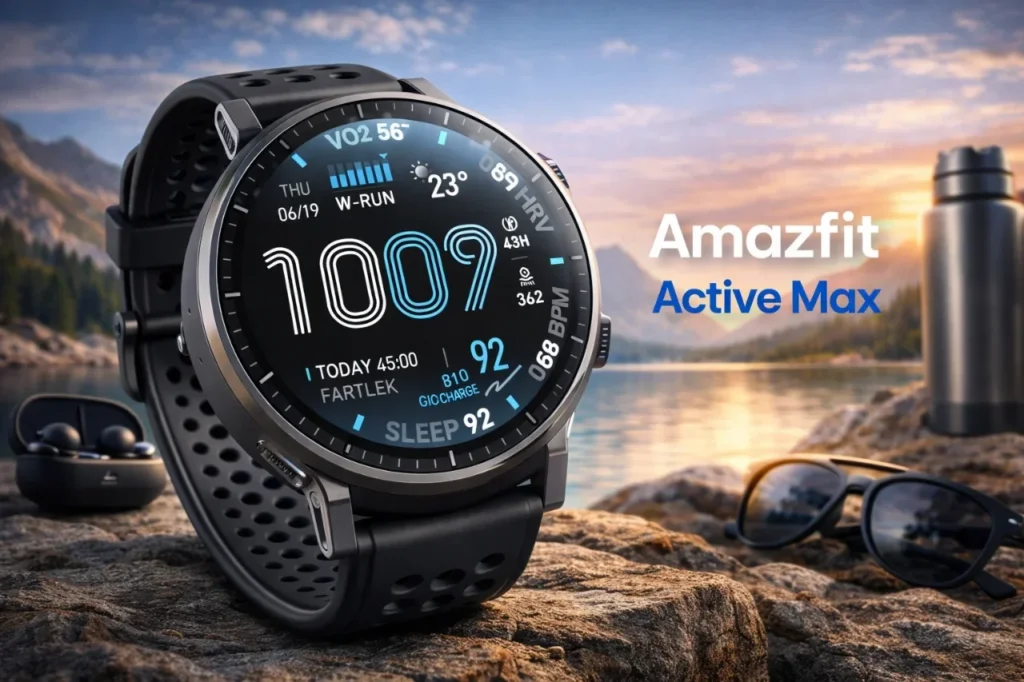
I tested the Amazfit Active Max to answer a simple question: is this smartwatch a reliable daily tracker for heart rate, sleep stages, and GPS-based workouts? This review breaks down the hardware, real-world measurement performance, strengths, weaknesses, and practical buying advice for anyone considering the Amazfit Active Max.

Amazfit Active Max
A sleek smartwatch built for everyday wear: workouts, health tracking, and a clean, modern look that works at the gym and outside it.
Tip: Place this box right after your intro paragraph for best conversions.
What the Amazfit Active Max is and who it targets
The Amazfit Active Max is a mid-size AMOLED smartwatch that positions itself as a highly usable, battery-friendly daily fitness companion. It targets people who want useful coaching, recovery insight, and phone-free workouts without paying premium prices for advanced sport features. In short, it aims at the “consistent mover”—someone who values readable displays, long battery life, offline music or maps, and sensible health metrics more than absolute elite-level GPS or pro-level sport sensors.
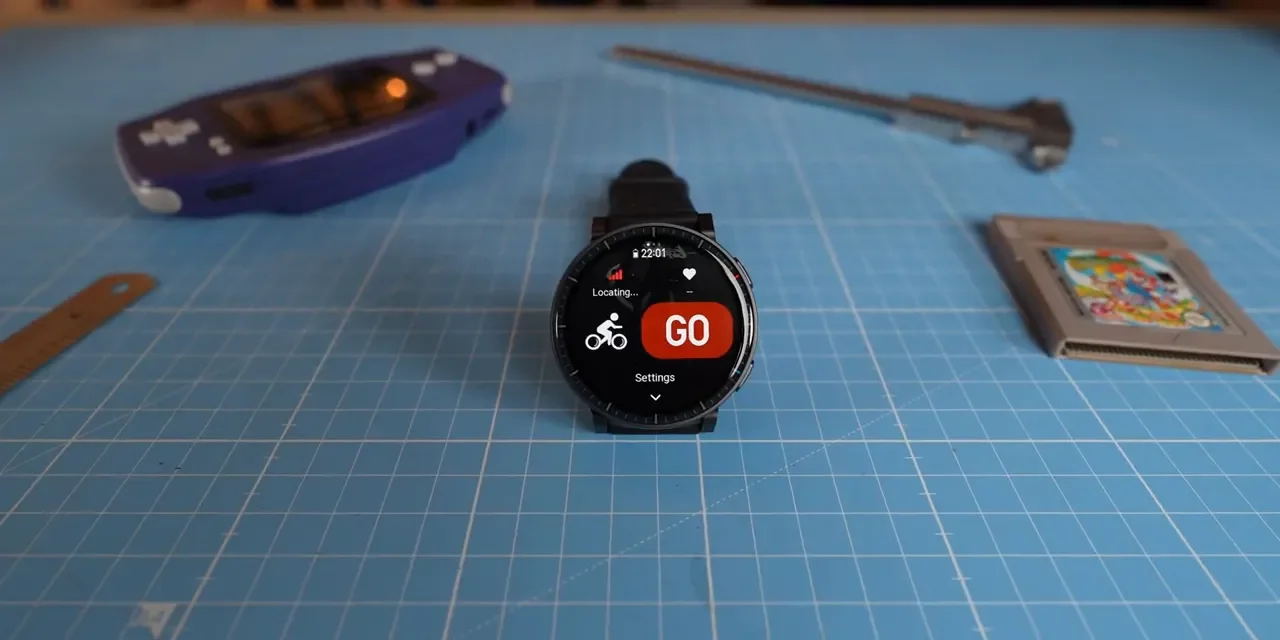
Quick spec overview
- Display: 1.5-inch round AMOLED, 480 x 480 resolution, very bright peak (up to 3,000 nits).
- Battery: Large cell with multi-day claims (typical daily use up to 25 days; heavy use lower). Up to ~64 hours continuous GPS in manufacturer scenarios.
- Sensors: Biotracker PPG 6.0 optical heart rate, accelerometer, gyroscope, geomagnetic sensor, ambient light, skin temperature, barometric altimeter.
- GPS: Single-band L1 GNSS (no dual-frequency L5/L1).
- Other: Microphone, speaker, Bluetooth 5.3, 4 GB storage for music and offline maps, 22mm standard strap, 5 ATM water resistance.
The hardware is clearly built around battery life and screen clarity. The trade-off is no dual-frequency GPS and a moderate 4 GB of storage—enough for offline playlists and small map sets, but limited compared to higher-end sport watches.
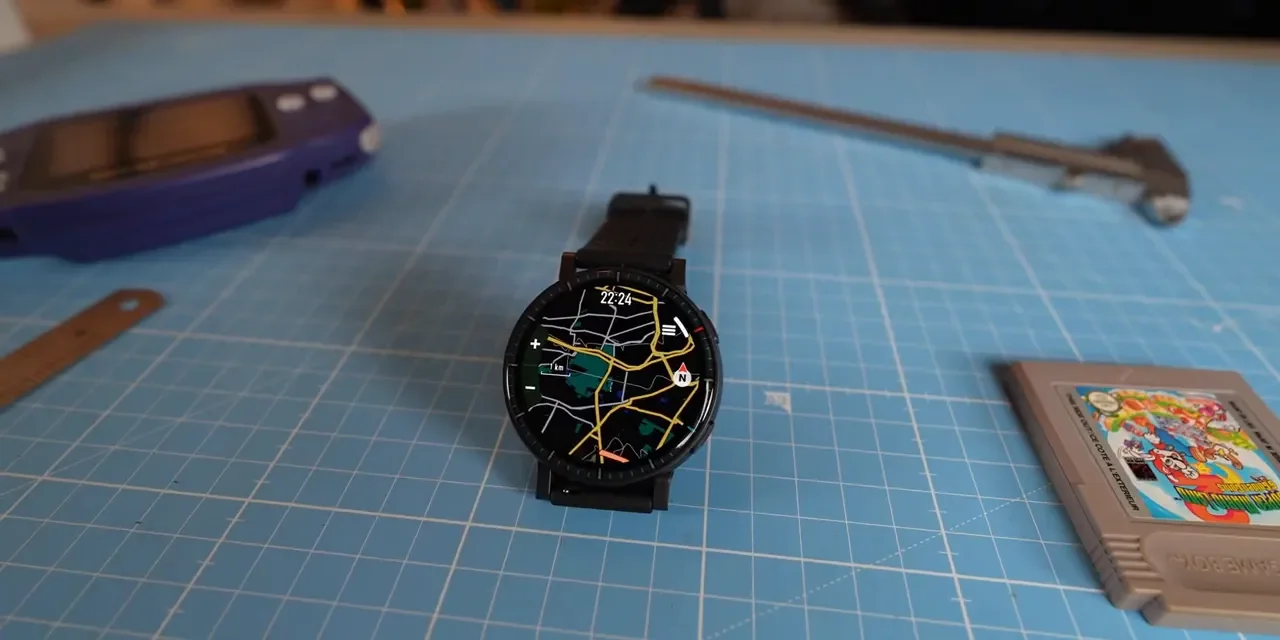
Key features that matter in daily use
- Readable display: The very bright AMOLED and a 1.5-inch screen make on-wrist glanceability excellent in daylight and during workouts.
- Offline media and maps: 4 GB supports local music, podcasts, and offline route maps—useful when you leave your phone at home.
- Guidance and recovery: Built-in workout modes (160+), AI training plans, and recovery/energy metrics (BioCharge-style metric) focus on consistency and readiness rather than deep performance analytics.
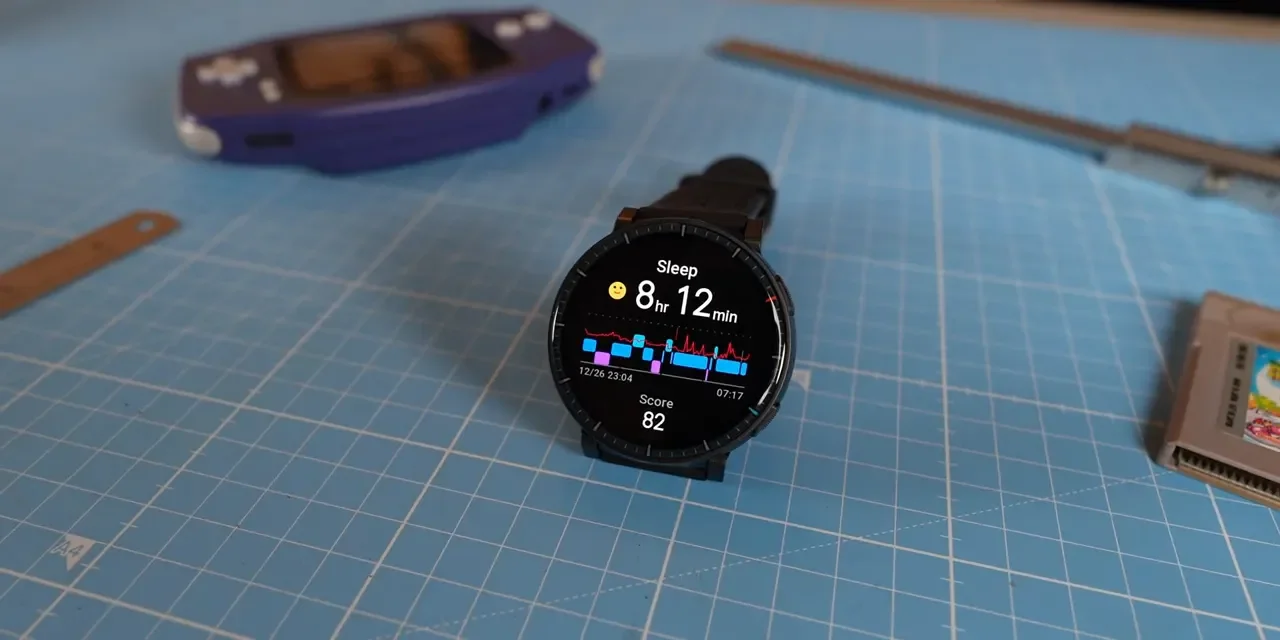
How the Amazfit Active Max performs: measurement breakdown
I focus on three practical measures that determine whether the watch’s coaching and recovery features are trustworthy: heart rate accuracy during typical activities, sleep stage tracking, and GPS route accuracy. Below I summarize the real-world behavior and provide action items for different users.
Heart rate: general patterns
The Amazfit Active Max uses a modern Biotracker optical sensor. Optical sensors are fine for steady-state monitoring and running, but wrist-based readings still struggle under heavy arm motion, high wrist tension, or when the watch shifts during activity.
Indoor cycling
Indoor cycling is typically the easiest activity for wrist-based PPG because wrist motion is relatively stable. The Amazfit Active Max performs well in this environment. Expect tight agreement with chest-strap references during steady intervals and good detection of heart rate dips during recovery periods. This makes the watch suitable for guided indoor workouts and training plans that rely on heart rate zones.
Running
Running shows strong and consistent heart rate tracking on the Amazfit Active Max for most users. Correlation to a chest strap reference is high during outdoor runs, and the watch handles cadence changes and intervals well. For runners who want heartbeat-driven pacing and feedback without a chest strap, the Amazfit Active Max is a practical choice.
Outdoor cycling
This is the watch’s weak spot. Outdoor cycling often leads to lower-than-actual wrist readings when the forearm undergoes repeated impacts, gripping, or varying temperatures that change fit and contact. If you ride on rough roads, sprint or climb hard, or frequently change body position, wrist-based heart rate dips are likely. For accurate outdoor cycling HR, pair the watch with a chest strap or an external cadence/HR sensor.
Weightlifting and resistance training
Wrist optical sensors generally struggle during resistance training because muscle contraction and wrist tension distort blood flow and optical coupling. Expect undercounts of peak heart rates during sets and better detection between sets. If you use heart rate for work/rest control during lifting, use a chest strap or armband sensor for reliable peaks.
Sleep tracking: stages and limitations
Sleep stage tracking is one of the hardest sensor challenges for wrist devices. The Amazfit Active Max provides reasonable detection of deep sleep and light sleep, but it struggles to reliably identify REM sleep. Practically:
- Deep sleep: High agreement with EEG-based references for many users, making deep sleep estimates useful for recovery insight.
- Light sleep: Good alignment overall.
- REM sleep: Lower agreement and frequent misclassification as light sleep.
If you need clinical-grade sleep staging or precise REM tracking for health reasons, consider a dedicated EEG mattress sensor or validated ring-based devices. For general sleep timing, total sleep, and deep sleep trends, the Amazfit Active Max is adequate.
GPS and route accuracy
The Amazfit Active Max uses single-band L1 GNSS. In open environments the GPS tracks pace and route consistently. Expect the following:
- Good performance on regular runs in parks or suburban areas.
- Possible smoothing around tight corners; minor deviations in dense tree cover or near tall buildings.
- Not ideal for very demanding mapping requirements where dual-frequency GPS excels (dense urban canyons, narrow mountain valleys).
For most recreational runners and cyclists who want reliable distance, pace, and route maps, the GPS is solid given the price and battery trade-offs.
Software, storage, and daily usability
The Amazfit Active Max includes usable smartwatch features: notification handling, music and podcast storage, offline maps for phone-free navigation, and basic voice interaction through mic and speaker. The 4 GB storage is enough for playlists and a few maps, but heavy media users or long offline trip planners should manage library size or rely on streaming from a phone when available.
Comparison: how the Amazfit Active Max sits in the lineup
Compared to cheaper Amazfit models, the Active Max emphasizes a larger, brighter display and stronger battery life. Against higher-end Amazfit watches (with dual-band GNSS, higher water resistance, or titanium builds), the Active Max is a value-focused middle child. If you want dual-frequency GPS, deeper sport profiles, or a higher water rating for serious water sports, consider the higher-tier models instead.
Pros and cons
- Pros
- Very bright, large AMOLED display that is easy to read outdoors.
- Long battery life for a smartwatch with smart features.
- Offline music and maps enable phone-free sessions.
- Solid heart rate tracking for running and indoor cycling.
- Practical recovery and coaching features aimed at consistency.
- Cons
- No dual-frequency GPS—can struggle in challenging GPS environments.
- Wrist HR accuracy drops during outdoor cycling and weightlifting for some users.
- Sleep stage detection underperforms for REM classification.
- 4 GB storage is modest compared to premium models.
Who should buy the Amazfit Active Max?
Consider the Amazfit Active Max if you match any of these profiles:
- You want a bright, easy-to-read display and long battery life for daily wear.
- You are a recreational runner or gym-goer who values guidance and recovery metrics over pro-level sensor fidelity.
- You want offline music and maps on a budget-friendly smartwatch.
Skip the Amazfit Active Max if:
- You need precise wrist heart rate for outdoor cycling, high-intensity interval training, or lifting without using an external sensor.
- You require dual-frequency GPS for mapping in urban canyons or mountainous terrain.
- You need medical-grade sleep staging and REM accuracy.
Practical tips to get the best accuracy from the Amazfit Active Max
- Fit is crucial: Place the watch snugly above the wrist bone. A loose fit produces motion artifacts and poorer optical coupling during workouts.
- Warm up the sensor: Cold skin and loose clothing can reduce contact. Warm the wrist with light motion or a brief warm-up to improve readings.
- Use external sensors when necessary: For outdoor cycling and heavy resistance training, pair a Bluetooth chest strap or a biceps armband for accurate peaks.
- Manage offline media: Keep playlists trimmed to fit the 4 GB capacity; remove maps after long trips to free space.
- Check firmware updates: Sensor and algorithm performance can improve with software updates. Install updates whenever available.
Comparison Table: Amazfit Active Max vs Smartwatch Alternatives
This table focuses on the factors that actually change your daily experience: display clarity outdoors, GPS robustness, heart-rate stability across sports, offline capability, and battery behavior. Use it to pick the watch that matches your use case.
| Model | Best For | Display | GPS | HR Reliability | Battery | Offline Music/Maps |
|---|---|---|---|---|---|---|
| Amazfit Active Max | Daily fitness + running + battery | Large AMOLED, extremely bright | Single-band GNSS (L1) | Strong for running/indoor; weaker for cycling/lifting peaks | Excellent | Yes |
| Garmin Forerunner (multi-band class) | Training accuracy + race prep | AMOLED or MIP (model dependent) | Often multi-band GNSS | Very consistent across sports | Strong | Varies |
| Apple Watch (latest class) | Apps + calls + ecosystem | High-end OLED | Strong GPS | Excellent overall optical HR | 1–2 days | Mostly streaming |
| Samsung Galaxy Watch (latest class) | Android smartwatch experience | AMOLED | Strong GPS | Good, but varies by sport and fit | Moderate | Mostly streaming |
| Higher-tier Amazfit (dual-band class) | Better GPS without leaving Amazfit | AMOLED | Often improved / dual-band (model dependent) | Similar strengths, sometimes improved | Strong | Often yes |
Pros and Cons
Clear, no-fluff buying summary. If your priorities align with the pros, the Amazfit Active Max is an easy recommendation. If the cons hit your use case, you’ll be happier with a dual-band training watch or an external heart-rate sensor.
Pros
- Exceptional AMOLED brightness and visibility outdoors; easy to read at a glance.
- Standout battery endurance for a smartwatch with strong display and fitness features.
- Offline music and offline maps enable genuinely phone-free workouts.
- Strong heart-rate tracking for running and steady cardio; handles intervals well for most users.
- Practical coaching and readiness-style metrics that support consistent training habits.
- Excellent value: premium-feeling daily experience without premium smartwatch pricing.
Cons
- No dual-frequency GPS; accuracy can drop in dense cities, forests, or narrow valleys.
- Outdoor cycling wrist HR can under-read due to grip, vibration, and temperature shifts.
- Weight training HR peaks are inconsistent (common optical wrist sensor limitation).
- REM sleep classification is less reliable than deep/light sleep estimation.
- 4 GB storage is useful but limited for heavy offline media + map users.
The Amazfit Active Max is a standout choice for people who want a large, premium AMOLED display, long battery life, and a practical set of fitness tools—especially for running, indoor cardio, and everyday health tracking. It becomes less “set-and-forget” for users who demand sport-grade precision during outdoor cycling or heavy strength training, where wrist-based heart rate often struggles.
Buy it if you prioritize battery, screen quality, offline features, and reliable running performance. Skip it if you need dual-band GPS accuracy in difficult environments or highly reliable peak HR without pairing a chest strap.
Common misconceptions and pitfalls
- Optical heart rate is not uniformly reliable. Good performance for runs or steady cardio does not guarantee accurate peaks during resistance training or when gripping a handlebar tightly.
- High peak brightness does not equal better sensors. The bright AMOLED helps visibility, but it has no direct effect on heart rate or GPS accuracy.
- Storage is limited. 4 GB is useful but finite—expect to manage space if you rely heavily on offline media.
Final verdict
The Amazfit Active Max is a strong value proposition for users who want a readable, long-lasting smartwatch that handles running and general fitness well, supports offline media, and provides helpful recovery and training guidance. It falls short where wrist-based optical sensors typically do—outdoor cycling and heavy resistance workouts—and it does not include dual-frequency GPS. If you prioritize battery, screen, and daily coaching, the Amazfit Active Max is a smart buy. If you need exact sport-grade measurements, consider adding a dedicated heart monitor or stepping up to a higher-end model with dual-band GNSS.
FAQ
Is the Amazfit Active Max good for running?
Yes. The Amazfit Active Max delivers strong wrist-based heart rate and GPS performance for most recreational runners. It provides reliable pace and distance and is well-suited for guided training plans that do not require pro-level measurement precision.
Should I use a chest strap with the Amazfit Active Max?
If you do outdoor cycling, heavy interval training, or weightlifting and need accurate peak heart rates, pairing a chest strap or arm-based sensor is recommended. For regular running and indoor workouts, the built-in optical sensor is usually sufficient.
Does the Amazfit Active Max have dual-band GPS?
No. It uses single-band L1 GNSS. This is fine for open-area runs and general route tracking but not as robust as dual-frequency GPS in signal-challenging locations like dense urban areas or deep valleys.
How long does the battery last on the Amazfit Active Max?
Battery life varies by usage. Typical manufacturer estimates range from multiple days up to several weeks in low-use scenarios. Continuous GPS runtime is in the range of a couple of days under nonstop use; expect shorter battery life with high-brightness, always-on display, and frequent GPS sessions.
Can I store music and podcasts on the Amazfit Active Max?
Yes. The watch includes around 4 GB of onboard storage for music, podcasts, and offline maps. It supports local playback for phone-free activities but you should manage the library size due to limited capacity.