Skip to content
Nike Pegasus 42 Review: The 2026 Everyday Workhorse, Rebuilt from the Inside Out
The Pegasus line has been Nike’s best-selling daily trainer for four decades — and the 42nd version is its biggest mechanical change in years. Here’s what Nike actually changed, what it means for your runs, and who should buy (or skip) it.
Key takeaways
- The headline change: Nike replaced the Pegasus 41’s two separate Air Zoom units (forefoot + heel) with one curved, full-length Air Zoom unit — the biggest structural redesign of the Pegasus in years.
- Specs that matter: 10mm drop, 37mm heel / 27mm forefoot stack, ReactX foam midsole, engineered mesh upper with a wider toe box than the 41. Men’s approx. 300g (10.59 oz), women’s approx. 243g. Priced at $145.
- Best for: neutral runners who want one shoe for daily easy miles, gym cross-training and occasional faster pickups — and beginners buying their first serious running shoe.
- The honest caveat: it is a $145 daily trainer competing in the most crowded price band in running. It is not a plated racer and it is not the lightest option on the shelf — and this review is research-based, not the result of personal wear-testing (see our transparency note at the bottom).
Quick answer
Should you buy the Nike Pegasus 42? If you are a neutral runner looking for one dependable shoe for daily training — easy miles, long-ish runs, treadmill sessions and gym cross-training — it is one of the safest $145 answers on the market. The full-length Air Zoom unit is a genuine mechanical upgrade over the 41, not a cosmetic refresh.
The trade-off: this is still, by design, an entry-level daily trainer. It will not match a plated tempo shoe for speedwork, and at around 300g it is one of the heavier shoes in the $140–150 band. Buy it for consistency and versatility, not for race day.
Score is an editorial assessment based on verified specs and published reviewer consensus — see the transparency note.
Nike Pegasus 42
Neutral road runner with ReactX foam and a curved full-length Air Zoom unit. The safest one-shoe answer for daily miles in 2026.
- $145 — men’s and women’s, multiple colorways
- 10mm drop, 37/27mm stack
- Wider toe box than the Pegasus 41
Tip: if the Pegasus 41 is heavily discounted where you shop, it may be the better value — see the Pegasus 42 vs 41 comparison before paying full price.
Nike Pegasus 42: full specs
Every figure below comes from Nike’s own product pages (canonical) or is explicitly flagged as third-party measurement. Nothing here is estimated.
| Category | Neutral daily trainer, road running |
|---|---|
| US price | $145 |
| Release | April 9, 2026 |
| Stack height | 37mm heel / 27mm forefoot (10mm drop) |
| Men’s weight | Approx. 300g / 10.59 oz (US 10) per Nike; third-party measurements range 284–307g depending on size and method |
| Women’s weight | Approx. 243g (UK 5.5) per Nike; third-party measurements approx. 8.6 oz |
| Midsole foam | ReactX foam — Nike claims 13% more responsiveness than previous React technology |
| Air cushioning | Curved, full-length Air Zoom unit (new — replaces the 41’s separate forefoot + heel units) |
| Upper | Lightweight engineered mesh, softer and more breathable than earlier iterations; updated fit with extra room in toes and forefoot vs the 41 |
| Outsole | Updated Waffle pattern, high-abrasion rubber with flex grooves; lighter than previous model |
| Last | MR-10 2.0 — updated from the Pegasus 41 |
| Support | Neutral (not a stability shoe) |
| Extras | Reflective design details; midfoot support system; fully molded sock liner; increased toe spring |
| Style codes | Men’s IQ0454-001 (shown: Football Grey); women’s IB1881-600 (shown: Pearl Pink), IB1881-002, IB1881-602, others |
What’s new in the Pegasus 42 vs the Pegasus 41
Many Pegasus updates are upper tweaks and colorway churn. The 42 is different — Nike changed the internals. Here’s each change, with what it means in plain language:
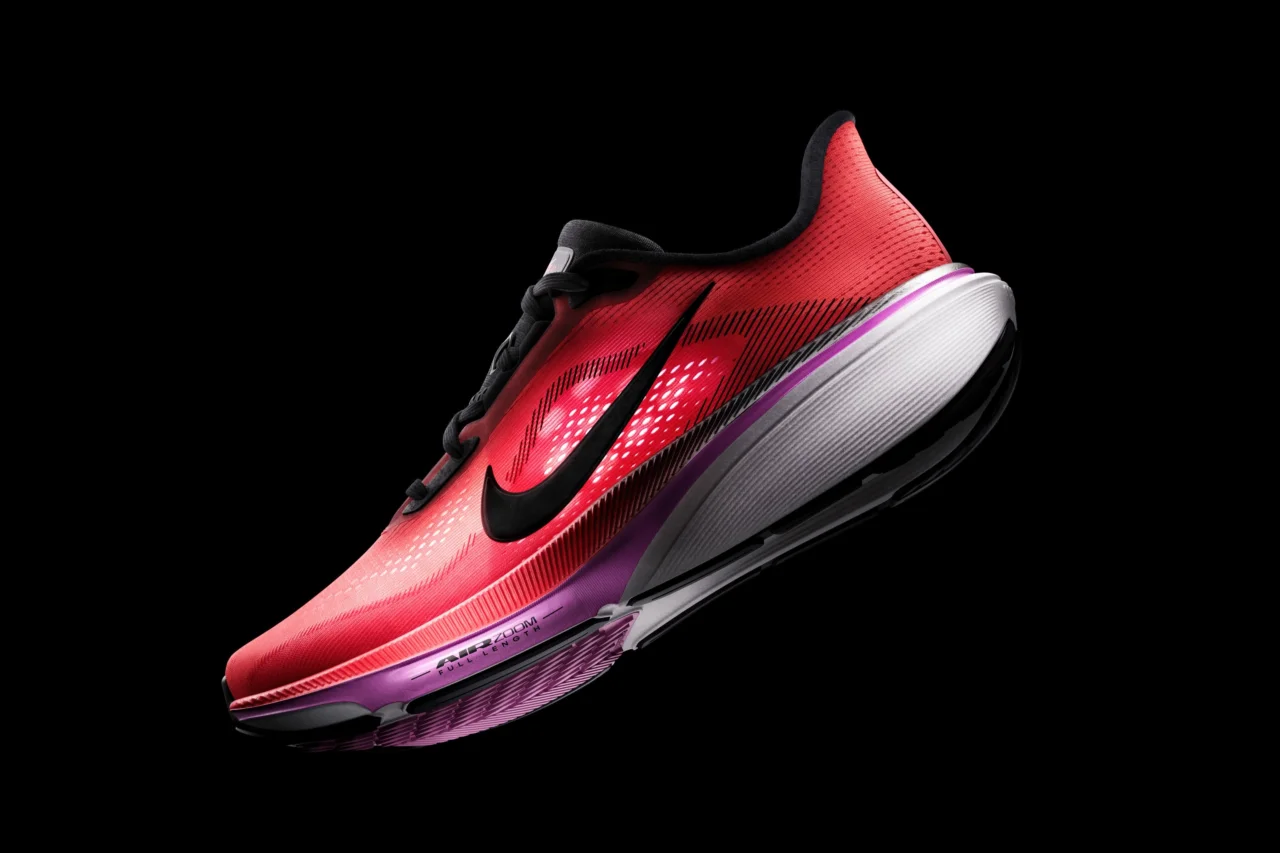
- Full-length Air Zoom unit (the big one). The Pegasus 41 used two separate Air Zoom units — one in the forefoot, one in the heel. The 42 merges them into a single curved, full-length unit shaped to the foot. Nike’s stated goal: a more propulsive heel-to-toe transition and the highest energy return the brand has put in a Pegasus. Launch materials describe the effect as a fine-tuned Air feel closer to Nike’s road-racing line, re-engineered for everyday runs.
- More toe spring. The silhouette has a greater curve at the toe box than the 41, which helps the shoe roll forward more smoothly at toe-off. This pairs with the full-length Air unit as the “smooth transition” half of the upgrade.
- Wider toe box, more forefoot room. Nike explicitly updated the fit to give extra space at the toes and forefoot compared to the 41. Reviewers who found the 41 snug up front should find the 42 more forgiving. Nike’s product FAQ says most runners find the 42 true to size.
- New MR-10 2.0 last. The foot-shaped foundation of the shoe was updated from the 41 — this is the structural reason for the fit change, not just thinner material.
- Updated, lighter Waffle outsole. Same Waffle DNA, revised pattern with high-abrasion rubber and flex grooves. Nike says it is lighter than the previous model’s outsole while keeping traction on roads and paved paths in dry and wet conditions.
- ReactX foam carried over. The midsole foam is continuity, not change: ReactX, which Nike rates 13% more responsive than previous React technology, with a stated ~43% lower carbon footprint vs React foam.
Technology deep-dive: what’s actually under the hood
ReactX foam — the base layer
ReactX is Nike’s workhorse training foam: lighter and, per Nike’s lab claims, 13% more responsive than the previous React formulation, plus a meaningful sustainability claim (~43% lower carbon footprint vs React). In practice, across published reviews, ReactX is consistently described as balanced — softer than Nike’s older Cushlon-era foams but firmer and more durable than the bouncy nitrogen-infused foams showing up in premium trainers. That “Goldilocks” character is exactly what a daily trainer wants: a midsole that doesn’t bottom out after 200 miles and doesn’t punish you at slow paces.
The curved full-length Air Zoom unit — the upgrade
This is the part worth understanding. Air Zoom is pressurized air in a tensile-fiber unit; when you compress it under footstrike, it returns energy as you roll through. A curved, full-length unit does two jobs at once: cushioning under impact (especially heel strike) and a propulsive snap at toe-off, with no dead zone between the old forefoot and heel units. Nike claims this delivers its highest energy return from heel to toe-off of any Pegasus to date, and launch materials attribute roughly a 15% energy-return improvement vs the 41. The curve matters because it works with the new toe spring — the geometry of the shoe is designed to roll you forward rather than sit flat.
Engineered mesh upper and the MR-10 2.0 last
The upper is a lightweight engineered mesh that Nike says is softer and more breathable than earlier iterations — plus reflective graphics for low-light visibility. The more important change is underneath: the updated last and the roomier toe box address the single most common fit complaint about recent Pegasus models. A midfoot support system and a fully molded sock liner round out the fit package, aimed at a secure-but-not-squeezing feel. Nike’s own FAQ describes the 42 as true to size with a slightly roomier forefoot than earlier iterations.
Waffle outsole
Nike’s Waffle pattern is a running institution — it predates the Pegasus itself. The 42’s version uses high-abrasion rubber with flex grooves for a balance of grip, flexibility and durability. Published third-party impressions describe traction as dependable on road and paved paths, wet or dry, with durability expected to hold up for hundreds of kilometers of consistent road training — exactly the job description of a daily trainer.
What kind of ride should you expect?
No review on the internet can tell you how a shoe feels on your feet — but the specs plus the consensus of published reviewers converge on a consistent picture:
- The defining trait is versatility, not extremity. Fleet Feet’s review frames it as a “Goldilocks shoe” — cushioning that is neither too soft nor too firm, responsive enough for pickups without being a speed shoe. Believe in the Run calls it “consistently pleasant” and, after a few years of mediocre Pegs, a win — positioning it as an entry-level daily trainer, full stop, and “the best Peg in recent memory.”
- Run types it covers: easy daily miles (its home turf), long runs up to roughly half-marathon distance, recovery runs, treadmill sessions, and moderate tempo pickups. Third-party running retailers put its comfortable pace band around easy-to-moderate paces — it will do faster work, but it is not a tempo-day specialist.
- The gym argument is real. Multiple reviewers note the Peg 42 doubles as a gym shoe: stable enough for machine work and lighter lifting, roomy enough to wear all day. (Heavy squats and deadlifts are still a no — no running shoe is a lifting shoe.)
- The honest limits: at ~300g men’s it is one of the heavier options in the $140–150 range; advanced runners with big weekly volume will likely want it as a rotation shoe rather than their only pair; and runners who want a plush maximalist feel or a bouncy nitrogen-foam ride should look elsewhere in the category.
Who Should Buy the Nike Pegasus 42?
Who Should Skip It?
Pegasus 42 vs Pegasus 41: is the upgrade worth it?
| Spec | Nike Pegasus 42 | Nike Pegasus 41 |
|---|---|---|
| US price | $145 | $140 at launch (often discounted now) |
| Air cushioning | Curved, full-length Air Zoom unit | Separate forefoot + heel Air Zoom units |
| Midsole foam | ReactX | ReactX |
| Drop / stack | 10mm (37/27mm) | 10mm |
| Fit | MR-10 2.0 last; wider toe box, more forefoot room | Previous last; snugger forefoot (common complaint) |
| Toe spring | Increased curve for smoother toe-off | Less pronounced |
| Outsole | Updated, lighter Waffle with flex grooves | Previous Waffle pattern |
| Verdict | Buy at $145 if you want the new Air system and roomier fit | Buy on discount if you just need a dependable daily trainer |
The 41 is still a good shoe — the foam is identical, and the core daily-trainer job is the same. The decision rule is simple: pay full price for the 42 if the full-length Air unit or the roomier fit matters to you; buy the 41 on sale if neither does. Nike’s own launch materials frame the 42 as delivering roughly 15% greater energy return than the 41, driven by the Air redesign.
Pegasus 42 vs the competition
The $140–150 daily-trainer band is the most crowded shelf in running. Here is how the Pegasus 42 stacks up on specs against two strong alternatives — all figures from published retailer spec tables:
| Spec | Nike Pegasus 42 | New Balance Ellipse v1 | Altra Experience Flow 3 |
|---|---|---|---|
| US price | $145 | $145 | $145 |
| Men’s weight | ~300g / 10.5 oz | 9.6 oz | 9.0 oz |
| Women’s weight | ~243g / 8.6 oz | 7.6 oz | 7.5 oz |
| Stack (heel/forefoot) | 37 / 27mm | 37.9 / 27.9mm | 32 / 28mm |
| Drop | 10mm | 10mm | 4mm |
| Midsole tech | ReactX + full-length curved Air Zoom | Fresh Foam X | EGO P35 |
| Character | Balanced “Goldilocks” trainer, iconic Nike ride | Slightly more forgiving, similar spring | Low-drop option, smooth step-in feel |
| Pick it if… | You want the traditional daily-trainer fit and Nike’s Air feel | You want the same brief at a lighter weight | You prefer a low drop and a roomier natural fit |
Comparison specs via Fleet Feet’s published Pegasus 42 review (comparison table) and Nike’s official product pages. Rival specs reflect those published figures, not independent testing by GearUpToFit.
Video reviews worth watching
We don’t embed unverified video content. These published video/text reviews from established running outlets are worth your time before buying:
- Believe in the Run — Nike Pegasus 42 video review — Thomas’s take: “the best Peg in recent memory,” but still an entry-level daily trainer.
- Believe in the Run — Nike Pegasus 42 written review — the full breakdown, including the 10.8 oz weighed measurement.
- Fleet Feet — Pegasus 42 review — the “Goldilocks shoe” framing and head-to-head spec tables vs rivals.
- RunnersLab — Pegasus 42 review — European pricing (€140) and the full 42-vs-41 change list.
📊 By the Numbers: Pegasus 42 vs. Pegasus 41
41: $140 at launch — often discounted now
41: the baseline
41: also a 10mm drop
41: same legendary lineage
🤔 Pegasus 42 or Pegasus 41 — Which Should You Buy?
Still Excellent: The Nike Pegasus 41 at a Discount

Frequently asked questions
How much does the Nike Pegasus 42 cost?
The Nike Pegasus 42 retails for $145 in the US (it launched April 9, 2026). European pricing is around €140. As with every Pegasus, expect discounts on older colorways within a few months of release — and the Pegasus 41 often drops well below its $140 launch price once the 42 is out.
What is the Nike Pegasus 42’s weight and drop?
Nike lists the men’s Pegasus 42 at approximately 300g / 10.59 oz (US 10) and the women’s at approximately 243g (UK 5.5), with a 10mm heel-to-toe drop (37mm heel, 27mm forefoot). Independent measurements vary slightly by size and method — third parties have reported 284–307g for men’s — so treat Nike’s figure as the canonical spec.
What’s new in the Pegasus 42 compared to the Pegasus 41?
The headline change is a curved, full-length Air Zoom unit replacing the 41’s separate forefoot and heel Air units. Nike also added more toe spring, a roomier toe box and forefoot, a new MR-10 2.0 last, and a lighter updated Waffle outsole. The ReactX foam midsole carries over from the 41.
Is the Nike Pegasus 42 good for beginners?
Yes — beginners are arguably its core audience. Neutral support, a forgiving fit with extra forefoot room, durable high-abrasion rubber, and a balanced ride that works at slow paces make it one of the safest first-shoe picks. Nike’s own product FAQ describes it as approachable for runners building consistency.
Does the Pegasus 42 fit true to size?
Per Nike’s product FAQ, most runners find the Pegasus 42 true to size, and the fit is roomier in the forefoot and toe box than the 41. If the 41 felt snug up front, the 42 specifically addresses that. Runners between sizes or with very narrow feet should still try before buying, as always.
Is the Pegasus 42 a stability shoe?
No. The Pegasus 42 is a neutral daily trainer with no medial posting or stability features. Overpronators who need guidance should look at Nike’s Structure line or stability models from Brooks (Adrenaline GTS) or ASICS (GT-2000) instead.
Can you run a marathon in the Pegasus 42?
You can — plenty of runners have finished marathons in far less shoe — but it isn’t designed as a marathon racer. Its sweet spot is daily training and runs up to about half-marathon distance. For race day, a plated model will be faster and lighter; for marathon training blocks, many runners use the Pegasus as the easy-day shoe in a rotation.
Is the Pegasus 42 good for the gym?
Published reviewers consistently say yes for general gym use: treadmill cardio, machine work, and lighter lifting. The stable heel and durable outsole handle it well. Skip it under a barbell for heavy squats or deadlifts — no cushioned running shoe is a proper lifting shoe.
How durable is the Pegasus 42?
Durability is a franchise strength: the ReactX foam is chosen for longevity, the outsole uses high-abrasion rubber in Nike’s proven Waffle pattern, and third-party reviewers describe it as built for hundreds of kilometers of consistent road training. Nike’s sustainability notes also cite at least 75% recycled material content by weight.
Should I buy the Pegasus 42 or wait for a sale on the Pegasus 41?
Buy the 42 at $145 if the full-length Air Zoom unit, increased toe spring, or roomier forefoot matter to you — those are real changes. Buy the 41 on discount if you just need a dependable neutral daily trainer, since the foam is the same and the core ride concept is similar. This is the classic Pegasus value decision, and the discounted older model usually wins on pure value.
References
Specs verified against Nike’s official Pegasus 42 product pages (men’s and women’s listings; What’s New, Product Details and FAQ sections). Supplementary spec and consensus data from Believe in the Run (video + written reviews), Fleet Feet’s published review and comparison tables, RunnersLab’s review, Top4Running’s Pegasus family overview, Gadgets360’s review, and SI/FanNation’s launch tech-spec coverage. No figures in this review are estimated or invented; third-party measurements are attributed as such.
Transparency note
This is a research-based review. Every specification, price, weight, and technology claim above is sourced from Nike’s official product materials or attributed published third-party reviews — see References. GearUpToFit did not wear-test the Pegasus 42 for this article, and nothing here should be read as a claim of personal mileage, wear-testing, or first-hand experience. Qualitative descriptions of ride feel reflect the consensus of the cited published reviewers, not our own feet. If that changes, we’ll update this note.