Skip to content
 A 10-minute workout can help you build momentum, improve fitness, and burn some calories. It cannot “melt belly fat,” override an inconsistent diet, or guarantee rapid weight loss. This guide gives you a safe beginner routine, realistic expectations, and the GearUpToFit calculators to turn effort into a sustainable plan.

Quick answer: can a 10-minute workout help with fat loss?
Yes, but only as one part of the plan. A 10-minute beginner workout can help you move more, raise your heart rate, improve confidence, and add a small amount of calorie expenditure. Fat loss still depends mostly on your long-term energy balance: how much energy you use compared with how much you eat and drink.
The best use of this workout is simple: do it consistently, pair it with a realistic calorie target, eat enough protein, and gradually add strength training or walking as your fitness improves.
What this workout can and can’t do
This article replaces quick-fix fat-loss language with practical coaching. The goal is not to promise a dramatic transformation from one “magic” move. The goal is to help a beginner start safely and keep going.
What it can do
- Help you build a repeatable exercise habit.
- Improve your heart-rate response and work capacity over time.
- Add movement to a busy day without needing a gym.
- Support fat loss when paired with a calorie deficit.
- Give you a low-pressure starting point before longer workouts.
What it can’t do
- Spot-reduce belly fat from one body area.
- Guarantee a specific number of calories burned.
- Cancel out consistently high calorie intake.
- Replace strength training, walking, sleep, or nutrition.
- Promise visible results in a few days.
For healthy weight loss, the CDC emphasizes gradual, steady progress and a lifestyle that includes nutrition, physical activity, sleep, and stress management. For most adults, a realistic rate is about 1 to 2 pounds per week when a sustainable calorie deficit is present.
Read the CDC’s healthy weight-loss guidance.
Before you start: safety first
Stop immediately if you feel chest pain, faintness, severe shortness of breath, sharp joint pain, or dizziness. If you are pregnant, returning after injury, managing a heart condition, managing diabetes, recovering from an eating disorder, or unsure whether vigorous exercise is appropriate, get personal guidance from a qualified healthcare professional.
During this routine, aim for a “comfortably hard” effort. You should breathe faster, but you should not feel out of control. Good form matters more than speed.
The 10-minute beginner fat-loss workout
This routine uses low-impact movements that raise your heart rate without requiring jumping, burpees, or floor work. You can do it in a living room, hallway, bedroom, or office with a small amount of clear space.
Warm-up
Main circuit
Cool-down
Total time
Warm-up: 2 minutes
| Move | Time | How to do it |
|---|---|---|
| Easy march in place | 45 seconds | Stand tall, swing your arms naturally, and breathe through your nose or mouth. |
| Shoulder circles | 30 seconds | Make slow circles forward, then backward. Keep your ribs down and neck relaxed. |
| Hip hinge practice | 45 seconds | Push your hips back slightly, keep your spine long, then stand tall and squeeze your glutes. |
Main circuit: 6 minutes
Perform each move for 40 seconds, then rest or step gently in place for 20 seconds. Complete one round of all six moves.
1. Sit-back squat
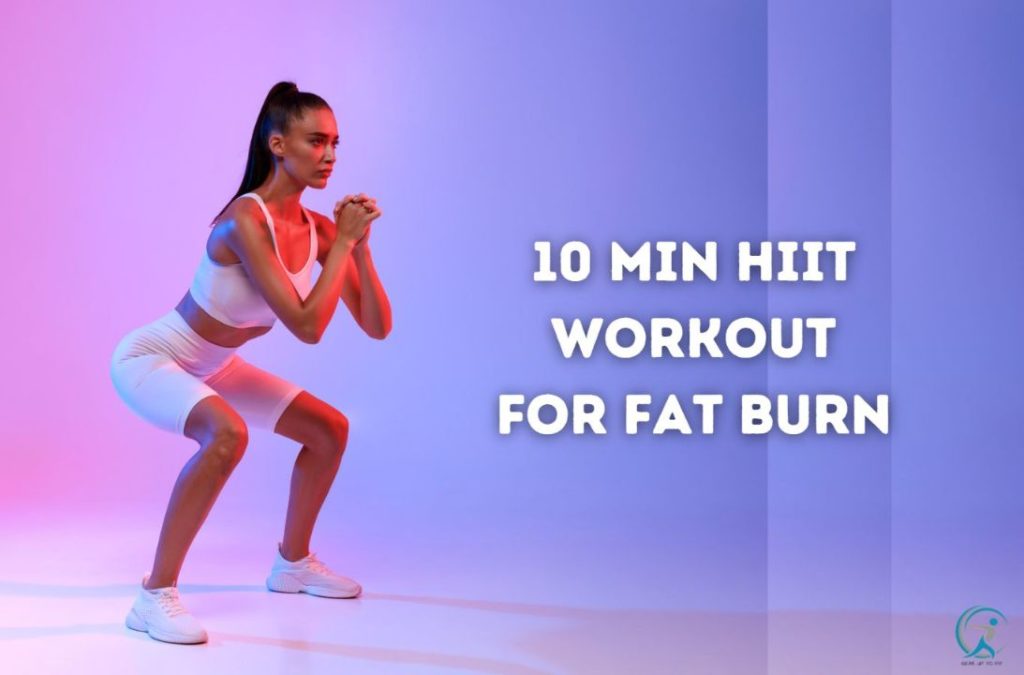
Stand with feet about hip-width apart. Push your hips back like you are reaching for a chair, then stand tall. Keep knees tracking over toes.
Make it easier: Tap a chair each rep.
2. Wall push-up
Place hands on a wall at chest height. Bend elbows, bring chest toward the wall, then press away. Keep your body in a straight line.
Make it harder: Use a countertop or sturdy bench.
3. Step-back tap
Step one foot back, tap the floor, return to center, then switch sides. Move smoothly and keep your chest lifted.
Focus: Control before speed.
4. Standing cross-body knee
Bring your right knee toward your left hand, then switch. Rotate gently through your torso without yanking your neck or shoulders.
Focus: Core control and balance.
5. Low-impact skater step
Step side to side, letting the trailing foot tap behind you. Keep it quiet and joint-friendly. No jumping needed.
Make it easier: Shorten the step width.
6. Fast march with punch
March in place while punching forward at shoulder height. Keep fists relaxed and avoid locking the elbows.
Focus: Finish strong without losing posture.
Cool-down: 2 minutes
| Move | Time | Purpose |
|---|---|---|
| Slow walk or march | 45 seconds | Bring your breathing down gradually. |
| Standing quad stretch | 30 seconds per side | Hold a wall or chair for balance. Keep knees close and hips tall. |
| Chest opener | 15 seconds | Clasp hands behind you or place hands on your lower back. Breathe slowly. |

Helpful follow-along video
Use the written workout above when you want a simple timer-based plan. Use this beginner-friendly follow-along video when you want visual coaching, no jumping, and a full 10-minute session.
Video: HASfit 10 Min HIIT Workout for Beginners. Use modifications, keep the effort controlled, and stop if anything feels painful or unsafe.
Four-week beginner progression
The first goal is not exhaustion. The first goal is repeatability. Progress by improving consistency, movement quality, and recovery before adding more intensity.
| Week | How often | Intensity target | Progress goal |
|---|---|---|---|
| Week 1 | 2 sessions | Easy to moderate | Learn the movements and finish feeling like you could do a little more. |
| Week 2 | 3 sessions | Moderate | Keep the same exercises but reduce long pauses between moves. |
| Week 3 | 3 sessions + 1 walk | Moderate to comfortably hard | Add a 15- to 25-minute walk on one non-workout day. |
| Week 4 | 3 sessions + 2 walks | Controlled hard efforts | Move with better form, stronger posture, and steadier breathing. |
Federal physical-activity guidance for adults recommends at least 150 minutes of moderate-intensity activity per week plus 2 days of muscle-strengthening activity. A 10-minute workout is a starting block, not the full long-term target.
See the CDC adult activity guidelines.
How this workout supports fat loss
Fat loss is not caused by one exercise. It happens when your average calorie intake is below your average calorie expenditure for long enough to create measurable change. Exercise helps because it can increase calorie use, protect fitness, support mood, and make healthier routines easier to maintain.
Think “calorie balance,” not “calorie burn hacks”
Wearables and machines can estimate workout calories, but they are not exact. Use them as trend tools, not as permission to eat back every calorie. Your weekly weight trend, waist measurement, hunger, training performance, and energy levels matter more.
Keep protein high enough
When calories drop, protein becomes more important for fullness and lean-mass retention. You do not need a perfect diet, but each meal should have a clear protein source.
The CDC explains that using calories through activity, combined with reducing calories eaten, creates the deficit that leads to weight loss. It also notes that most weight loss comes from reducing calories, while regular activity is important for maintaining weight loss.
Read the CDC explanation of physical activity and weight.
Turn the workout into a real plan with GearUpToFit tools
Use this workout as your starting habit, then use the tools below to set the numbers and weekly structure that make fat loss more predictable.
How to track progress without obsessing over the scale
Scale weight is useful, but it is noisy. Water, sodium, stress, soreness, digestion, menstrual cycle changes, and sleep can all move the number short term. Track a small set of signals for four weeks before making big changes.
1. Weekly average weight
Weigh at the same time of day and compare weekly averages, not random single weigh-ins.
2. Waist measurement
Measure at the same location, relaxed, once or twice per week. Do not pull the tape tight.
3. Workout consistency
Count completed sessions. For beginners, showing up repeatedly is the first performance metric.
4. Breathing and recovery
Notice whether the same workout feels easier after two to four weeks.
5. Energy and hunger
If you are constantly exhausted or ravenous, your deficit may be too aggressive.
6. Steps or walking time
Daily movement outside workouts can make a major difference in total energy use.
Common mistakes that slow beginner fat-loss progress
| Mistake | Why it hurts progress | Better choice |
|---|---|---|
| Going all-out on day one | Excess soreness can make you skip the rest of the week. | Finish with energy left. Build intensity slowly. |
| Using exercise to “earn” food | This can create a frustrating restrict-and-reward cycle. | Use a planned calorie target and include foods you enjoy. |
| Chasing belly-fat exercises | Core moves strengthen muscles, but they do not choose where fat comes off first. | Train the whole body and focus on total fat-loss habits. |
| Ignoring protein | Low protein can make a deficit harder and may reduce lean-mass retention. | Include a protein source at most meals. |
| Changing everything at once | Too many changes make it hard to know what works. | Start with this workout, a calorie target, and one daily walking goal. |
Your simple 7-day launch plan
For the next week, do not chase perfection. Do the 10-minute workout twice, walk on two other days, calculate your TDEE, and set one protein target. That is enough to move from guessing to planning.
Frequently asked questions
Is 10 minutes of exercise enough to lose fat?
Ten minutes can help you start, but it is usually not enough by itself for major fat loss. It works best as a consistency tool combined with a calorie deficit, adequate protein, walking, and progressive strength training.
Can this workout burn belly fat?
It can support overall calorie expenditure and fitness, but it cannot target belly fat directly. Your body decides where fat comes off first based on genetics, hormones, age, sex, and overall fat-loss progress.
How many times per week should a beginner do this?
Start with 2 or 3 sessions per week. Add easy walking on non-workout days. If your joints feel good and recovery is strong, you can slowly add sessions or increase intensity.
Should I do this workout every day?
You can move every day, but this exact interval workout does not need to be daily. Beginners often do better with 2 to 4 structured sessions per week plus walking, mobility, or light activity on other days.
How hard should the workout feel?
Aim for a 6 or 7 out of 10 effort. You should breathe faster and feel challenged, but you should still control your form. If your technique breaks down, reduce speed, shorten the range of motion, or rest.
What should I eat after a 10-minute workout?
You do not need a special recovery meal after a short beginner workout. If it is near mealtime, eat a balanced meal with protein, fiber-rich carbohydrates, and healthy fats. If fat loss is your goal, keep the meal inside your daily calorie target.
What should I do when the workout gets easy?
First, improve form and consistency. Then make one change at a time: add another round, shorten rest slightly, increase walking, or add beginner strength training. Do not increase everything at once.
Sources and further reading
Educational content only. This guide is not medical advice, diagnosis, or treatment. For individual recommendations, consult a qualified healthcare professional, registered dietitian, or certified fitness professional.
Frequently Asked Questions
Is 10 minutes of exercise enough to lose weight?
Ten minutes of exercise alone won’t cause rapid weight loss, but it is an excellent way to build consistency and support a calorie deficit. For best results, pair short workouts with a structured nutrition plan.
Do I need equipment for this fat-loss strategy?
No, this routine is designed as a bodyweight-only circuit. You only need a small clear space and optionally a chair or wall for balance and modifications.
How often should a beginner do this workout?
Start with 2 sessions per week to master form, then progress to 3 sessions plus walking as your fitness improves, following a gradual four-week progression.
Fat Loss Workout FAQ
Can you lose fat with 10 minute workouts?
Yes, 10-minute workouts help by increasing daily activity and building consistency. However, they must be paired with a calorie deficit for meaningful fat loss.
What is the easiest strategy to kill fat?
The most sustainable strategy is combining short, repeatable resistance or HIIT routines with high protein intake and a moderate calorie deficit.
Maximize Your Results
While a 10-minute routine builds consistency, long-term success requires a holistic approach. To accelerate your progress, consider incorporating HIIT weight loss techniques once you build a fitness base. For those looking to optimize their nutrition alongside exercise, our 40-40-20 diet meal plan provides a balanced macro strategy to fuel your workouts and support recovery.
Frequently Asked Questions
Can I lose weight with just 10 minutes of exercise?
A 10-minute daily routine builds consistency and improves metabolic health, but it works best when paired with a calorie-controlled diet and increased daily movement.
What is the best exercise for beginner fat loss?
Compound movements like sit-back squats and wall push-ups are excellent because they engage multiple muscle groups, increasing calorie burn during and after the session.
Frequently Asked Questions
Is 10 minutes of exercise enough to lose weight?
Ten minutes is an excellent starting point to build consistency and improve metabolic health. However, for significant fat loss, it should be paired with a calorie deficit and gradually integrated into a broader routine, such as a beginner walk-run schedule.
Should I do cardio or strength training for fat loss?
A mix is best. While this 10-minute routine focuses on movement, adding core stability exercises or bodyweight resistance helps preserve muscle mass while losing weight.
Frequently Asked Questions
How many calories does a 10-minute beginner workout burn?
Estimates range from 40 to 100 calories depending on intensity and body weight. However, the real value lies in boosting metabolic health and building the consistency needed for long-term fat loss.
Is 10 minutes of exercise enough to lose belly fat?
Spot reduction is a myth; you cannot target fat loss in one area. A 10-minute routine supports a calorie deficit, which leads to total-body fat loss over time when paired with proper nutrition.