Skip to content
Quick answer: The Adidas Adizero Evo SL EXO is a real, official adidas model — an upper-updated sibling of the Adizero Evo SL that launched on March 1, 2026. Same Lightstrike Pro midsole, same 39/33 mm stack, same $150 price — the difference is an exoskeleton fit system of external TPU overlays wrapped around a woven upper for a more locked-down, secure fit. Buy the EXO if the standard Evo SL ever felt a touch loose or floppy through the midfoot; buy the original (usually cheaper on sale) if you loved its minimal feel and want the best value.
- The EXO is real. It is an official adidas product (style codes include KI4763, KI4764, KJ0422, KJ0430, LC1933), sold through adidas, JD Sports, specialty run shops and resellers — not a counterfeit or a retailer typo.
- Underfoot, nothing changes. Full-length Lightstrike Pro midsole, 39 mm heel / 33 mm forefoot, ~6 mm drop, no carbon plate on both shoes.
- The upgrade is all in the upper. The EXO swaps the standard engineered mesh for a woven textile shell plus an external TPU exoskeleton cage that hugs the midfoot.
- Both cost $150. The original Evo SL is routinely discounted to around $110–$120 a year after launch; the EXO is newer so deals are rarer.
- Who wins? Secure-fit seekers and runners doing faster workouts in the same shoe: EXO. Bargain hunters and fans of the airy original: standard Evo SL.
Evo SL vs Evo SL EXO: at a glance
| Feature | Adizero Evo SL | Adizero Evo SL EXO |
|---|---|---|
| Price (retail) | $150 (often ~$110 on sale) | $150 (sale prices rare so far) |
| Midsole | Full-length Lightstrike Pro | Full-length Lightstrike Pro — identical |
| Plate | None | None |
| Stack height | 39 mm heel / 33 mm forefoot | 39 mm heel / 33 mm forefoot |
| Drop | ~6–6.5 mm | ~6–6.5 mm |
| Weight (men’s US 9) | ~224 g (7.9 oz) | ~224–231 g — effectively identical |
| Upper | Engineered mesh | Woven textile shell + external TPU exoskeleton overlays |
| Tongue | Standard tongue | Ultra-thin gusseted tongue |
| Outsole | Continental rubber patches | Continental rubber patches |
| Support | Neutral | Neutral |
| Best for | Easy days, tempos, long runs — the do-it-all trainer | Same, but with a more secure fit for faster efforts |
| Launched | March 2025 (limited Oct 2024) | March 1, 2026 |
Why this comparison even needs to exist
When “Evo SL EXO” listings first started surfacing in late 2025, plenty of people — including, frankly, running sites that should have known better — assumed the EXO was a knockoff name, a retailer naming quirk, or a regional colorway slapped with a fancy suffix. The skepticism was understandable: adidas never gave the EXO a big launch campaign, and the name sounds exactly like the kind of thing a marketplace seller invents to make a listing look special.
But the EXO turned out to be an official, catalogued adidas model with its own style codes, its own product pages on major retailers like JD Sports, and shelf space at real specialty running stores. It launched quietly on March 1, 2026 — and because it shares so much DNA with the standard Evo SL, the two have been confusing runners ever since.
This guide fixes the confusion: what each shoe actually is, what changed (and what very deliberately didn’t), and which one deserves your money.
The standard Adizero Evo SL: the shoe that started it all
Before the EXO existed, there was just the Evo SL — and what a debut it had. Adidas took the Lightstrike Pro superfoam from its world-record Adios Pro racing line, poured a full-length slab of it into a plate-free daily trainer, and priced it at $150. Reviewers lost their minds. Tom’s Guide ran it for over 100 miles and called it one of the best all-rounders on the market; runners on deal forums snapped up second pairs at $90 and called it the fastest non-plated shoe they owned.
The formula is beautifully simple. No carbon plate dictating your stride. No towering 50 mm stack trying to do your running for you. Just a generous wedge of bouncy PEBA-based foam, a sharp forefoot rocker, a minimal engineered-mesh upper, and a weight that hovers around 224 g in a men’s US 9. It’s the kind of shoe that handles a Tuesday easy run, a Thursday tempo, and a Sunday long run without complaining — and looks clean enough to wear to the coffee shop after.
The honest knocks? The upper was minimal to a fault. Some runners found the engineered mesh a little unstructured at speed — your foot could swim around when you really started turning over. Stability was never its strong suit either, thanks to a cutout on the medial side of the midsole. And the pronounced forefoot rocker feels a bit odd for just walking around. But at $150 launch — and frequently closer to $110 a year later — it became one of the great value picks in running.
Evo SL specs
| Spec | Adizero Evo SL |
|---|---|
| Retail price | $150 (frequently discounted to ~$110) |
| Weight (men’s US 9) | ~224 g / 7.9 oz |
| Stack height | 39 mm heel / 33 mm forefoot |
| Drop | ~6–6.5 mm |
| Midsole | Full-length Lightstrike Pro (PEBA-based superfoam) |
| Plate | None |
| Upper | Engineered mesh |
| Outsole | Continental rubber (forefoot + heel patches) |
| Support | Neutral |
| Surface | Road (track-friendly for workouts) |
Who the Evo SL is for
- The one-shoe runner who wants a single pair that can do easy miles, tempos, and long runs without feeling wrong at any pace.
- Value hunters — a year after launch it regularly dips toward $110, which is absurd for race-derived foam.
- Neutral runners who like a nimble, light feel and don’t need guidance or stability features.
- Racers on a budget who want a non-plated option for shorter races or fast training.
Evo SL strengths and weaknesses
- Strengths: exceptional foam for the price; featherweight; versatile across paces; sharp rocker gives a fast turnover; clean lifestyle looks.
- Weaknesses: minimal upper can feel loose at speed; not the most stable; medial cutout reduces support; rocker feels odd for walking; foam only really comes alive at moderate effort and above.
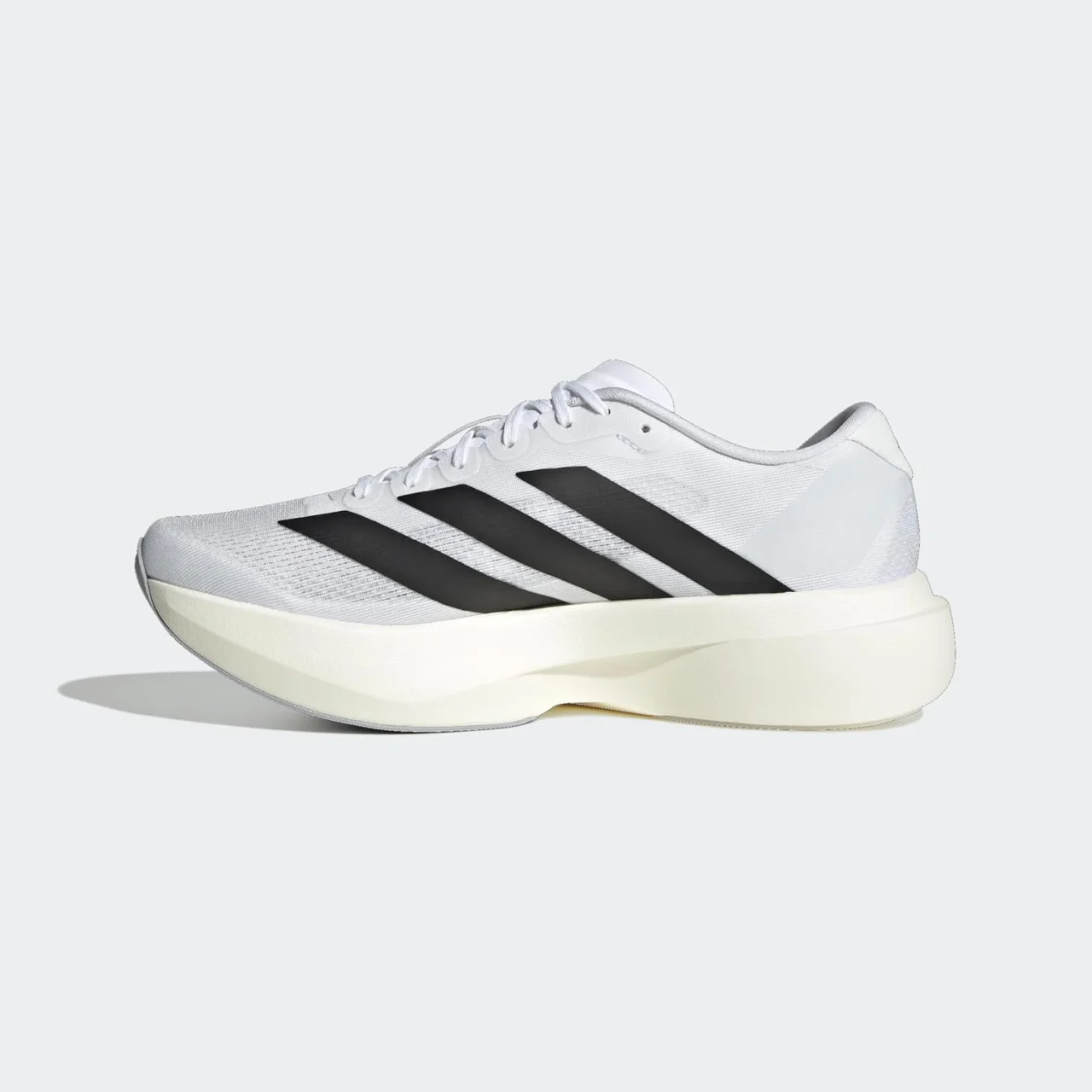
adidas Adizero Evo SL
The original breakout super-trainer — full-length Lightstrike Pro, no plate, ~224 g. Watch for sale prices well under the $150 retail.
The Adizero Evo SL EXO: the lockdown edition
Here’s the thing about the EXO: adidas didn’t redesign the Evo SL. They fixed its one recurring complaint. Everything runners loved about the original — the foam, the rocker, the weight, the price — is untouched. The EXO keeps the exact same full-length Lightstrike Pro midsole, the same 39/33 mm stack, the same aggressive rocker geometry, and the same $150 sticker.
What changed is the container. Out goes the simple engineered-mesh upper; in comes a lightweight woven textile shell wrapped in an external TPU exoskeleton — overlays that cage the midfoot and lock the foot down from heel to toe. Adidas pairs it with an ultra-thin gusseted tongue for a precise, low-profile fit. The goal, per every retailer description, is better lockdown and midfoot stability during faster running without meaningfully adding weight.
And the weight claim mostly holds. Adidas lists the men’s EXO at around 224 g (UK 8.5), essentially matching the original; some retailers weigh samples a few grams heavier at ~231 g in a US 9.5. Either way, we’re talking about a difference you’d never feel on foot — the cage doesn’t turn this into a heavy stability shoe.
Fit-wise, the EXO runs true to size but noticeably more secure and performance-oriented than the standard Evo SL, according to specialty-store fit notes. If the original’s airy upper ever let your foot slide on corners or hard efforts, the EXO is the direct answer.
Evo SL EXO specs
| Spec | Adizero Evo SL EXO |
|---|---|
| Retail price | $150 |
| Weight (men’s) | ~224 g (adidas spec, UK 8.5); retailers report ~231 g (US 9.5) |
| Stack height | 39 mm heel / 33 mm forefoot |
| Drop | ~6 mm (adidas); some retailers list 6.5–7 mm |
| Midsole | Full-length Lightstrike Pro — same as standard Evo SL |
| Plate | None |
| Upper | Woven textile shell with external TPU exoskeleton overlays |
| Tongue | Ultra-thin gusseted tongue |
| Outsole | Continental rubber patches |
| Support | Neutral |
| Surface | Road, track |
| Launch date | March 1, 2026 |
| Style codes | KI4763, KI4764, KI4782, KJ0422, KJ0430, LC1933 (among others) |
Who the EXO is for
- Runners who liked the Evo SL but wanted more hold — this is the entire reason the shoe exists.
- Speed-day trainers who do intervals and tempos in their daily shoe and want the upper to keep up with the foam.
- Narrow-to-medium feet that appreciate a precise, locked-in fit rather than a roomy one.
- Style-conscious runners — the exoskeleton cage gives the EXO a bolder, more technical look than the plain original.
EXO strengths and weaknesses
- Strengths: same beloved ride and foam as the original; noticeably more secure midfoot lockdown; barely any weight penalty; same $150 price; still plate-free and versatile.
- Weaknesses: if you loved the airy minimal feel, the cage may feel like overkill; less breathability potential from the structured upper; newer, so discounts are rare; doesn’t fix the Evo SL’s inherent stability limits (it’s still a neutral shoe with a rocker).
adidas Adizero Evo SL EXO
The lockdown edition — identical Lightstrike Pro ride with an exoskeleton upper. Search current listings, since colorways and stock rotate fast.
✅ What stayed identical
- Full-length Lightstrike Pro midsole
- 39 mm heel / 33 mm forefoot stack
- ~6–6.5 mm drop
- Continental rubber outsole patches
- $150 retail price, neutral support
🔶 What actually changed
- Upper: engineered mesh → woven shell + external TPU exoskeleton
- Tongue: standard → ultra-thin gusseted
- Weight: ~224 g → ~224–231 g (effectively identical)
- Street price: original often ~$110 on sale; EXO rarely discounted
- Fit: noticeably more locked-down for faster efforts
Head to head: the only real differences
Let’s be blunt: this is one of the easiest comparisons in running shoes, because there is almost nothing to compare underfoot. The midsole, stack, drop, plate (none), outsole rubber and support category are the same. The entire decision comes down to the upper and the wallet.
| Round | Winner | Why |
|---|---|---|
| Cushioning and ride | Tie | Identical Lightstrike Pro midsole and geometry — the ride is the same shoe. |
| Fit and lockdown | EXO | The exoskeleton cage and gusseted tongue hold the midfoot noticeably better at speed. |
| Breathability / minimal feel | Evo SL | The simple engineered mesh is airier and less structured. |
| Weight | Tie | ~224 g vs ~224–231 g — a rounding error. |
| Value | Evo SL | A year of discounts has it hovering near $110; the EXO rarely dips below $150. |
| Style | Subjective | EXO looks more technical and aggressive; the original is cleaner and more minimal. |
| Versatility | Tie | Same easy-day-to-tempo range on both. |
🏃 Evo SL vs EXO: Pick Your Runner Profile
Verdict: which Evo SL should you buy?
After a year of the original winning “best value trainer” plaudits and the EXO quietly fixing its fit, the decision tree is refreshingly simple:
- Buy the Adizero Evo SL EXO if you tried the original and your foot moved around in it, you regularly do faster workouts in your daily trainer, or you want the most secure version of this ride and don’t mind paying full retail.
- Buy the standard Adizero Evo SL if you want the same ride for less money, you liked (or never minded) the minimal upper, you run mostly easy miles, or you find the EXO’s cage visually or physically overbuilt.
There’s no wrong answer here — you’re choosing between two versions of the same excellent foam. The EXO is the refined sequel; the original is the bargain. Pick the one whose upper matches your foot, and whose price matches your patience for sales.
Buying tips: making sure you get the right shoe
The EXO’s quiet launch means listings can still be confusing, so a little verification goes a long way:
- Check the style code. A genuine EXO carries its own adidas style code — KI4763, KI4764, KI4782, KJ0422, KJ0430 and LC1933 are confirmed examples. If a listing claims “EXO” but shows a standard Evo SL style code, treat it as a mislabeled standard shoe.
- Look at the upper in photos. The EXO’s exoskeleton overlays are visible: external TPU strips wrapping the midfoot over a woven shell. A plain engineered-mesh upper with an “EXO” title is the classic mislabel.
- Compare prices skeptically. The EXO retails at $150 and rarely discounts below that. A “brand new EXO” listed far under $100 deserves the same scrutiny you’d give any too-good-to-be-true sneaker deal.
- Buy from authorized sellers when it matters. adidas, JD Sports, and established specialty run shops all stock the EXO. Marketplace listings are fine too — just verify the style code and photos first, and use a seller with a real return window.
One more thing worth knowing: because the EXO shares the standard model’s tooling and price, some sellers use the two names interchangeably in titles to catch search traffic. If the photos, style code, and description disagree with each other, the photos and style code win — always.
Bonus: the third sibling — Evo SL Zip
Completing the family is the Adizero Evo SL Zip, released July 6, 2026 at $150. It keeps the same Lightstrike Pro midsole (38/32 mm stack, 6 mm drop, ~230 g men’s) but hides the laces under a tongue-length zipper shroud inspired by early-2000s adidas track spikes. Think of it as the style-forward sibling: same engine, fashion-first upper. If the EXO is the fit upgrade, the Zip is the attitude upgrade.

Frequently asked questions
Is the Adidas Adizero Evo SL EXO a real shoe?
What is the difference between the Evo SL and the Evo SL EXO?
Does the Evo SL EXO have a carbon plate?
How much does the Evo SL EXO weigh?
What is the stack height and drop of the Evo SL EXO?
How much does the Evo SL EXO cost?
Is the Evo SL EXO good for daily training?
Does the Evo SL EXO fit true to size?
What is the Evo SL Zip?
Which should I buy: Evo SL, Evo SL EXO, or wait?